In the realm of financial reporting, change is the constant that keeps organizations agile and transparent. One such transformative change is the introduction of the Accounting Standards Codification (ASC) 842 — the lease accounting standard. Underst
Implementing the standard comes down to four things: find every contract that contains a lease, abstract the terms that drive the calculation, choose a transition method and the expedients you will elect, then record the opening balances and build a process that keeps them accurate. Most of the work is data, not accounting.
If you are on a real estate team, your part is the lease inventory and the terms behind it, including the renewal options nobody wrote down. If you are on a finance team, your part is the transition method, the discount rates, and the disclosures. For background on the standard itself, start with the ASC 842 guide.
On this page:
- What implementation actually involves
- Step 1: Build the project team
- Step 2: Find every lease, including the embedded ones
- Step 3: Abstract the data that drives the calculation
- Step 4: Choose your transition method
- Step 5: Decide which practical expedients to elect
- Step 6: Set your discount rates
- Step 7: Classify each lease
- Step 8: Calculate and record the transition entries
- Step 9: Build the ongoing process
- A worked transition entry
- Where implementations go wrong
- How long implementation takes
- FAQs
What Implementation Actually Involves
The calculation is arithmetic. The difficulty is that the inputs live in filing cabinets, in the heads of regional managers, and in contracts nobody filed as leases. Companies that finish on time treat this as a data project with an accounting deadline attached.
The standard has been effective for years: public business entities adopted for fiscal years beginning after December 15, 2018, and all other entities for fiscal years beginning after December 15, 2021. Companies still implementing are usually doing it because they crossed an audit threshold, took on debt with reporting covenants, are preparing for a transaction, or acquired an entity that never adopted properly.
Step 1: Build the Project Team
Implementation fails when it sits with one person in accounting. At minimum, the team needs finance to own the calculations and disclosures, real estate or facilities to own the lease inventory and the terms, legal to interpret contract language, procurement to surface service contracts that may contain embedded leases, and IT to handle the system and the data.
Name one person accountable for the lease inventory being complete. That accountability is the single best predictor of whether the deadline holds.
Step 2: Find Every Lease, Including the Embedded Ones
Real estate is the easy part. The misses are elsewhere.
- Vehicles, forklifts, and equipment financed through leases
- Copiers, IT hardware, and lab equipment
- Storage units, billboards, cell tower sites, and parking
- Service contracts with a specified asset the supplier cannot substitute, which are the classic embedded leases: warehousing and logistics agreements, dedicated transportation, managed print, and some data center or hosting arrangements
A contract contains a lease when it conveys the right to control the use of an identified asset for a period of time in exchange for consideration. Two tests decide it: the customer gets substantially all the economic benefits from using the asset, and the customer directs how and for what purpose it is used.
Practical way to find them: pull the general ledger for recurring payments to vendors, filter for anything paid monthly to the same party for the same amount, and read the contract behind each one.
Step 3: Abstract the Data That Drives the Calculation
For each lease, pull these fields. This is the part that takes the longest, and it is what lease abstraction means in practice.
Step 4: Choose Your Transition Method
ASC 842 requires a modified retrospective transition. Full retrospective restatement is not permitted. What you are choosing between is two application options within that transition.
Most companies elect the optional transition method, because it removes the need to recalculate prior periods. The comparative method is worth considering when comparability across years matters to lenders or investors, or when the company is preparing for a transaction where restated comparatives are expected.
Step 5: Decide Which Practical Expedients to Elect
Elections have to be documented, and several apply to a whole class of assets rather than to individual leases.
- The package of three. Elected together, not individually: no reassessment of whether expired or existing contracts contain leases, no reassessment of lease classification, and no reassessment of initial direct costs. This is the expedient that saves the most work at transition.
- Hindsight. Permits using what you now know about renewals, terminations, and purchase options when determining lease term and assessing ROU asset impairment. It can be elected separately from the package, and it cuts both ways: it can extend terms you would otherwise have treated as short.
- Land easements. Allows not reassessing existing or expired land easements that were not previously accounted for as leases.
- Short-term lease policy election. Leases of twelve months or less with no purchase option reasonably certain of exercise can be kept off the balance sheet. Elected by class of underlying asset, and the expense is disclosed.
- Combining lease and non-lease components. Elected by class of underlying asset. Simpler, and it increases the liability, because service costs get discounted along with rent.
- Risk-free rate election. Available to entities that are not public business entities, by class of underlying asset. Simpler than deriving an incremental borrowing rate, and it usually produces a lower rate, which means a larger liability.
Step 6: Set Your Discount Rates
Use the rate implicit in the lease if it is readily determinable. For most tenants it is not, because it depends on the lessor's assumptions about residual value. The fallback is the incremental borrowing rate: what the company would pay to borrow, on a collateralized basis, over a similar term, in a similar economic environment, for an amount equal to the lease payments.
Rates should reflect the term of each lease rather than one company-wide number, and they need to be documented well enough to explain to an auditor a year later. Entities that are not public business entities may elect the risk-free rate by class of asset instead.
Step 7: Classify Each Lease
Classification happens at commencement and drives the expense pattern. A lease is a finance lease if any one of five criteria is met: ownership transfers by the end of the term, there is a purchase option reasonably certain of exercise, the term is for the major part of the asset's remaining economic life, the present value of payments and any residual value guarantee equals or exceeds substantially all of the asset's fair value, or the asset is so specialized it has no alternative use to the lessor at the end of the term.
Everything else is an operating lease. Both sit on the balance sheet. The difference is the income statement: an operating lease produces a single straight-line lease cost, while a finance lease produces amortization plus interest, which front-loads expense.
Step 8: Calculate and Record the Transition Entries
For each lease, measure the liability as the present value of the remaining payments at the date of initial application, then measure the right-of-use asset as that liability adjusted for existing balances: less deferred rent and unamortized lease incentives, plus prepaid rent and unamortized initial direct costs.
A Worked Transition Entry
A company adopts using the optional transition method on January 1. One operating lease remains, with four years left, annual payments of $120,000 in arrears, and an incremental borrowing rate of 6%. Under ASC 840 the books carry $18,000 of deferred rent from straight-lining escalations.
- Present value of four payments of $120,000 at 6%: $415,813
- Lease liability recognized: $415,813
- ROU asset: $415,813 less $18,000 of deferred rent, or $397,813
The entry on the date of initial application:
Deferred rent is cleared because it now lives inside the ROU asset. No adjustment to retained earnings arises in this example, since the operating lease expense pattern does not change. For the entries after transition, see our guide to ROU asset journal entries.
Step 9: Build the Ongoing Process
Adoption is a project. Compliance is a routine, and it is where most companies quietly fall out of compliance in year two.
- A path for new leases to reach finance before they are signed, not at close
- A quarterly review of modifications, renewals exercised, and terminations, each of which can trigger remeasurement
- Owner and cadence for reassessing whether optional periods are now reasonably certain
- Reconciliation of the lease schedule to the general ledger every period
- Disclosure inputs maintained continuously: maturity table, weighted average remaining lease term, weighted average discount rate, and the cash flow supplemental amounts
- A rule for embedded leases in new procurement contracts
Where Implementations Go Wrong
- An incomplete inventory. Embedded leases and equipment leases are the usual gaps, and they surface during the audit rather than during the project.
- Undocumented discount rates. A rate no one can reconstruct becomes an audit finding.
- Renewal options assessed once. Reasonably certain is a judgment that changes, and it is required to be reassessed when a significant event within the company's control occurs.
- Modifications handled as new leases. A modification that is not a separate contract requires remeasurement of the existing lease, not a fresh one.
- Non-lease components ignored. If the expedient to combine was not elected, service costs have to be separated.
- Data that stops being maintained. The lease schedule matches the leases on day one and drifts from there unless someone owns it.
- International entities on the wrong standard. IFRS 16 classifies differently, so a consolidated group may need both.
How Long Implementation Takes
For a portfolio of fifty leases or fewer with reasonable records, a focused team can finish in six to ten weeks, and most of that is abstraction. Portfolios in the hundreds, or portfolios where lease documents are scattered across regions, run a quarter or more. The variable is almost never the accounting. It is how long it takes to find the leases and confirm the terms.
Why This Matters for Real Estate and Finance Teams Together
Implementation exposes the split that already existed. Real estate holds the leases and the terms. Finance owns the numbers and the deadline. When the lease data lives in one team's spreadsheets, adoption becomes a months-long request queue, and the same queue reappears at every close afterward.
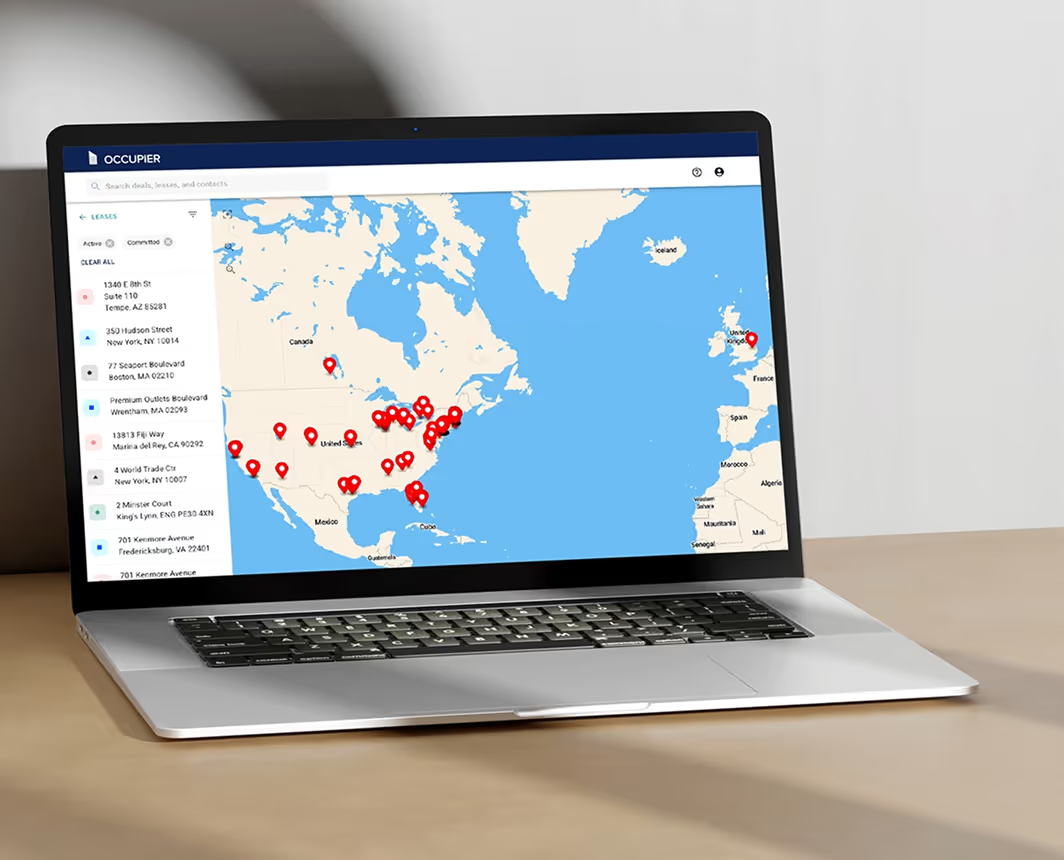
Occupier holds the lease documents, the abstracted terms, and the ASC 842 calculations in one place, so the inventory built during implementation stays accurate afterward instead of decaying into a static file.
One platform. Two teams. Zero compromise.
See how Occupier turns lease terms into audit-ready entries →
ASC 842 Implementation FAQs
What transition methods does ASC 842 allow? Only modified retrospective. Within it, a company either applies the standard from the beginning of the earliest comparative period presented, or uses the optional transition method and applies it at the effective date with a cumulative-effect adjustment to opening retained earnings, leaving prior periods under ASC 840. Full retrospective restatement is not permitted.
What is the package of practical expedients? Three elections taken together: not reassessing whether existing or expired contracts contain leases, not reassessing lease classification, and not reassessing initial direct costs. It is the most commonly elected relief at transition.
Can we elect hindsight without the package? Yes. Hindsight is a separate election covering lease term determination and ROU asset impairment assessment, and it can be elected independently.
Do short-term leases have to go on the balance sheet? Not if the policy election is taken. Leases of twelve months or less with no purchase option reasonably certain of exercise can be excluded, elected by class of underlying asset, with the short-term lease cost disclosed.
What discount rate should a private company use? The rate implicit in the lease if it is readily determinable, otherwise the incremental borrowing rate. Entities that are not public business entities may elect a risk-free rate by class of underlying asset instead, which is simpler but generally produces a larger liability.
How do we handle embedded leases? Identify contracts that convey the right to control an identified asset, separate the lease component from the service component unless the expedient to combine was elected, and account for the lease component under ASC 842. Recurring vendor payments in the general ledger are the fastest way to find candidates.
What happens to deferred rent at transition? It is cleared against the ROU asset. The liability is the present value of remaining payments, and the ROU asset is that amount adjusted for deferred rent, prepaid rent, unamortized incentives, and unamortized initial direct costs.
Do we need software to implement ASC 842? Not for a small, stable portfolio. Software becomes necessary when leases change frequently, when several people maintain the data, or when the audit trail has to be reconstructed rather than retrieved.

Lease management that works for real estate and finance
15,000 sq ft
90 days notice
March 2026
Action required