Lease impairment happens when a right-of-use (ROU) asset’s recoverable value drops below its carrying value on the balance sheet, typically because the space or equipment is no longer worth what the company expected when it signed the lease. Under ASC 842, lessees have to test the ROU asset for impairment whenever specific indicators are present, using the same long-lived asset impairment guidance in ASC 360 that applies to other noncurrent assets. When impairment is confirmed, the company writes the ROU asset down to its recoverable amount and recognizes a loss, while the lease liability keeps accruing on its original schedule.
If you’re on a real estate team, impairment is usually triggered by a decision you’re already close to: downsizing, subleasing, or exiting a location. If you’re on a finance team, it’s a calculation that depends entirely on getting that decision, and its financial detail, in time to run the test correctly.
What Is Lease Impairment?
When a company leases an asset, office space, retail space, equipment, delivery trucks, it records a right-of-use asset and a lease liability on its balance sheet under ASC 842. Lease impairment is what happens when circumstances change enough that the ROU asset’s recoverable value falls below its carrying value, the amount still sitting on the balance sheet. When that happens, the lessee has to write the asset down and recognize a loss.
Occupier customers can also find the quick-reference version in our help center article on impairments.
Lease Impairment vs. Depreciation
These get confused because both reduce an asset’s carrying value over time, but they reflect very different things. Amortization (the ROU asset equivalent of depreciation) follows a predictable, scheduled reduction over the lease term, the expected, planned decline in value as the lease is used up. Impairment is the opposite: an unscheduled, unexpected write-down triggered by something nobody planned for when the lease was signed, a downsizing decision, a facility that’s no longer needed, or a market shift that makes a location worth less than the books say. Amortization happens regardless of how business is going. Impairment only happens when something changes.
Impairment Indicators for Right-of-Use Assets
Under ASC 842, lessees are required to review ROU assets for impairment whenever indicators are present. Common indicators include:
- A significant decrease in the asset’s fair value
- A significant change in how the asset will be used, or plans to change that use
- Worse-than-expected operating performance tied to the space or equipment
- Plans to sublease the space or exit the lease early
If any of these are present, the lessee has to test the ROU asset for impairment, not wait for a scheduled review.
The Two-Step Impairment Test Under ASC 360
This is the step worth getting precisely right, since it’s easy to conflate with a simpler version of the test. Under US GAAP (ASC 360, which governs ROU asset impairment the same way it governs other long-lived assets), the test happens in two distinct steps:
Step 1: Test for recoverability. Compare the ROU asset’s carrying value to the sum of the undiscounted future cash flows expected from using it. If the carrying value is less than or equal to those undiscounted cash flows, the asset is considered recoverable and no impairment is recorded, even if there’s been some decline in value. If the carrying value exceeds the undiscounted cash flows, move to Step 2.
Step 2: Measure the impairment. Calculate the loss as the carrying value minus the asset’s fair value (not value-in-use, and not the undiscounted cash flow figure from Step 1). That difference is the impairment loss.
This two-step structure matters because it’s easy to skip straight to comparing carrying value against a discounted cash flow or “value in use” figure, which is closer to how IFRS approaches impairment. Under US GAAP, the recoverability test specifically uses undiscounted cash flows, and only the measurement step brings in fair value.
Worked Example: Calculating a Lease Impairment
A company leases office space with 10 years remaining on the term. The ROU asset has a carrying value of $5 million; the lease liability is $6 million. The company decides to downsize operations and sublease part of the space.
Step 1 (recoverability): Management estimates the undiscounted future cash flows the company will realize from continuing to use the space (including sublease income) at $3.5 million, well below the $5 million carrying value. The asset fails the recoverability test, so the company proceeds to Step 2.
Step 2 (measurement): The recoverable amount is separately determined to be $3.5 million in fair value. The impairment loss is:
Impairment Loss = Carrying Value ($5,000,000) − Fair Value ($3,500,000) = $1,500,000
The journal entry:
- Debit Impairment Loss: $1,500,000
- Credit Right-of-Use Asset: $1,500,000
The ROU asset is written down from $5 million to $3.5 million. Going forward, remaining amortization is calculated on that new, lower balance over the remaining lease term. The write-down entry itself (debit impairment loss, credit ROU asset) sits alongside the regular lease entries covered in our ROU asset journal entries guide.
A note on where this loss shows up: it’s recognized within operating expenses on the income statement, reducing net income for the period. Whether a company adds it back when calculating a non-GAAP metric like Adjusted EBITDA is a reporting choice some companies make, not a GAAP requirement, and it’s worth checking your own company’s policy before assuming it’s excluded.
What Happens to the Lease Liability When the ROU Asset Is Impaired?
The lease liability isn’t reduced by the impairment. The company still owes the same future lease payments regardless of whether the space is being fully used, subleased, or sitting empty, so the liability continues accruing on its original schedule. Impairment only affects the asset side of the entry; it doesn’t change what you owe.
Can a Lease Impairment Be Reversed?
No, not under US GAAP. Once an impairment loss is recognized, it establishes a new, lower cost basis for the ROU asset, and that write-down can’t be reversed in a future period even if the space’s value later recovers. This is a real point of divergence from IFRS, which permits impairment reversals under certain circumstances. If your company reports under both frameworks, this is one of the places the two sets of books can genuinely diverge, not just in presentation.
Building a Process to Catch Impairment Indicators Early
Lease impairment accounting depends on catching the indicators early and documenting the test consistently. That typically means:
- Maintaining a lease management system that tracks every leased asset and any potential impairment triggers
- Designating someone responsible for monitoring leasing activity and flagging possible indicators
- Writing a clear internal policy defining what counts as an impairment indicator for your organization
- Running periodic impairment reviews on a set schedule, not just reactively
- Requiring accounting or finance sign-off on any impairment test performed
- Feeding impairment considerations into the budgeting and forecasting cycle, not treating them as a separate exercise
- Training both accounting and operational staff, including real estate, on what triggers a review
- Auditing the impairment process itself periodically, not just the individual calculations
Getting this wrong isn’t a minor error. Improperly accounting for ROU asset impairment can lead to a material misstatement of the company’s financial position, which is exactly the kind of finding that turns into an audit problem.
Why This Is Where Real Estate and Finance Coordination Matters Most
Impairment is one of the clearest examples of the two-team compliance gap in action. The decision that triggers an impairment test, downsizing, subleasing, exiting a location, almost always originates on the real estate side. The test itself, and the resulting journal entry, is entirely finance’s responsibility. If that decision doesn’t reach finance until weeks later, the impairment gets recorded a quarter late, on numbers that may already be stale.
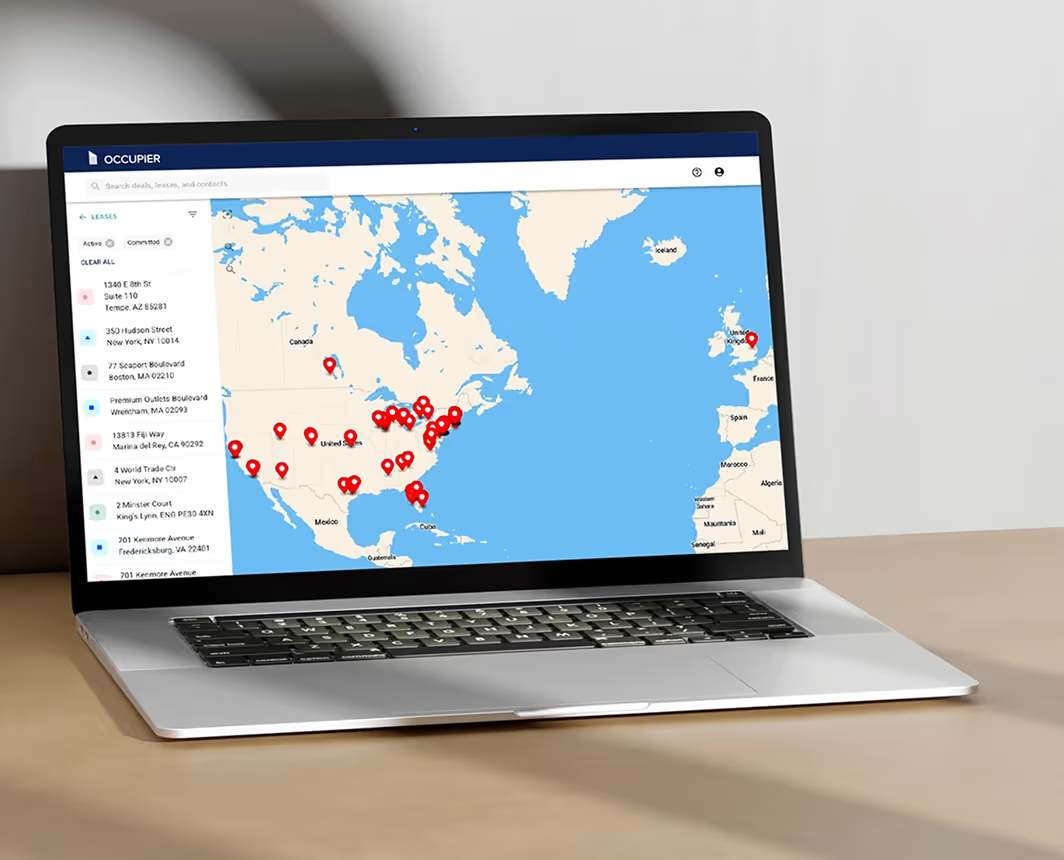
Occupier closes that gap by keeping real estate’s lease decisions and finance’s accounting on the same platform, so a sublease plan or an exit decision is visible to the team running the impairment test the moment it’s real, not after the fact.
See how Occupier keeps lease decisions and accounting in sync →
Lease Impairment FAQs
What triggers a lease impairment test? A significant decline in the asset’s fair value, a change in how the space or equipment will be used, underperformance relative to expectations, or plans to sublease or exit the lease early.
Is ROU asset impairment the same as goodwill impairment? No. Goodwill impairment is governed by ASC 350 and follows a different test (goodwill requires annual testing regardless of indicators). ROU asset impairment follows ASC 360, the same guidance used for other long-lived assets, and is only tested when indicators are present.
Does impairing the ROU asset reduce the lease liability? No. The lease liability represents the remaining obligation to make lease payments and continues on its original schedule regardless of the impairment. Only the asset side of the entry is affected.
What’s the difference between lease impairment and amortization? Amortization is a scheduled, predictable reduction in the ROU asset’s value over the lease term. Impairment is an unscheduled write-down triggered by an unexpected change in circumstances.
Can a company reverse a lease impairment if the space’s value recovers? No, not under US GAAP. Once recognized, the write-down establishes a new cost basis that can’t be reversed in a later period. IFRS permits reversal under certain conditions, which is a real difference between the two frameworks, not just a presentation one.
How is a lease impairment loss measured under ASC 360? In two steps: first, a recoverability test comparing the carrying value to undiscounted future cash flows; if the asset fails that test, the loss is measured as carrying value minus fair value.



Lease management that works for real estate and finance
15,000 sq ft
90 days notice
March 2026
Action required