AI in Commercial Real Estate: 7 Use Cases in 2026
How Is AI Used in Commercial Real Estate?
AI is used for lease abstraction, document analysis, market research, property valuation support, portfolio reporting, building operations, and predictive maintenance. Its role is to help professionals process information and support decisions across different real estate activities.
Artificial intelligence is changing how commercial real estate teams manage information, evaluate properties, and make decisions. From reviewing lengthy lease agreements to analyzing market conditions, AI helps professionals work with information that once required hours of manual research.
For businesses managing multiple commercial locations, these capabilities are particularly useful. A single lease can contain dozens of financial terms, deadlines, and responsibilities. Multiply that across a portfolio of offices, retail stores, or restaurants, and keeping information accurate becomes a significant responsibility.
In 2026, AI in commercial real estate has moved beyond basic chatbots and predictive models. New applications can extract lease obligations, organize contractual information, support portfolio analysis, and help building operators understand how properties are being used. The value comes from making existing real estate workflows more efficient while keeping important decisions in the hands of experienced professionals.
How Is AI Used in Commercial Real Estate?
AI in commercial real estate refers to the use of machine learning, natural language processing, predictive analytics, and other AI technologies to support property-related activities.
These systems can analyze large amounts of information, recognize patterns, interpret documents, and help automate repetitive tasks. Their applications range from commercial leasing and property management to investment analysis, building operations, and site selection.
For example, a real estate team managing 100 locations may need to identify which leases contain certain maintenance obligations. Traditionally, that could involve searching through individual agreements and reviewing each relevant clause.
AI-powered lease technology can help organize the information and make it searchable, allowing professionals to spend less time locating records and more time evaluating what those obligations mean for their business.
However, not every automated real estate process uses AI. A system that sends reminders on predetermined dates is performing rule-based automation. AI becomes particularly useful when software must interpret unstructured information, identify patterns, or generate insights from different sources.
7 Practical AI Use Cases in Commercial Real Estate in 2026
AI is being applied across several parts of the commercial real estate lifecycle. Some applications help businesses make decisions before signing a lease, while others support ongoing administration, accounting, and property operations.
1. AI-Powered Lease Abstraction
Commercial lease agreements can run dozens or even hundreds of pages. They contain important information about rent payments, renewal options, maintenance responsibilities, termination rights, and operating expenses.
Extracting this information manually takes time, especially when lease portfolios contain multiple amendments and different contract formats.
AI-powered lease abstraction uses document processing and language models to identify relevant terms and organize them into structured records.
Consider a restaurant company acquiring 40 existing locations. Its real estate team needs to collect the leases, identify upcoming expirations, review rent schedules, and establish who is responsible for different property expenses.
Rather than entering every detail manually, the team can use AI to generate initial lease records and direct reviewers toward terms that need confirmation.
The important distinction is that AI extraction should support the review process, not replace it. Incorrect dates or misunderstood clauses can affect financial decisions and contractual obligations.
For more information about the process, see Occupier's guide to lease abstraction.
2. Lease Clause Analysis and Responsibility Mapping
One of the more practical developments in 2026 is the ability to turn complex lease language into information that can be analyzed across an entire portfolio.
Commercial leases often assign responsibilities differently. One agreement may require the landlord to maintain the HVAC system, while another places that obligation on the tenant. Similar differences can apply to insurance, structural repairs, signage, and common area maintenance.
In April 2026, Occupier announced AI Clause Intelligence and AI Responsibilities Mapping, two features designed to help commercial tenants interpret lease provisions and organize contractual responsibilities.
AI Clause Intelligence generates summaries of dense lease language. Responsibilities Mapping identifies proposed landlord and tenant obligations and organizes accepted information into searchable records.
For example, a facilities manager could review which locations assign HVAC maintenance to the landlord before preparing a portfolio-wide maintenance plan.
The process still includes human review. Users verify proposed responsibilities before accepting them, and the original contractual language remains important when making legal or financial decisions.
These applications demonstrate how AI is moving beyond document storage toward making existing lease information more accessible and useful.
3. AI-Assisted Lease Negotiations
Commercial lease negotiations require an understanding of market conditions, rental rates, operating expenses, and contractual flexibility.
AI can support the research involved in these decisions by identifying relevant provisions, comparing structured financial information, and helping teams review historical transaction data.
Consider a retailer approaching a lease renewal. Its existing agreement includes annual rent increases, a renewal option, and responsibilities for certain building repairs.
AI-assisted tools may help the real estate team locate the relevant clauses and organize information for comparison with alternative locations.
This gives brokers and real estate managers a clearer starting point for negotiations.
However, AI cannot determine the best lease terms without understanding the business's priorities, financial constraints, and the specific property market. Negotiation strategy still depends on professional experience, reliable comparable data, and the circumstances of each transaction.
The most useful role for AI is supporting preparation and analysis while allowing people to make the final decisions.
4. Portfolio Analysis and Real Estate Planning
Businesses managing multiple locations need to understand how their portfolio is changing.
That may involve reviewing lease expirations, upcoming rent increases, occupancy costs, location performance, and potential consolidation opportunities.
AI can help analyze structured portfolio information and identify patterns that deserve attention.
For example, a company may discover that several locations in the same market have leases expiring within a relatively short period. Identifying those dates together can help the real estate team consider negotiations, relocations, or alternative space requirements before deadlines become urgent.
AI can also assist with scenario analysis when reliable financial, operational, and market data are available.
This application is becoming increasingly relevant as corporate real estate strategies respond to changing business requirements.
In its August 2026 research, JLL reported that 78% of surveyed business and corporate real estate leaders believe AI will significantly affect portfolio strategies and the CRE function over the next three to five years.
The challenge for real estate teams is translating that expectation into practical decisions about space, costs, and future flexibility.
5. AI for Site Selection and Market Analysis
Choosing a commercial location requires evaluating more than available square footage and rental rates.
Retailers and restaurant operators often examine customer demographics, traffic patterns, nearby competitors, accessibility, and the performance of existing locations.
AI and predictive analytics can help process these different datasets and identify potential relationships.
For instance, a fitness company evaluating three neighborhoods may use location intelligence to compare population characteristics, consumer activity, and the presence of competing facilities.
Some platforms also provide predictive models that estimate sales potential or assign scores to prospective sites.
These results are useful for comparing opportunities, but they depend on the quality of the underlying information and the assumptions used by the model.
A strong location score does not eliminate the need for property inspections, financial analysis, or discussions with local brokers.
Businesses evaluating these capabilities can compare specialized site selection software before deciding which analytical tools fit their expansion strategy.
6. AI-Powered Building Operations and Predictive Maintenance
Artificial intelligence is also being used to improve how commercial buildings operate.
Connected building systems collect information about temperature, energy consumption, equipment performance, occupancy, and environmental conditions.
AI can analyze this information to identify unusual patterns, support maintenance planning, and recommend operational adjustments.
For example, a building management system may detect equipment behavior associated with a potential fault. Facilities teams can investigate the issue before it develops into a more disruptive failure.
In June 2026, Siemens introduced an AI-based scheduling recommendation capability within its Building X Occupancy Manager. The beta feature analyzes forecast occupancy patterns and suggests building schedules over a two-week period.
Its September 2026 release also introduced a Fault Triage Agent to support investigation of building system faults and their potential causes.
These applications show how AI can assist building operators with maintenance and energy planning. However, recommended actions still need to be evaluated against actual equipment requirements, operating conditions, and occupant needs.
7. AI in Lease Accounting and Financial Reporting
Real estate and finance teams rely on accurate lease information to maintain financial records.
Under standards such as ASC 842, organizations must account for applicable leases using recognized lease liabilities, right-of-use assets, and supporting financial information.
AI can help prepare the underlying data by extracting contractual terms, identifying relevant amendments, and organizing information that finance teams need for review.
For example, when a commercial lease is modified, finance may need to determine whether the change requires remeasurement or another accounting adjustment.
An AI-supported system can help locate the amended provisions and highlight differences from the previous agreement.
However, extracting information is not the same as making an accounting determination. Lease classification, discount rate decisions, remeasurement, and financial reporting must follow the applicable accounting standard and the organization's documented policies.
Understanding the requirements of ASC 842 lease accounting remains essential, regardless of how much of the data preparation process is automated.
Real-World Examples of AI in Commercial Real Estate in 2026
The following developments illustrate how real estate companies are applying AI to specific operational problems.
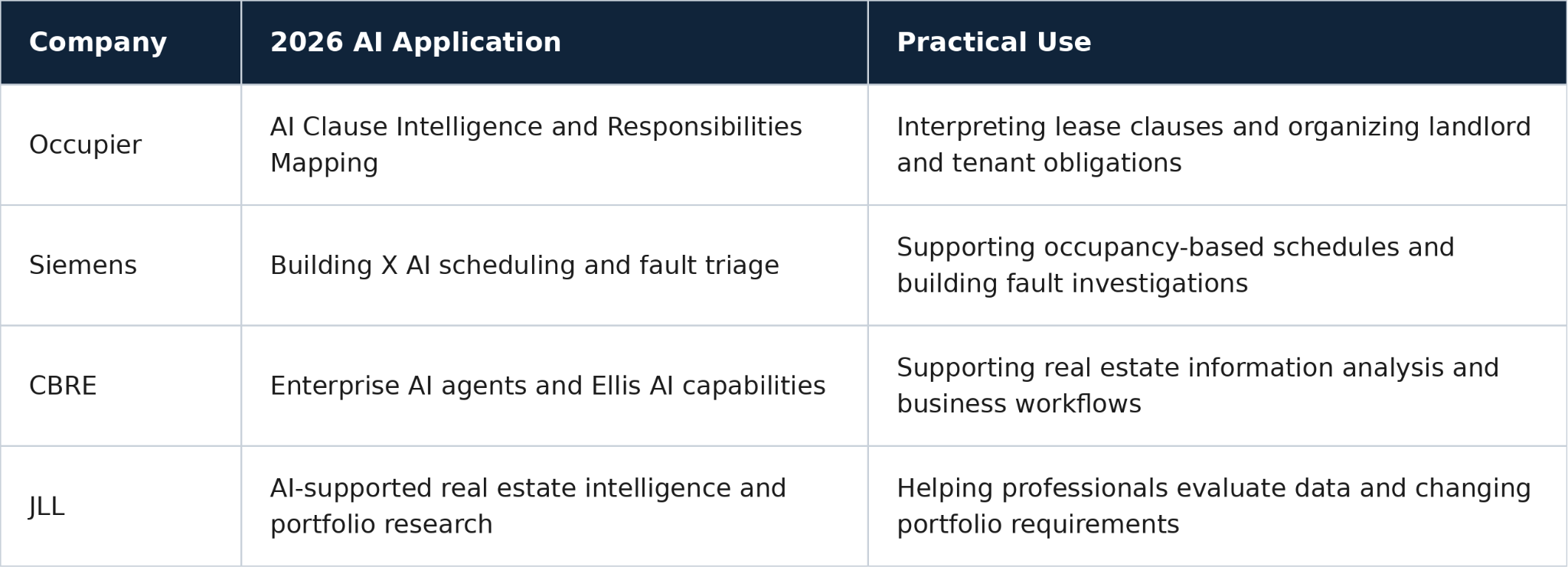
Occupier's lease intelligence: Its 2026 AI features help real estate and finance teams work with contractual information already contained in their lease records. The focus is on turning complex clauses into reviewed, structured information that can support portfolio reporting.
Siemens' building operations: Its 2026 Building X updates demonstrate how occupancy forecasting and AI-assisted fault analysis can support facilities management decisions.
CBRE's enterprise AI development: In September 2026, CBRE announced a collaboration involving McKinsey and Google Cloud to develop and scale enterprise AI agents. The initiative reflects a broader shift toward embedding AI in professional workflows rather than using standalone chat interfaces.
JLL's portfolio intelligence: JLL's 2026 research examines how AI adoption is changing workforce planning and corporate real estate decisions. Its work highlights the growing importance of aligning long-term property commitments with faster-changing business needs.
These examples show that commercial real estate AI is not one product category. Different systems address document analysis, portfolio strategy, building operations, and organizational workflows.
What Are the Benefits of AI in Commercial Real Estate?
The benefits of AI depend on how well the technology fits an organization's existing responsibilities.
Less Time Spent on Repetitive Work
Real estate teams regularly review documents, prepare reports, update records, and search for information across large portfolios.
AI can assist with these activities by extracting data, generating summaries, and organizing information for review.
That allows employees to devote more attention to work that requires direct communication, negotiation, or business judgment.
Better Access to Lease and Portfolio Information
A commercial tenant may have hundreds of agreements with different financial terms, notice periods, and operating responsibilities.
When relevant information is difficult to locate, even straightforward questions can require substantial research.
AI-assisted search and structured lease records can help teams locate information more efficiently, provided the source data is accurate and accessible.
More Consistent Collaboration
Real estate decisions affect finance, legal, facilities, and operations teams.
If different departments maintain separate records, changes to agreements may not reach everyone who needs the information.
AI becomes more useful when it operates within shared systems where employees can review the same underlying records and understand how information was obtained.
Earlier Identification of Potential Problems
AI can highlight possible discrepancies, unusual patterns, or information that requires further investigation.
For example, a lease analysis tool may surface clauses assigning unexpected responsibilities to the tenant. A building analytics platform may identify equipment behavior that warrants maintenance review.
These alerts provide opportunities for investigation rather than automatic proof that a problem exists.
What Are the Risks and Limitations of AI in CRE?
Despite its potential, AI introduces risks that real estate organizations need to manage carefully.
Accuracy is one of the biggest concerns. AI systems can misunderstand contractual language, overlook exceptions, or generate information that appears reasonable but is incorrect. Lease provisions involving legal obligations or significant financial commitments require verification against source documents.
Data quality is another limitation. Outdated lease records, missing amendments, and inconsistent property information can reduce the usefulness of AI-generated results.
Businesses must also consider confidentiality and access controls. Commercial real estate documents may contain financial information, contractual terms, and other sensitive business records. Before adopting AI tools, organizations should understand how data is processed, stored, accessed, and protected.
There is also the issue of accountability. AI can support recommendations, but experienced professionals remain responsible for deciding whether those recommendations are appropriate.
A reliable implementation should establish which tasks can be automated, which outputs require review, and who approves changes to official records.
How to Introduce AI Into Commercial Real Estate Workflows
A practical starting point is identifying processes that involve significant manual work or information that is difficult to access.
For example, a company might spend considerable time reviewing lease agreements, collecting financial terms from multiple departments, or preparing reports on upcoming renewals.
Rather than implementing AI across every activity immediately, begin with one clearly defined workflow.
Evaluate whether the system can access the relevant information, how results will be validated, and what improvements the team expects to measure.
Before expanding its use, establish procedures for reviewing outputs and correcting errors.
It is also important to distinguish between standalone AI applications and technology integrated into the systems employees already use. Introducing another disconnected platform can create additional work if its information must be exported and re-entered elsewhere.
The goal should be to make existing processes more reliable, not simply to add AI capabilities.
The Role of AI-Powered Lease Management for Commercial Tenants
For businesses managing multiple leased locations, much of the most valuable real estate information is contained within agreements that have already been signed.
The challenge is accessing that information when employees need it.
A finance team may need to review expense responsibilities, while facilities employees need to understand maintenance obligations. Real estate managers may be evaluating renewal rights or upcoming notice deadlines.
These activities are connected, but they often involve different departments and records.
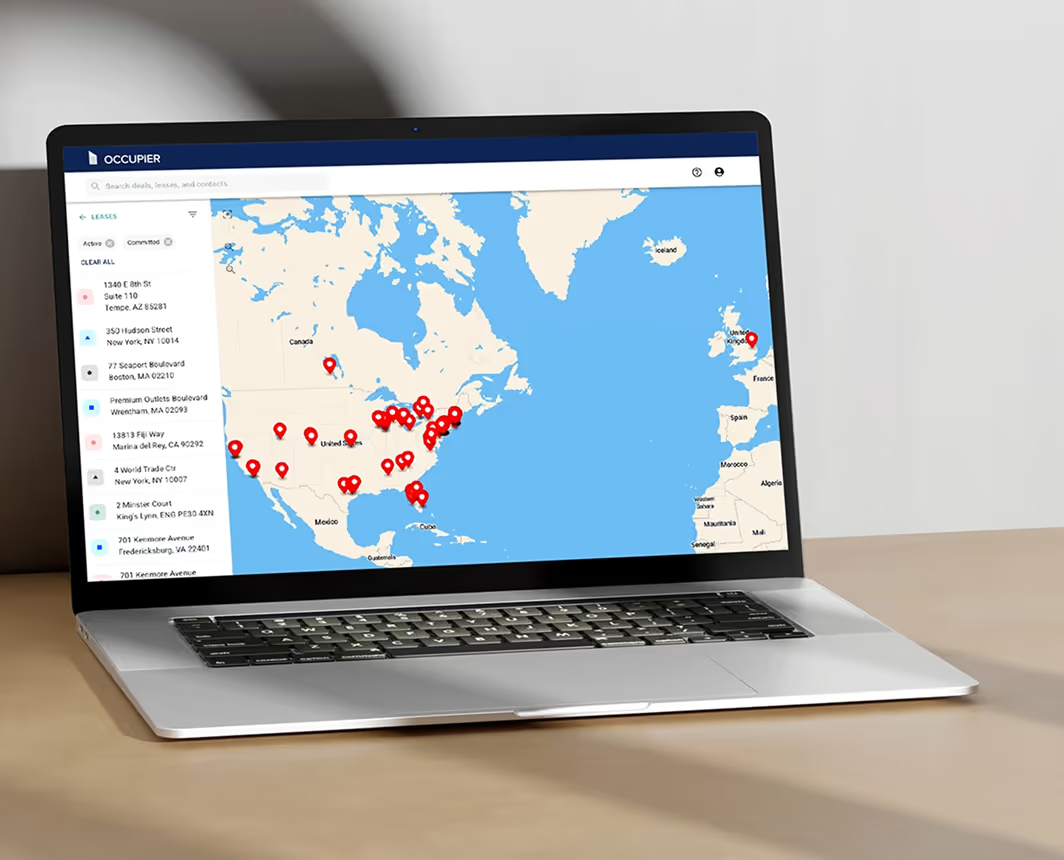
Occupier's AI Lease Management brings AI-assisted lease abstraction, clause intelligence, and responsibilities mapping into its commercial lease management platform.
Its approach connects information extracted from agreements with the broader lease records used by real estate and finance teams. Users can review AI-generated information before relying on it for operational decisions.
As AI becomes a more established part of commercial real estate, this connection between technology and existing workflows is likely to matter more than automation alone.
Frequently Asked Questions About AI in Commercial Real Estate
How Is AI Used in Commercial Real Estate?
AI is used for lease abstraction, document analysis, market research, property valuation support, portfolio reporting, building operations, and predictive maintenance. Its role is to help professionals process information and support decisions across different real estate activities.
Can AI Review Commercial Lease Agreements?
Yes. AI-powered tools can extract important dates, financial terms, and contractual provisions from lease agreements. Some also summarize clauses and identify potential landlord and tenant responsibilities. However, material legal and financial interpretations should be verified against the original documents.
How Does AI Help Commercial Real Estate Brokers?
AI can support brokers by organizing property research, reviewing transaction information, preparing document summaries, and analyzing relevant market data. These capabilities can reduce administrative work, but brokers still provide negotiation expertise, client relationships, and professional judgment.
Can AI Help Reduce Commercial Real Estate Costs?
AI can help identify potential cost-saving opportunities by analyzing occupancy patterns, building operations, lease obligations, and portfolio information. Actual savings depend on data quality, operating conditions, and whether the organization acts on the findings.
Will AI Replace Commercial Real Estate Professionals?
AI can automate portions of research, data extraction, and administrative work. However, commercial real estate transactions involve negotiations, contractual obligations, financial decisions, and relationships that require human judgment. AI is better understood as a tool that supports professionals rather than a complete replacement for their responsibilities.


Lease management that works for real estate and finance
15,000 sq ft
90 days notice
March 2026
Action required