ChatGPT vs. AI Lease Abstraction Software: Which Is More Accurate for Commercial Leases?

Can ChatGPT accurately abstract commercial leases?
Yes. It can extract dates, rent schedules, and lease clauses, particularly from complete and clearly formatted documents. Accuracy should be checked against the executed agreement and controlling amendments before the abstract is used operationally.
A commercial lease can contain hundreds of details, but only some drive the decisions real estate and finance teams make every day. Rent escalations affect budgets. Renewal notice windows determine whether a tenant can stay. Maintenance clauses establish who pays when equipment fails. If even one of those terms is captured incorrectly, a polished lease summary offers little protection.
ChatGPT can read lease documents, answer questions, and produce a first-pass abstract. Specialized AI lease abstraction software approaches the same task with structured fields and, depending on the platform, document references, review queues, and portfolio workflows. That raises the practical question behind ChatGPT lease abstraction: which approach gives commercial tenants information they can trust?
There is no independent, universal head-to-head accuracy score establishing a winner. Accuracy depends on the documents, the requested fields, and how outputs are checked. For a single straightforward lease, ChatGPT may be an efficient starting point. Across dozens of amended commercial leases, purpose-built software may provide a more dependable process for finding, validating, and maintaining the terms that matter.
What Is the Difference Between ChatGPT and AI Lease Abstraction Software?
ChatGPT is a general-purpose AI assistant. A team can supply a lease, specify the fields it wants, and ask for a table showing commencement dates, rent obligations, renewal options, and other provisions. It can also explain unfamiliar wording or compare clauses across documents. The flexibility is useful, particularly during a preliminary review.
But commercial lease abstraction is not just a summary of legal language. It is the process of converting signed lease terms into verified, structured information that people can rely on for rent payments, deadlines, negotiations, and reporting. An abstract must reflect the current agreement, including amendments and exhibits, rather than only what appears in the original document.
Specialized software is designed around that recurring task. Instead of prompting separately for each contract, a team may use a standard set of fields and a controlled review process. The strongest distinction is often not whether the AI can find a date, but what happens after it finds one: Can an analyst locate the source clause, correct the value, record approval, and use the result throughout the lease lifecycle?
Which Approach Is More Accurate for Commercial Lease Terms?
Neither category guarantees accuracy. A clean, digitally generated lease with a simple rent table is different from a scanned agreement containing handwritten changes and seven amendments. Both ChatGPT and specialized systems can make errors, including extracting an outdated clause or overlooking an exception buried elsewhere in the document.
The comparison is therefore best made by type of task, rather than by a blanket accuracy claim.
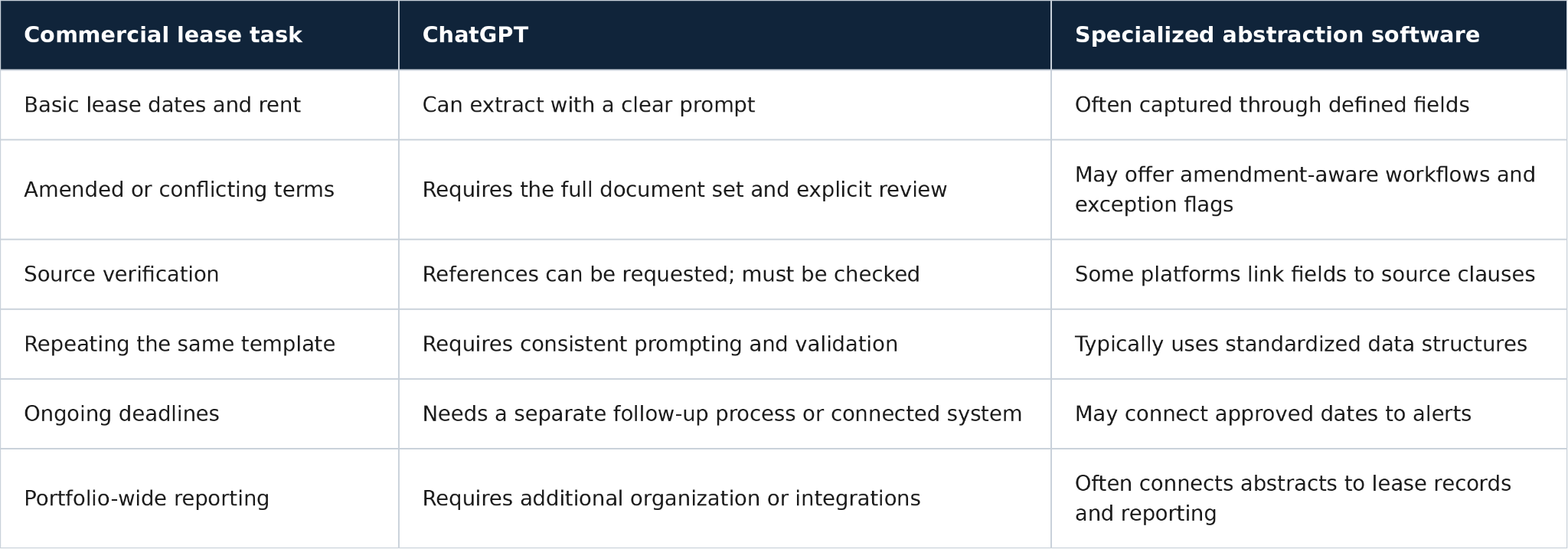
These are workflow characteristics, not measured performance results for every product. Specific features and accuracy should be confirmed in a vendor demonstration using the tenant's own leases.
Rent Escalations and Amendments
Consider a retailer whose original ten-year lease includes annual 3% rent increases. In year four, the landlord and tenant sign an amendment replacing the increases with fixed monthly amounts and granting a period of free rent. A tool that extracts the original rent schedule perfectly but misses the amendment still produces the wrong answer for the finance team.
ChatGPT can compare both documents when they are supplied and the instructions require it to identify the controlling terms. A specialized platform may make that review easier through document grouping, structured schedules, and a process for approving amended values. Neither approach should silently choose between conflicting clauses. The abstract should identify the governing amendment and flag uncertainty for review.
Critical Dates and Tenant Rights
A lease may expire on December 31, but the tenant's renewal option could require written notice months earlier. Extracting the expiration date without the notice deadline misses the information that protects the tenant's rights. The same issue arises with early termination options, expansion rights, and landlord reimbursement deadlines.
Reliable critical date tracking starts with the actual clause, including notice methods, conditions, and any amendment that changes the relevant date. ChatGPT can identify or calculate deadlines, but those answers need verification. A purpose-built workflow can connect an approved date to the people responsible for acting on it. For multi-location tenants, that continuing responsibility matters as much as extraction speed.
What Does Published Accuracy Evidence Actually Show?
One relevant industry example comes from a Databricks case study describing JLL and DealSumm's specialized contract-extraction workflow. The case study reports accuracy improving from approximately 65% in a previous approach to 92%–98%, with average review time falling from 130 to 85 minutes per lease. The workflow uses extraction, checking, correction, and source evidence rather than relying on a single AI-generated answer.
Those figures are useful evidence that structured verification can improve an abstraction process. They are not a head-to-head test against ChatGPT, not a measured accuracy rate for Occupier, and not a guarantee that another specialized platform will produce the same results. The case study also reflects its own documents, scoring method, and deployment conditions.
Likewise, a vendor's confidence score is not the same as demonstrated field accuracy. A system can assign high confidence to an incorrect date. Teams should evaluate the final extracted data against a human-verified reference, with separate attention to errors that affect money or contractual rights.
For a tenant deciding between tools, the most meaningful number is not a generic advertised percentage. It is the error rate on its own leases after applying a consistent definition of what counts as correct.
How Should a Tenant Team Run a Fair Head-to-Head Test?
A genuine comparison requires the same lease packages, the same requested fields, and the same standard of review. The following is a practical testing method, not a claim that a benchmark has already been performed.
Build a Representative Test Set
Select 10 to 20 leases from the portfolio. Include a straightforward retail lease, an agreement with several amendments, a poor-quality scan, and a lease containing complicated CAM or renewal language. Gather the executed agreement, all applicable amendments, commencement letters, and exhibits. A missing document can make any tool appear inaccurate for reasons unrelated to its extraction ability.
Define the same required fields for each system before testing. A consistent lease abstract template should include rent and escalation schedules, commencement and expiration dates, options, notice requirements, operating expense responsibilities, and relevant landlord obligations. Have an experienced lease analyst establish the correct values and controlling source clauses without relying on either tool's output.
Score Both Accuracy and Review Effort
Run the complete package through ChatGPT and the selected specialized platform. Keep the template, documents, and evaluation rules equivalent. Record whether each required field is correct, wrong, missing, or appropriately flagged as uncertain. Distinguish extraction mistakes from unsupported interpretations.
For example, if a tool gets 92 of 100 required fields correct, its illustrative field accuracy is 92%. That calculation alone is not sufficient: a wrong renewal deadline may carry more risk than an incorrect suite-format abbreviation. Report critical-date and financial-field accuracy separately, alongside omitted clauses, incorrect source citations, and reviewer correction time.
Also measure how long the team needs to get from an initial output to an approved abstract. A fast draft requiring extensive repair may cost more analyst time than a slower, more traceable result. The best-performing process is the one that produces accurate, maintainable records with reasonable review effort.
When Is ChatGPT the Better Fit?
ChatGPT can be practical for a small number of documents, exploratory clause analysis, or a first-pass summary before a trained employee checks the source. It is particularly useful when the question is narrow: What does this maintenance clause say? Which amendment changed the security deposit? How do two proposed renewal provisions differ?
For these tasks, a well-designed prompt should instruct the model to use only the supplied documents, identify the source for every important field, distinguish current terms from superseded terms, and mark unresolved conflicts rather than guessing. The user still needs to inspect the cited language. ChatGPT's ability to explain a clause does not replace legal interpretation, and an abstract should not be treated as approved simply because it looks complete.
Confidentiality also belongs in the decision. Before uploading executed leases, teams should verify that their chosen account, retention settings, contractual protections, and internal policies permit that use. A consumer-facing AI workflow is not automatically appropriate for every confidential agreement.
When Does Specialized Software Make More Sense?
The case for specialized software becomes stronger when abstraction is a recurring operation rather than a one-off task. A restaurant group managing 80 locations may need to see all termination notice windows, upcoming rent increases, and landlord maintenance obligations in one place. Recreating that view from individual chat sessions adds administrative work even when each initial extraction is accurate.
For businesses handling large volumes of lease documents, AI lease abstraction can help extract rent terms, clauses, and critical dates, including information from scanned PDFs. A structured review process allows teams to verify extracted details before adding them to their lease records, rather than assuming every AI-generated field is automatically correct.
That distinction continues after the initial abstract. With AI-powered lease management, confidence indicators can help identify ambiguous information requiring further review while connecting approved lease data with ongoing management workflows. A finance team may need a rent schedule while facilities needs to confirm who handles HVAC repairs; both decisions should start with the same verified terms.
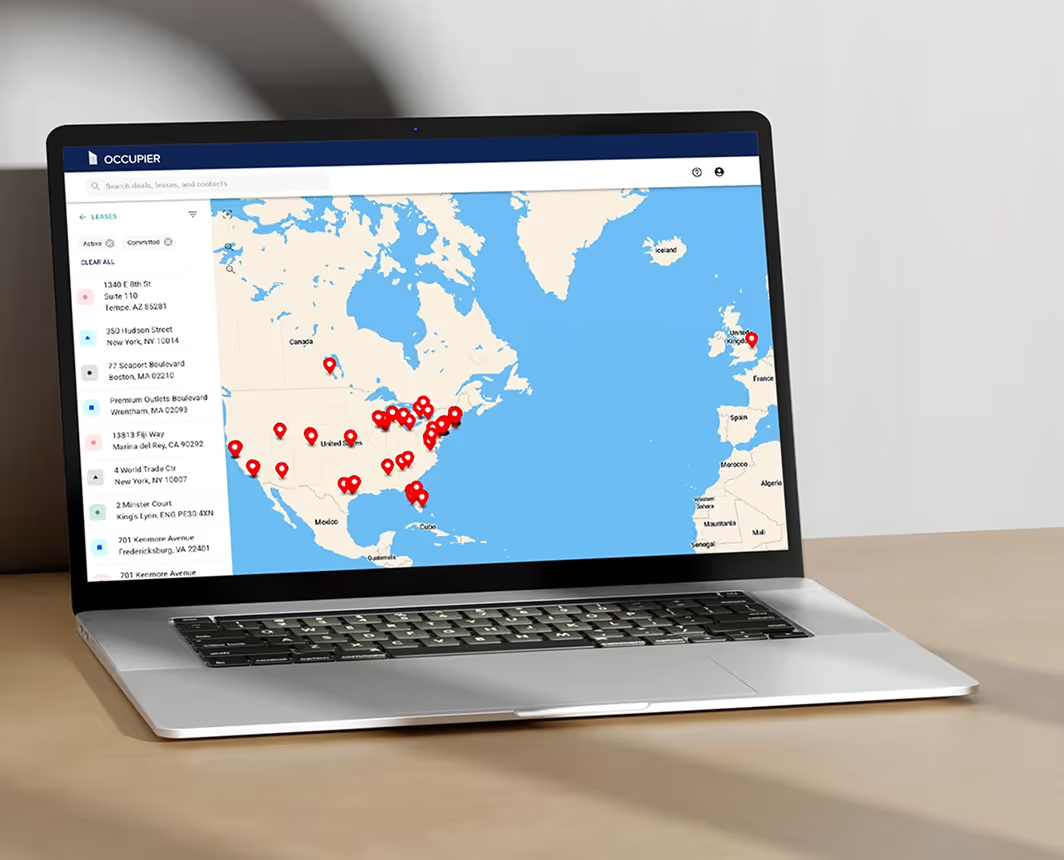
For multi-location tenants, Occupier’s lease administration software can carry those records forward through alerts, amendments, and portfolio reporting. That reduces the risk of verified information becoming outdated in a spreadsheet or disappearing into separate documents. Software still requires governance, particularly when a lease amendment changes an already approved obligation.
Which Is More Accurate: ChatGPT or Specialized AI?
For commercial leases, the strongest recommendation is to choose an auditable abstraction workflow, not to assume that a particular AI label guarantees accuracy. ChatGPT can be accurate and useful for focused first-pass extraction. Specialized systems are often better suited to applying consistent fields, documenting review, and maintaining lease data across a tenant portfolio.
The difference is especially important when an incorrect abstract can affect a renewal right, rent payment, or property obligation. Teams should test both options on representative documents, independently verify critical terms, and compare the time needed to reach an approved result.
If the organization manages only a few leases, ChatGPT with a strict template and experienced review may be sufficient. If it manages dozens of locations and needs reliable records beyond the initial extraction, a purpose-built lease administration workflow is usually the more practical investment. Accuracy is proven by verified outputs, not by the name of the tool.
ChatGPT Lease Abstraction FAQs
Can ChatGPT accurately abstract commercial leases?
Yes. It can extract dates, rent schedules, and lease clauses, particularly from complete and clearly formatted documents. Accuracy should be checked against the executed agreement and controlling amendments before the abstract is used operationally.
Is specialized AI lease abstraction always more accurate than ChatGPT?
No. There is no universal result across all products and leases. Specialized tools may offer stronger review and consistency features, but a fair comparison requires testing both approaches on the same documents and fields.
Can ChatGPT read lease amendments?
Yes, when the relevant amendments are included. It can compare them against the original lease, but reviewers must confirm that the output applies the latest controlling terms and identifies any unresolved conflicts.
What matters most when measuring abstraction accuracy?
Correct financial amounts, critical dates, lease options, completeness, and traceability to source clauses matter most. Review time and the effort required to correct errors should also be measured.
Are source citations enough to guarantee accuracy?
No. A citation can point to the wrong provision or support only part of an answer. Reviewers should inspect the referenced language and confirm that no amendment or exception changes the result.
Can AI lease abstraction replace a lease administrator?
AI can reduce manual data entry and accelerate review, but people remain responsible for verifying important terms, handling exceptions, and making decisions based on the lease.
What is the best option for a large tenant portfolio?
A specialized system is often a better operational fit when the organization needs standardized abstracts, review workflows, critical date monitoring, and consistent access across real estate and finance teams. Actual extraction accuracy still needs to be tested.


Lease management that works for real estate and finance
15,000 sq ft
90 days notice
March 2026
Action required