Accretion Expense in Lease Accounting

What is accretion expense in lease accounting?
Accretion is the increase in a discounted liability as time passes. Lease liability accretion reflects interest on the outstanding obligation, while ARO accretion increases a qualifying retirement liability toward its expected settlement amount.
Accretion expense represents the increase in a discounted liability as time passes. In lease accounting, the concept helps finance teams understand how lease liabilities grow through interest before payments reduce the outstanding balance.
Under ASC 842, businesses recognize most leases on their balance sheets as right-of-use (ROU) assets and lease liabilities. Because the liability is initially measured using the present value of future lease payments, the accounting must reflect the effect of time on that discounted amount.
Accretion also plays an important role in asset retirement obligations (AROs), particularly when commercial tenants must remove improvements or restore leased properties at the end of their agreements.
While these calculations are related, their accounting treatment differs. Understanding those differences helps finance teams prepare accurate journal entries, maintain reliable liability schedules, and avoid misstatements in financial reporting.
What Is Accretion Expense in Lease Accounting?
Accretion is the gradual increase in the carrying value of a discounted liability as it moves closer to settlement. The increase reflects the unwinding of the original present value discount.
When a company signs a commercial lease, the lease liability is generally measured at the present value of qualifying future payments rather than their undiscounted total. As time passes, interest increases the liability, while payments reduce it.
For example, a retailer may initially recognize a lease liability of $100,000. If the applicable periodic interest rate is 0.5%, the liability increases by $500 during the first month before considering the payment made that month.
That $500 represents interest accretion on the lease liability.
Accretion occurs throughout the recognized lease term, not just during periods of free rent. However, its effect becomes particularly visible during rent-free periods because there may be no payment to offset the increase.
The accounting presentation depends on lease classification. Under ASC 842, finance leases recognize interest expense separately, while operating leases generally recognize a single lease cost.
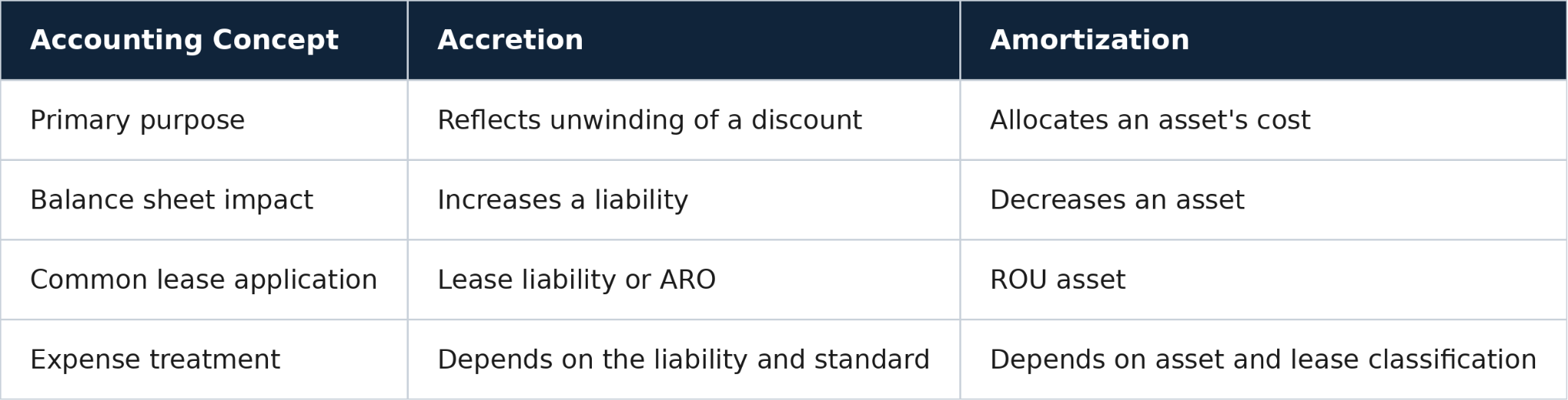
Accretion vs. Amortization
Accretion and amortization affect different components of lease accounting.
Accretion increases a liability as the present value discount unwinds. Amortization generally reduces an asset's carrying value over its applicable period.
For a finance lease, the company records interest expense associated with the liability and amortization expense associated with the ROU asset.
For an operating lease, liability accretion is still calculated, but the ROU asset reduction works alongside that calculation to produce a single lease cost.
Understanding the distinction between ROU assets and lease liabilities is important because their balances do not necessarily decline at the same rate.
How Is Accretion Calculated Under ASC 842?
Lease liability accretion is calculated using the outstanding liability and the applicable periodic discount rate.
For a lease with regular end-of-month payments, the basic formula is:
Periodic Interest Accretion = Opening Lease Liability × Periodic Discount Rate
The closing liability is then calculated as:
Closing Lease Liability = Opening Liability + Interest Accretion − Lease Payment
Other events, such as lease modifications or required remeasurements, must be accounted for separately.
Consider a business leasing office space for 12 months with monthly payments of $1,000 at the end of each month. Assume the agreement is recognized on the balance sheet and uses a 6% nominal annual discount rate with monthly compounding.
The monthly discount rate is:
6% ÷ 12 = 0.5%
The present value of the 12 payments produces an initial lease liability of approximately $11,618.93.
During the first month:
Interest Accretion = $11,618.93 × 0.5% = $58.09
After the $1,000 payment, the closing liability is approximately:
$11,618.93 + $58.09 − $1,000 = $10,677.03
The same process continues throughout the lease term.
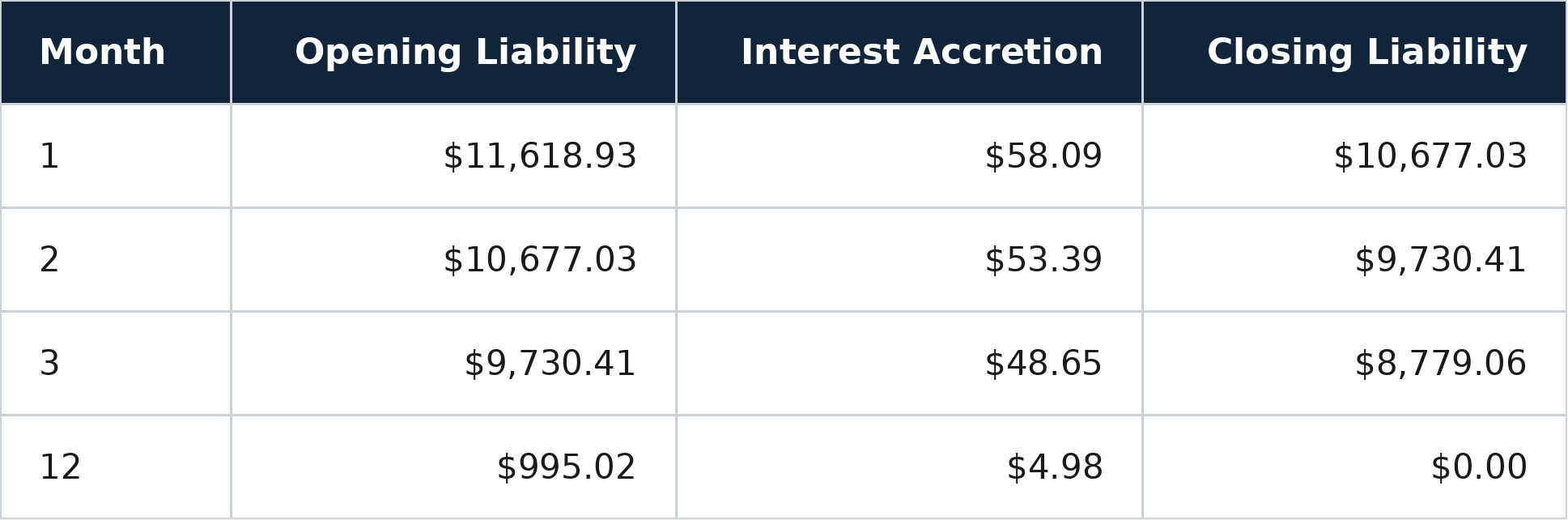
Calculations use unrounded values, with displayed amounts rounded to cents.
Across the complete schedule, total payments equal $12,000. The difference between those payments and the initial liability is approximately $381.07 of total interest accretion.
For finance teams managing multiple properties, the schedule makes it possible to reconcile the opening liability, periodic interest, payments, and closing balance.
How Is Accretion Recorded for Operating and Finance Leases?
Although operating and finance leases generally follow the same liability measurement mechanics, their income statement treatment differs under ASC 842.
This distinction is important because using finance lease journal entries for an operating lease can overstate reported expenses.
Finance Lease Accounting
Finance leases separately recognize interest expense and ROU asset amortization.
Using the previous example, the first month's interest expense is $58.09.
The company records the following entries:
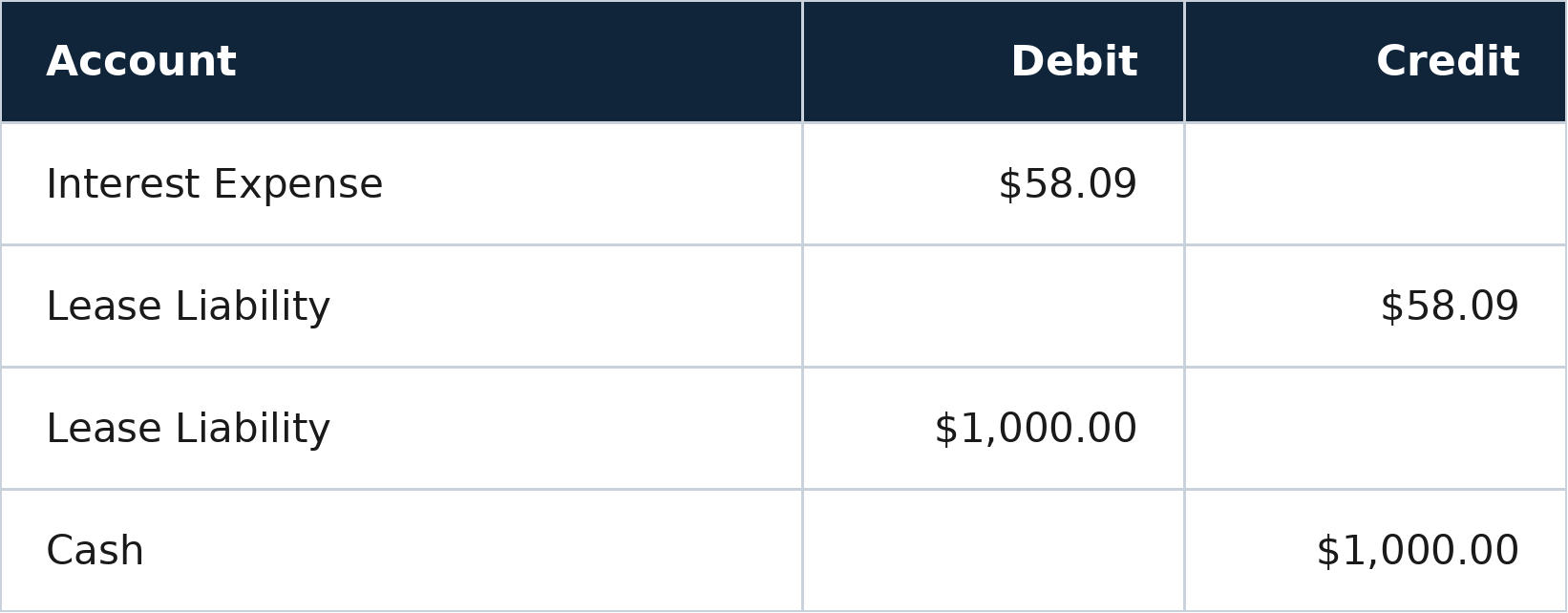
The first two lines recognize interest accretion. The remaining lines record the monthly payment.
The company also recognizes ROU asset amortization separately, based on the applicable amortization period.
This means finance lease expenses commonly decrease over time as interest on the remaining liability declines.
Operating Lease Accounting
Operating leases generally recognize a single lease cost, typically on a straight-line basis.
Using the same simplified lease, assume there are no incentives, initial direct costs, or other adjustments. Total lease payments equal $12,000 over 12 months, producing monthly lease cost of $1,000.
The liability still accretes by $58.09 during the first month. However, that amount is not recognized as a separate interest expense on top of the operating lease cost.
Instead, the ROU asset reduction is:
$1,000 − $58.09 = $941.91
The first month's entry is:
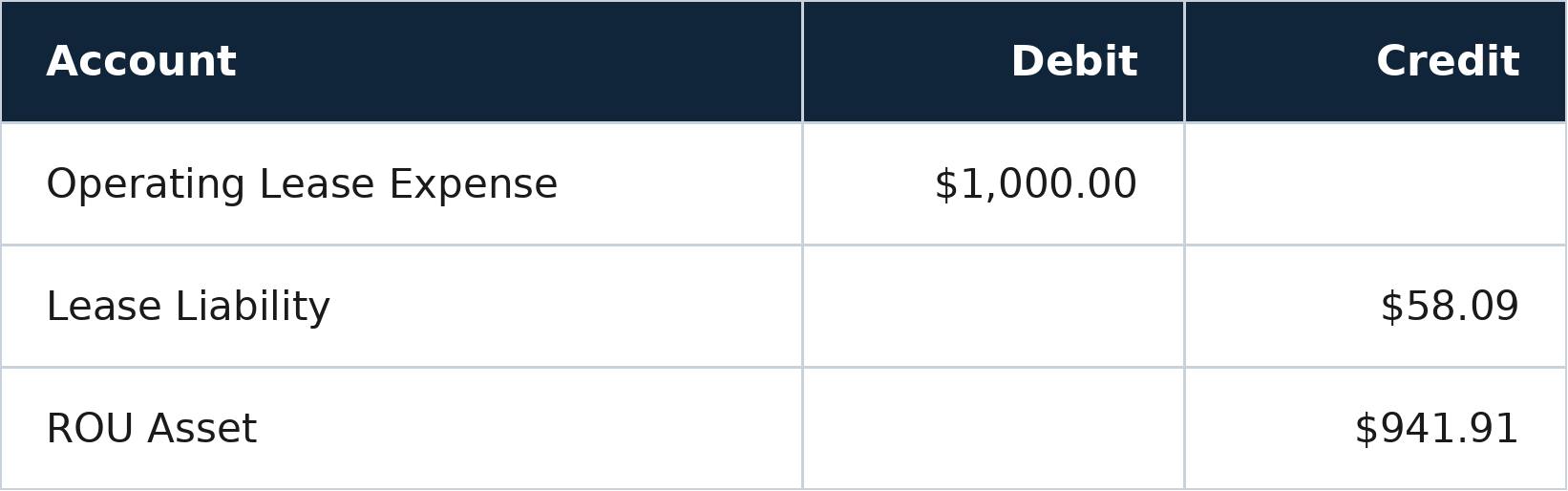
The separate payment entry debits the lease liability and credits cash for $1,000.
Occupier's guide to lease accounting journal entries explains the different entries required for operating and finance leases.
The key distinction is that both classifications use liability accretion, but only finance leases separately present the associated interest expense.
How Does Accretion Work for Asset Retirement Obligations?
Accretion expense is also associated with asset retirement obligations, which arise when a company has a qualifying legal obligation to retire a tangible long-lived asset.
In commercial real estate, an ARO may arise when a lease requires the tenant to remove certain improvements or specialized installations at the end of their useful life or lease term.
For example, a retailer may install specialized equipment that must be removed when its lease expires.
If the removal obligation meets the recognition requirements under ASC 410, the company records an ARO liability based on the estimated fair value of that future obligation.
The corresponding asset retirement cost is generally capitalized as part of the related long-lived asset.
Accretion Expense Example for an ARO
Assume a company leases commercial space for five years and is legally required to remove specialized installations at the end of the term.
The expected restoration cost is $50,000, and the appropriate credit-adjusted risk-free discount rate is assumed to be 4% annually.
The initial liability is:
Present Value = $50,000 ÷ (1.04)⁵ = $41,096.36
The company initially recognizes an ARO liability of approximately $41,096.36, together with the associated capitalized retirement cost.
At the end of the first year:
Accretion Expense = $41,096.36 × 4% = $1,643.85
The entry is:
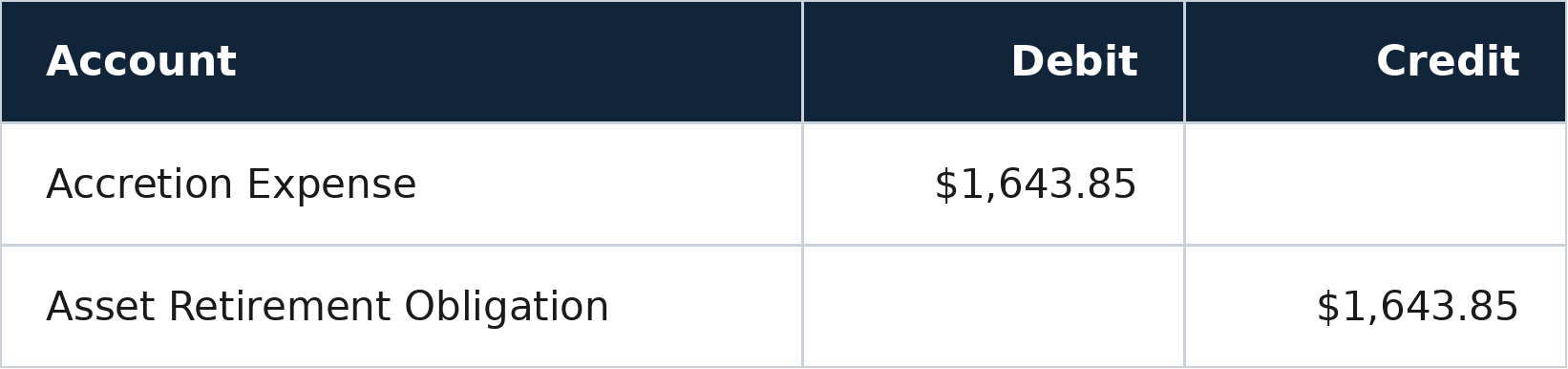
The liability continues increasing through accretion until it reaches the expected settlement amount, assuming the estimate and timing remain unchanged.
Unlike lease liability interest on a finance lease, ARO accretion under ASC 410 is classified as an operating expense under US GAAP.
The capitalized retirement cost is separately allocated to expense over the appropriate period.
Businesses should also distinguish qualifying AROs from ordinary property maintenance and repair responsibilities. Not every lease restoration provision automatically results in a recognized ARO.
Occupier's discussion of leasehold improvements provides additional context on improvements made to commercial properties and their accounting treatment.
How Does Accretion Expense Affect Financial Statements?
Accretion affects financial statements differently depending on whether it relates to a lease liability or an ARO.
For a finance lease, interest expense increases reported expenses while the liability increases before payments are applied. The ROU asset is amortized separately.
For an operating lease, liability accretion is incorporated into the measurement of the single lease cost and associated ROU asset reduction. It should not be added again as a separate interest expense.
For an ARO, periodic accretion increases the recognized restoration liability and creates an operating expense.
These differences are important when evaluating financial performance metrics such as EBITDA.
Finance lease interest is generally excluded from conventional EBITDA calculations because it is interest expense. However, ARO accretion is classified as an operating item under US GAAP and is not automatically excluded merely because it is noncash.
Companies should apply their established metric definitions consistently rather than assume all accretion receives identical treatment.
Common Accretion Accounting Mistakes to Avoid
Accretion calculations can become difficult when companies manage leases with different payment schedules, discount rates, or amendments.
Several errors are particularly important to prevent.
Incorrect discount rates: Applying a rate that does not match the approved measurement assumptions can misstate periodic interest and the remaining liability.
Ignoring payment timing: Monthly payments made in advance require different calculations from payments made at the end of the period.
Mixing operating and finance lease entries: Recording separate interest expense in addition to the full operating lease cost can overstate expenses.
Combining lease liabilities with AROs: Restoration obligations and future rent payments generally require separate calculations and accounting treatment.
Missing lease changes: Amendments, term reassessments, and certain other changes may require updated liability measurements and future accretion schedules.
For a retailer operating dozens of stores, these issues can multiply when payment information and lease amendments are maintained in separate spreadsheets.
Accurate calculations begin with keeping the contractual data, accounting assumptions, and journal entries aligned.
How Can Businesses Manage Accretion Across Multiple Leases?
Managing accretion becomes more complex as a company's commercial lease portfolio grows.
Each location may have a different commencement date, payment schedule, discount rate, or lease classification. Rent-free periods and subsequent amendments can further complicate the calculations.
Finance teams need to maintain schedules that reconcile opening liabilities with interest accretion, payments, modifications, and closing balances. Using lease accounting software can help centralize lease information, calculate liabilities, generate amortization schedules, and prepare ASC 842 journal entries.
Real estate teams must also communicate changes to lease terms so that accounting records reflect the current agreements.
For organizations with substantial real estate portfolios, connecting lease administration and accounting helps reduce manual reconciliation and improve consistency during financial close.
Occupier's lease accounting automation also supports recurring schedules and journal entry generation, helping finance teams work from current lease information.
Accretion calculations may be technical, but maintaining accurate lease data and consistent accounting practices makes them easier to manage throughout the lease term.
Accretion Expense FAQs
What is accretion expense in lease accounting?
Accretion is the increase in a discounted liability as time passes. Lease liability accretion reflects interest on the outstanding obligation, while ARO accretion increases a qualifying retirement liability toward its expected settlement amount.
How do you calculate accretion expense?
Accretion is generally calculated by multiplying the opening liability by the applicable periodic rate. The exact method depends on the liability type, rate assumptions, and timing of payments.
Is accretion expense the same as interest expense?
Not always. Finance lease liability accretion is recognized as interest expense. Under ASC 842, operating lease liability accretion is incorporated into the single lease cost calculation. ARO accretion under ASC 410 is classified as an operating expense.
What is the difference between accretion and amortization?
Accretion increases a discounted liability over time, while amortization generally reduces an asset's carrying value by allocating its cost over the applicable period.
Does accretion occur during rent-free periods?
Yes. If a recognized lease has a rent-free period, the liability generally continues accruing interest even when no payment is due. As a result, the liability may increase during that period.
Is accretion expense a cash expense?
Accretion itself does not involve an immediate cash payment. It is a noncash accounting increase in a liability. Cash is paid separately according to the lease or retirement obligation.
Does accretion affect EBITDA?
The impact depends on the applicable accounting model and EBITDA definition. Finance lease interest is generally excluded from conventional EBITDA, while ARO accretion is an operating item under US GAAP and is not automatically excluded.
Does IFRS 16 treat lease accretion differently?
IFRS 16 generally recognizes lease liability interest and ROU asset depreciation separately. This resembles ASC 842 finance lease expense presentation, while ASC 842 operating leases generally use a single lease cost model.



Lease management that works for real estate and finance
15,000 sq ft
90 days notice
March 2026
Action required