Related Party Leases Under ASC 842

What is a related party lease under ASC 842?
A related party lease is a leasing arrangement between parties that have a qualifying relationship under the related-party accounting guidance. Examples include leases between parent companies and subsidiaries or between businesses controlled by the same owner.
Related party leases are common among businesses where the same individuals, families, or affiliated companies have ownership interests in multiple entities. A business owner might hold a commercial property through one LLC while leasing that space to a separate operating company. Although both businesses are connected, the arrangement can still create lease accounting obligations under ASC 842.
These agreements can be more difficult to account for than leases between unrelated parties. Rental terms may be informal, agreements may be renewed without formal documentation, and business owners may have flexibility to change payment arrangements.
ASC 842 generally requires related party leases to be accounted for based on their legally enforceable terms and conditions. However, the Financial Accounting Standards Board (FASB) introduced important changes through Accounting Standards Update (ASU) 2023-01, providing relief for certain common control arrangements.
Understanding these requirements helps finance teams identify qualifying leases, calculate the appropriate balances, and account for improvements made to properties owned by related entities.
What Are Related Party Leases?
A related party lease is a leasing arrangement between entities or individuals that have a relationship covered by the related-party accounting guidance in ASC 850.
These relationships may involve common ownership, control, significant influence, or other qualifying connections.
For example, consider a restaurant business operating from a building owned by a separate real estate company. If the same person controls both businesses, the lease represents a related party arrangement. Other examples include a parent company leasing office space to its subsidiary or affiliated businesses sharing warehouse facilities under a rental agreement.
The accounting treatment matters because related parties may negotiate terms differently from independent landlords and tenants. They might agree to below-market rent, extend occupancy informally, or make improvements without clearly documenting who owns them.
These arrangements still require appropriate accounting and disclosure when they meet the applicable requirements.
Related Party Leases vs. Common Control Leases
A common control lease is a specific type of related party arrangement in which the participating entities are controlled by the same party or controlling group.
All common control leases are related party leases, but not every related party lease involves common control.
For example, a business leasing space from an entity owned by its controlling shareholder may qualify as a common control arrangement. A lease involving an entity over which the business has significant influence, but not common control, may still be related-party activity without qualifying for the common control guidance.
This distinction is important because the practical expedient introduced by ASU 2023-01 applies only to qualifying common control arrangements. Determining common control requires considering the facts and circumstances of ownership and control rather than applying a universal ownership percentage.
How Are Related Party Leases Accounted for Under ASC 842?
Under ASC 842, related party leases generally follow the same recognition and classification requirements as leases between unrelated parties. This means finance teams must apply the standard ASC 842 lease accounting requirements, including identifying whether an arrangement contains a lease, determining its classification, and recognizing the appropriate assets and liabilities.
A company must first determine whether the arrangement conveys the right to control the use of an identified asset for a period of time in exchange for consideration. If the arrangement contains a lease, the lessee generally recognizes a right-of-use (ROU) asset and lease liability, subject to applicable recognition exemptions.
The lease must also be classified as operating or finance based on the relevant accounting criteria. For related party arrangements, ASC 842 generally requires these assessments to reflect the legally enforceable terms and conditions of the agreement.
Consider a retailer leasing a warehouse from a company controlled by one of its owners. Although the parties may expect the arrangement to continue for several years, the legally enforceable lease term may differ from that expectation. That difference can affect the lease term, present value of payments, and initial ROU asset.
Why Legally Enforceable Terms Matter
Related businesses sometimes operate under informal agreements because the same owners influence both sides of the transaction.
A written lease might establish a one-year term even though the operating company has occupied the property for ten years. Without an applicable practical expedient, management must determine which terms and conditions are legally enforceable. This may require examining written agreements, other relevant evidence, and governing law.
The expected business relationship alone does not automatically establish a longer enforceable lease term. Because the determination can significantly affect reported liabilities, companies may need accounting and legal input when the arrangement is unclear.
What Changed for Related Party Leases Under ASU 2023-01?
In March 2023, the FASB issued ASU 2023-01 to address accounting challenges involving common control leases.
The update introduced two important changes: an optional practical expedient for certain entities and revised accounting requirements for leasehold improvements associated with common control arrangements.
Both amendments became effective for fiscal years beginning after December 15, 2023, including interim periods within those fiscal years. Early adoption was permitted.
The Written-Terms Practical Expedient
ASU 2023-01 allows eligible entities that are not public business entities to elect a practical expedient for qualifying common control arrangements.
Eligible entities may include private companies and certain not-for-profit organizations, while specified entities such as SEC-reporting employee benefit plans are excluded.
Under the election, a company can use the written terms and conditions of the arrangement to determine whether a lease exists and, if so, how it should be classified and accounted for, without separately establishing that those written terms are legally enforceable.
The election is available on an arrangement-by-arrangement basis.
For example, two commonly controlled companies may have a written agreement identifying the leased property, monthly rent, and lease term. An eligible entity can elect to evaluate that arrangement using its written terms, even when establishing legal enforceability would otherwise be difficult.
The practical expedient does not eliminate the other ASC 842 requirements. The company must still evaluate the arrangement and apply the appropriate recognition, measurement, and disclosure rules.
It also does not apply when the arrangement has no written terms and conditions. In that situation, the company must use the general legally enforceable terms approach.
What Happens When Common Control Ends?
A change in ownership can affect the accounting treatment.
Suppose an operating company leases property from another entity controlled by the same owner. If one company is subsequently sold to an unrelated party, the entities may no longer qualify as being under common control.
When that happens, a continuing lease previously accounted for using the practical expedient must be evaluated based on its legally enforceable terms and conditions.
If those terms differ from the written terms previously used, the applicable lease modification guidance may need to be applied.
This makes ownership changes important information for both the legal and finance teams, even when the physical property and monthly rental payments remain unchanged.
How Are Leasehold Improvements Treated Under Common Control?
One of the most significant changes introduced by ASU 2023-01 concerns leasehold improvements.
For most leases, qualifying leasehold improvements are generally amortized over the shorter of their useful life or the remaining lease term, subject to specific exceptions. However, this approach can produce unusual results when the tenant and landlord are under common control.
A commonly controlled operating company might invest heavily in a building even though its written lease runs for only a short period. The improvements may continue benefiting the broader ownership group long after that agreement expires.
To address this situation, ASU 2023-01 requires qualifying leasehold improvements associated with common control leases to be amortized over their useful life to the common control group, regardless of the lease term, as long as the lessee controls the use of the underlying asset through a lease.
Unlike the written-terms practical expedient, this leasehold improvement requirement applies to both public and private entities.
Example: Leasehold Improvement Amortization
Consider an operating company leasing a retail property from a commonly controlled real estate entity.
The company makes $120,000 in qualifying leasehold improvements. Its written lease runs for two years, but the improvements have a useful life of ten years to the common control group.
Assume straight-line amortization with no residual value.
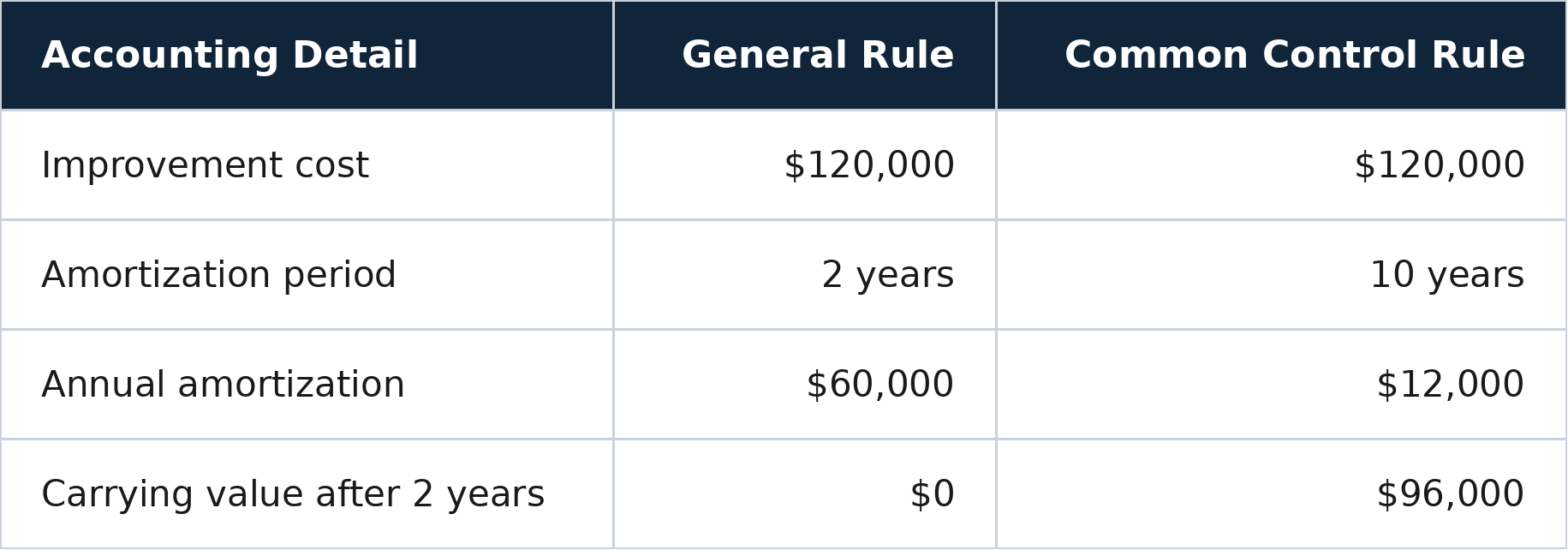
Under the general rule, the company would recognize $60,000 in annual amortization expense over the two-year lease term.
Under the common control guidance, annual amortization is $12,000 because the improvements provide benefits to the group over ten years.
This example assumes the common control group owns the underlying property rather than holding it under a shorter lease with an unrelated party. A separate limitation applies when the common control lessor itself leases the asset from an outside party.
The distinction is particularly relevant for businesses investing in specialized retail interiors, offices, or production facilities.
What Happens When the Tenant Leaves?
If the lessee no longer controls the use of the underlying asset through a lease, any remaining carrying amount of qualifying common control leasehold improvements is generally accounted for as a transfer between entities under common control through an adjustment to equity.
Using the previous example, suppose the tenant stops controlling the space after two years. The improvements still have a $96,000 carrying amount.
Assuming the requirements for the common control transfer are met, that remaining balance would be removed through the appropriate equity accounting rather than treated as ordinary accelerated amortization expense.
The improvements remain subject to applicable impairment requirements while they are recognized.
How Do Related Party Leases Affect Financial Reporting?
Related party leases can affect a company's balance sheet, income statement, and required financial statement disclosures.
When a related party arrangement qualifies as a lease under ASC 842, the lessee generally records an ROU asset and lease liability based on the applicable terms and measurement requirements. For private companies using the common control practical expedient, written terms can determine the recognized lease balances even when the parties' broader business relationship suggests they might continue the arrangement longer.
Leasehold improvements can also create different amortization patterns, particularly when their useful life to the common control group exceeds the contractual lease term.
Companies must separately evaluate disclosure requirements under ASC 850 and ASC 842. Because ASC 842 disclosure requirements cover more than the recognized lease balances, finance teams must also consider the nature of related party relationships and the additional information required for common control arrangements.
Relevant disclosures may include descriptions of the relationships, transactions, amounts involved, and balances due to or from related parties.
When qualifying common control leasehold improvements have a useful life longer than the lease term, additional disclosures include the unamortized balance, remaining useful life to the common control group, and remaining lease term.
These requirements help financial statement users understand arrangements that may not reflect ordinary market transactions.
How Can Businesses Manage Related Party Leases Accurately?
For businesses operating through multiple entities, related party leases can be difficult to track when agreements, ownership records, and accounting schedules are maintained separately.
A retailer might occupy properties owned by several affiliated real estate companies, each with different rental terms and improvement arrangements. Maintaining those agreements within a consistent lease administration process helps real estate teams organize contracts, amendments, critical dates, and responsibilities across the portfolio.
Finance teams also need a process for identifying related party relationships, confirming which agreements are written, and documenting whether the practical expedient applies. They must distinguish between ordinary related party arrangements and those involving common control because the accounting requirements are not identical.
For example, a company may manage several leases between affiliated entities while only some qualify for the common control practical expedient. Its lease accounting software needs to support accurate lease measurements and accounting schedules based on the terms and accounting decisions established for each arrangement.
Supporting documentation should include lease classification assessments, discount rates, practical expedient elections, improvement useful lives, and required disclosures. Management remains responsible for determining the accounting treatment, regardless of the systems used to maintain these records.
When related party agreements change, consistent communication between real estate and finance teams becomes especially important. Occupier's lease accounting automation can support recurring calculations and journal entry workflows, while finance teams review changes that may affect recognized balances.
For companies managing multiple affiliated entities, reliable documentation and a consistent accounting process help ensure that related party leases remain accurately reflected in financial statements.
Related Party Leases Under ASC 842 FAQs
What is a related party lease under ASC 842?
A related party lease is a leasing arrangement between parties that have a qualifying relationship under the related-party accounting guidance. Examples include leases between parent companies and subsidiaries or between businesses controlled by the same owner.
Are all related party leases considered common control leases?
No. All common control leases are related party arrangements, but some related party relationships do not involve common control. This distinction determines whether the common control practical expedient may be available.
What is ASU 2023-01?
ASU 2023-01 is a FASB accounting update that introduced a written-terms practical expedient for eligible common control leasing arrangements and revised the accounting for leasehold improvements associated with common control leases.
Can private companies use written agreements for common control leases?
Yes. Eligible entities can elect to use written terms and conditions to determine whether a qualifying common control arrangement contains a lease and how it should be accounted for. The election is made on an arrangement-by-arrangement basis.
What if a related party lease has no written agreement?
If a common control arrangement has no written terms and conditions, the practical expedient is not available. The entity must determine whether a lease exists and account for it using legally enforceable terms and conditions.
How are leasehold improvements amortized under common control?
Qualifying leasehold improvements are generally amortized over their useful life to the common control group while the lessee controls the use of the underlying asset through a lease, subject to relevant limitations.
Does ASU 2023-01 apply to public companies?
The written-terms practical expedient is not available to public business entities. However, the revised accounting for leasehold improvements associated with common control leases applies to both public and private entities.
Are related party lease disclosures required?
Yes. Related party lease transactions are subject to applicable ASC 850 disclosure requirements, along with relevant ASC 842 disclosures. Certain common control leasehold improvements also require additional information when their useful life exceeds the lease term.



Lease management that works for real estate and finance
15,000 sq ft
90 days notice
March 2026
Action required