Lease Critical Date Management: Tracking & Best Practices

What are critical dates in a commercial lease?
Critical dates are contractual deadlines requiring attention or action. Common examples include lease commencement, expiration, renewal notices, termination rights, rent escalations, and insurance deadlines.
Critical date management is the process of identifying, tracking, and acting on important deadlines in commercial lease agreements. These dates determine when tenants must exercise renewal rights, provide termination notices, prepare for rent increases, and fulfill other contractual obligations.
Missing a deadline can have significant consequences. A business might lose its right to renew a valuable location, become subject to an unwanted automatic renewal, or miss an opportunity to negotiate more favorable lease terms.
For companies managing multiple commercial properties, keeping track of these obligations becomes increasingly challenging. Each agreement may contain different notice periods, expiration dates, payment schedules, and requirements.
An effective critical date management process helps real estate teams prepare for upcoming decisions, coordinate responsibilities, and maintain greater control over their lease portfolios.
What Is Critical Date Management?
Critical date management involves monitoring contractual dates and ensuring that the appropriate actions are completed before their deadlines.
In commercial real estate, these dates are established through lease agreements and related amendments.
They often involve renewal options, termination rights, rent escalations, commencement dates, insurance obligations, and other time-sensitive requirements.
For example, a retailer may have a lease that expires on December 31, 2028, with a requirement to provide renewal notice at least nine months before expiration.
Although the property remains available until the end of 2028, the actual deadline for exercising the renewal option may fall in March.
Missing that earlier notice deadline could cause the tenant to lose its contractual renewal right.
Critical date management helps organizations distinguish between the date an event occurs and the earlier date by which a decision or notice must be completed.
Which Critical Lease Dates Should You Track?
Commercial lease agreements can contain numerous important dates.
Some relate to financial obligations, while others affect occupancy rights, property operations, and contractual flexibility.
The following table identifies common dates and the actions they may require.
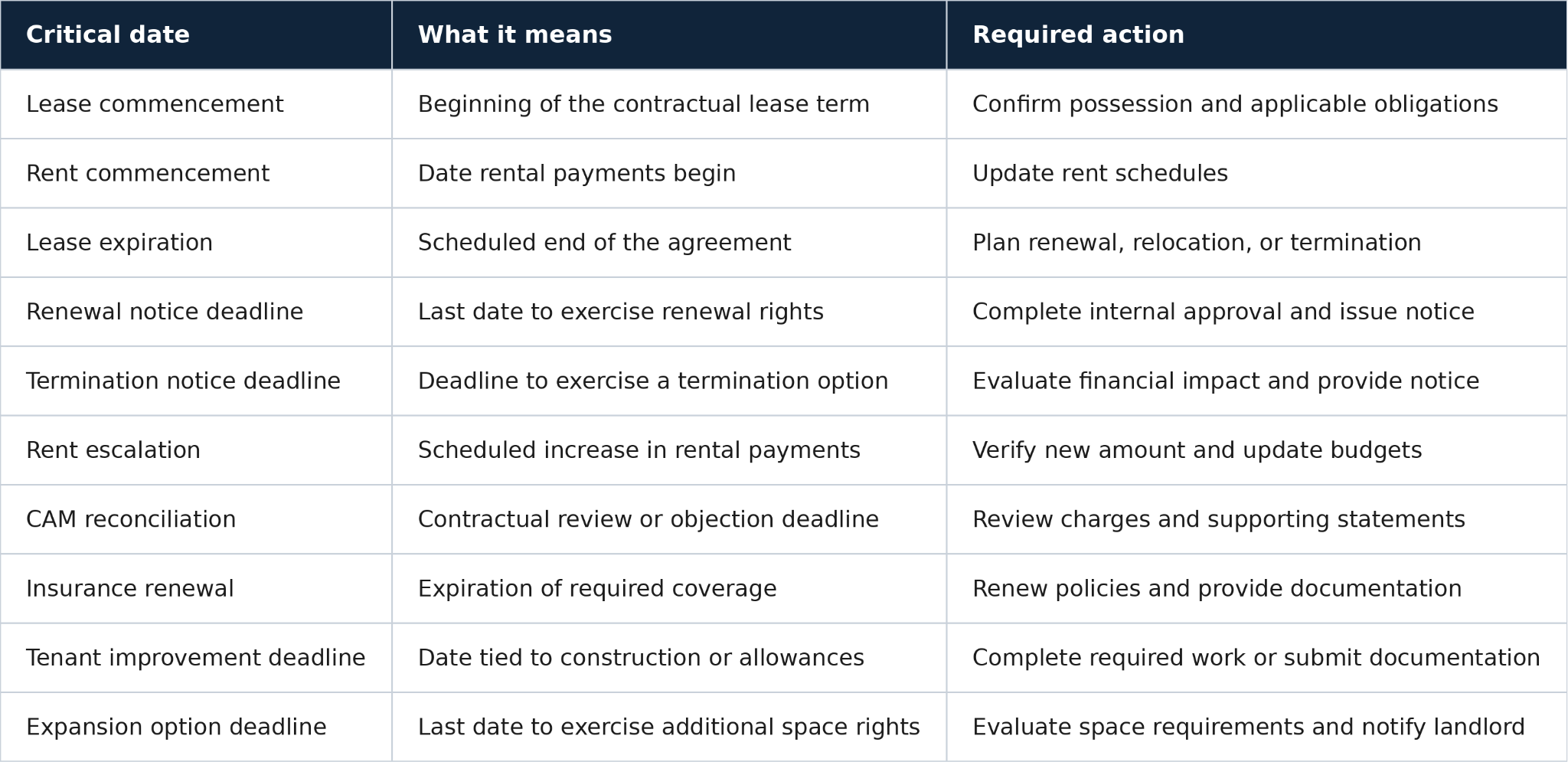
Not every lease includes all these provisions.
A single-tenant retail property may have different obligations from an office lease in a multi-tenant building.
The correct tracking process begins with the actual agreement rather than a standardized list of assumed deadlines.
Why Critical Lease Dates Matter
Critical dates influence financial performance, location planning, and the flexibility available to commercial tenants.
The consequences of missing a deadline depend on the lease, but even one oversight can create substantial problems.
Losing Renewal or Expansion Rights
A renewal option may allow a business to remain in a strategically valuable property for an additional term.
However, these rights often require formal notice within a defined period.
If a tenant misses the deadline, the landlord may no longer be contractually required to honor the option.
A similar issue can arise with expansion rights.
For example, a growing healthcare practice may have the right to lease adjacent space, provided it exercises that right before a specified date.
Missing the deadline could leave the business without sufficient space to expand.
Unexpected Financial Commitments
Some leases contain automatic renewal provisions or specific notice requirements for ending an agreement.
A missed deadline could extend the tenant's financial obligations beyond its intended occupancy period.
Rent escalations can also create budgeting problems when they are not tracked correctly.
For example, an increase tied to a specified index may require calculation and verification before the new amount is paid.
Without accurate tracking, a company may pay an incorrect amount or discover an unexpected expense during financial reconciliation.
Reduced Negotiating Flexibility
Successful real estate decisions require sufficient preparation time.
A business considering renewal may need to review market rents, evaluate relocation options, obtain internal approvals, and negotiate with its landlord.
When the process begins shortly before a notice deadline, the tenant has fewer opportunities to assess alternatives.
Starting early gives the real estate team more time to make a decision based on business needs rather than deadline pressure.
How to Build a Critical Date Management Process
A reliable process should identify contractual dates, assign responsibility, establish reminders, and confirm when required actions have been completed.
The goal is to create a repeatable workflow rather than relying on individual employees to remember upcoming obligations.
Step 1: Collect Lease Agreements and Amendments
Begin by gathering executed lease agreements, amendments, renewal notices, and other relevant documents.
An amendment may change the original expiration date, payment schedule, or renewal provisions.
For example, a lease originally expiring in 2027 may have been extended to 2030 through a subsequent agreement.
If the tracking system still uses the original expiration date, it may generate unnecessary reminders or overlook the revised obligations.
Documents should be organized so the real estate team can identify the current controlling terms.
Step 2: Extract Critical Dates From Each Agreement
Review the relevant clauses and record important dates in a structured format.
This process is commonly part of lease abstraction, which converts lengthy agreements into accessible lease information.
Each record should include the relevant date, associated contractual requirement, notice provisions, and supporting document reference.
Avoid recording only the expiration date.
For example, a renewal clause might require notice between 12 and 9 months before expiration. The tracking record should capture the opening and closing dates of that exercise window.
When a deadline is determined by a formula rather than a specific calendar date, calculate it carefully using the agreement's provisions.
Step 3: Assign Ownership to Each Deadline
Every important date should have a clearly identified owner.
The responsible person may differ depending on the obligation.
A real estate manager might oversee renewal decisions, while finance handles rent changes and facilities management coordinates maintenance requirements.
Legal teams may need to review formal notices before they are delivered.
Assigning responsibility helps prevent tasks from being overlooked because multiple departments assume someone else is handling them.
For significant events, consider identifying both the task owner and the person responsible for final approval.
Step 4: Establish Advance Reminders
Notifications should provide enough time to evaluate the issue and complete the required action.
For a major renewal, reminders might begin 18 months before expiration, followed by additional alerts as the notice deadline approaches.
Shorter administrative deadlines may require a different schedule.
A practical reminder structure could include:
- An early planning alert to begin evaluating options
- An intermediate reminder to complete analysis and obtain approvals
- A final internal reminder before the contractual notice deadline
The exact timing should reflect the agreement and the complexity of the decision.
For example, relocating a large distribution facility may require substantially more preparation than renewing a small office lease.
Step 5: Complete and Document the Action
A reminder alone does not satisfy a contractual obligation.
The responsible team must complete the required action and retain evidence.
If a renewal option requires written notice, the tenant should follow the delivery method, recipient information, and timing requirements established in the lease.
An email may not satisfy the agreement if formal notice must be sent through another method.
After completing the action, update the tracking record and preserve the relevant notice, acknowledgment, or supporting documentation.
Critical Date Tracking Example
Consider a retailer with a lease expiring December 31, 2028.
The agreement requires renewal notice at least nine months before expiration.
The company wants to evaluate whether renewing or relocating would better support its business.
A practical internal schedule might look like this:
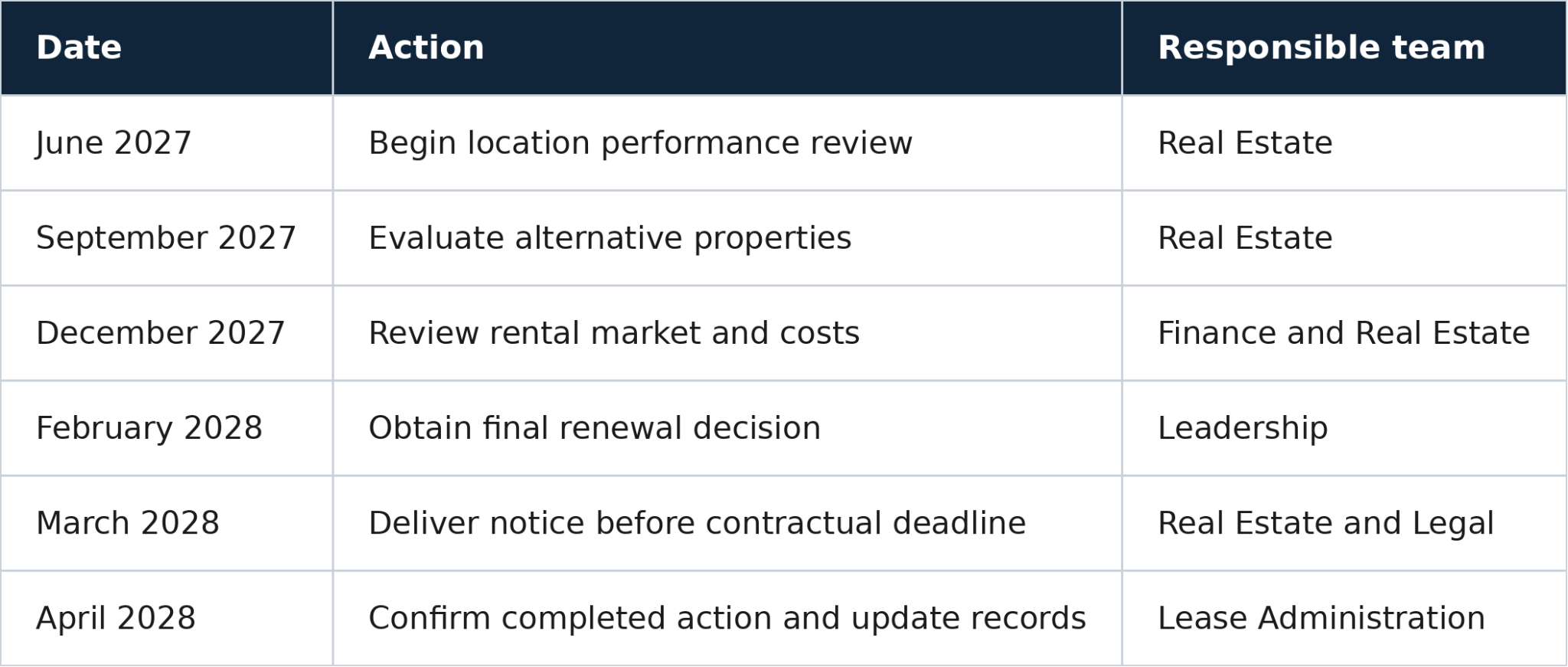
In this example, the contractual renewal notice deadline would be March 31, 2028, assuming the lease uses a nine-calendar-month calculation and contains no additional timing provisions.
The company establishes internal milestones well before that deadline.
This provides time to evaluate alternatives, obtain approval, and prepare the formal notice.
If leadership decides not to renew, the same schedule creates time to plan relocation and avoid disruption.

How to Monitor Critical Lease Dates Across Multiple Locations
Managing critical dates for a single property is relatively straightforward.
The challenge increases when a company operates numerous stores, offices, restaurants, or healthcare locations.
For example, a retailer managing 80 leases may have renewal deadlines, rent escalations, insurance requirements, and operating expense reviews occurring throughout the year.
Each location may also have different notice periods and approval requirements.
A centralized system should make it possible to see upcoming obligations across the entire portfolio.
Teams should be able to filter dates by location, region, deadline type, responsible employee, or urgency.
A portfolio-level view helps identify concentrations of upcoming decisions.
For example, if 20 locations approach expiration within the same year, leadership may need to allocate additional resources to market reviews, negotiations, and relocation planning.
The detailed stages of managing these activities are covered in Occupier's lease management workflow.
For critical date management specifically, the priority is making deadlines visible and ensuring that the correct actions are completed on time.
Common Critical Date Management Mistakes
Even organizations with established lease tracking processes can encounter problems when records are incomplete or responsibilities are unclear.
Tracking Expiration Dates but Not Notice Deadlines
The expiration date is not always the most important date in a lease.
Renewal, termination, and expansion rights may need to be exercised months before expiration.
Tracking only the final date can create a false sense of security.
The system should include the earliest dates when planning must begin and the final dates when action is permitted.
Relying on Outdated Lease Information
A lease amendment may revise important deadlines.
If the tracking system is not updated, reminders may continue to reference superseded terms.
Organizations should establish a process for reviewing executed amendments and updating records promptly.
Using Reminders Without Clear Responsibilities
A calendar notification may alert several employees, but that does not establish who must act.
Each critical date should have an assigned owner and a documented completion process.
For significant obligations, management should also be able to review outstanding actions.
Failing to Verify Notice Requirements
Some agreements contain detailed instructions about the delivery of formal notices.
The lease may specify the recipient, address, required notice period, and permitted delivery methods.
A notice delivered late or through an unauthorized method may fail to exercise the intended right.
Legal review may be appropriate for significant or disputed notices.
Should You Use Spreadsheets or Critical Date Management Software?
Spreadsheets can be effective for organizations with a small number of straightforward lease agreements.
They allow teams to record dates, sort information, and review upcoming deadlines without substantial implementation work.
However, spreadsheets often require manual updates and separate calendar reminders.
When multiple employees manage lease information, duplicate records and outdated versions can become difficult to control.
Purpose-built lease management software may provide centralized records, automated notifications, task assignments, and visibility into completed actions.
For organizations with larger portfolios, these capabilities can reduce reliance on individual employees and disconnected files.
Occupier's lease administration software helps commercial tenants manage lease information, contractual obligations, and critical dates across multiple properties.
The appropriate approach depends on portfolio size, team structure, reporting requirements, and how frequently agreements change.
Measuring the Effectiveness of Critical Date Management
A critical date process should be reviewed regularly to determine whether it is working.
Simply storing dates does not demonstrate that the organization is completing its obligations.
Useful performance measures include the percentage of deadlines with assigned owners, the number of overdue actions, and the proportion of notices completed before contractual deadlines.
Teams may also monitor how far in advance renewal decisions are completed.
For example, if most renewal decisions occur shortly before the final notice deadline, the organization may need earlier planning alerts or a more efficient approval process.
Another useful measure is the number of critical dates affected by amendments that have not yet been reviewed.
These measures help identify operational weaknesses without relying on unsupported assumptions about potential savings.
Regular reporting also gives leadership visibility into upcoming location decisions and their financial implications.
How Critical Dates Affect Lease Accounting
Certain lease events can affect financial reporting.
For example, a change in the assessment of a renewal option may affect the accounting lease term and require remeasurement under ASC 842 when the relevant criteria are met.
New leases, modifications, and terminations may also require accounting updates.
However, not every approaching renewal deadline automatically changes the recognized lease liability.
The accounting treatment depends on the contractual terms and applicable requirements.
Real estate and finance teams should communicate significant decisions promptly so that accounting records reflect the relevant events.
For a broader explanation of how lease changes affect financial statements, see Occupier's ASC 842 guide.
Maintaining accurate critical dates helps finance teams identify information that may require accounting review.
What software tracks critical dates across multiple locations?
Lease administration software tracks every renewal, option and notice date across your locations and sends alerts before each deadline, so nothing depends on a spreadsheet or one person’s calendar.
- Occupier: Built for commercial tenants with 20 leases to a few hundred, such as retail, restaurant, healthcare and franchise brands. Every notice date has a primary and backup owner, and alerts go to the person responsible for each location before the notice period starts.
- Leasecake: Built for multi-unit operators such as restaurant and dental chains. Linked critical dates update together when one changes.
- CoStar Real Estate Manager (including Visual Lease): Built for large organizations that want lease management alongside CoStar market data.
- MRI ProLease: Built for medium to large enterprises with big portfolios that also want space management and maintenance tools.
- Yardi Corom: Built for corporate occupiers and retail tenants, especially teams that already use Yardi or want a broad real estate suite.
- Tango: Built for retail and restaurant brands that want one system from site selection through maintenance.
- Accruent Lucernex: Built for large portfolios that also manage site planning and construction for new locations.
Frequently Asked Questions About Critical Date Management
What are critical dates in a commercial lease?
Critical dates are contractual deadlines requiring attention or action. Common examples include lease commencement, expiration, renewal notices, termination rights, rent escalations, and insurance deadlines.
Why is critical date management important?
It helps tenants protect contractual rights, prepare for major real estate decisions, maintain accurate payment information, and reduce the risk of missed obligations.
How far in advance should lease renewals be tracked?
Renewal planning should begin early enough to assess business needs, market conditions, and alternative properties. The correct lead time depends on the lease and the complexity of the location.
Can a missed renewal deadline be corrected?
Not always. The result depends on the contract, landlord response, and applicable law. Tenants should seek appropriate legal guidance rather than assuming an expired option can still be exercised.
What is the difference between a lease expiration date and a renewal notice deadline?
The expiration date is when the existing lease term ends. The renewal notice deadline is the earlier date by which the tenant must exercise an available renewal right under the agreement.
How can businesses automate lease date tracking?
Businesses can use lease administration software to maintain critical dates, assign responsibilities, generate advance notifications, and monitor outstanding actions.



Lease management that works for real estate and finance

15,000 sq ft
90 days notice
March 2026
Action required