What is a Certificate of Insurance (COI)?

Managing insurance requirements across multiple commercial lease agreements can be complex and time-consuming. For heads of real estate and development officers overseeing growing portfolios, understanding and effectively managing Certificates of Ins
A Certificate of Insurance (COI) is a document that summarizes a business's insurance coverage, including policy types, coverage limits, and effective dates. Commercial landlords commonly request COIs from tenants to confirm that the insurance listed in their lease agreements is in place.
For businesses managing multiple commercial locations, keeping these certificates organized can be challenging. Each lease may have different coverage requirements, additional insured provisions, and renewal deadlines. Missing documentation or allowing coverage to lapse can create compliance issues and increase financial exposure.
Understanding what a COI includes and how to review it helps real estate teams maintain accurate insurance records. This guide explains commercial lease COI requirements, provides a practical checklist, and walks through a sample certificate.
What Is a Certificate of Insurance?
A Certificate of Insurance is a document issued by an insurer or authorized insurance representative that summarizes information about an insurance policy. It allows a landlord, property manager, or other interested party to review relevant coverage details without requesting the entire policy.
For commercial liability insurance, the most commonly used certificate is ACORD 25, a standardized form that summarizes liability policies and related information.
A typical COI identifies the named insured, insurance provider, policy numbers, types of coverage, limits, and policy dates. It also identifies the certificate holder, which is usually the party requesting proof of insurance.
However, a COI is not an insurance policy. It provides information about the coverage listed at the time of issuance but does not independently establish coverage, change policy terms, or guarantee that insurance will remain in force.
The underlying policy and endorsements determine the actual protection available.
Why Are Certificates of Insurance Important in Commercial Leases?
Commercial leases often require tenants to maintain insurance throughout their occupancy. These requirements help allocate financial risk between the landlord and tenant when property damage, injuries, or other covered incidents occur.
For example, a retail tenant may be required to maintain commercial general liability insurance with specified coverage limits. Its landlord may also require additional insured status under the tenant's liability policy.
Before the tenant occupies the property, the landlord may request a COI showing the relevant coverage.
For tenants, maintaining accurate insurance documentation is part of broader commercial lease management. Lease agreements may specify when certificates must be delivered, which parties must be included, and whether updated documents are required at renewal.
A certificate helps demonstrate that the tenant has arranged the indicated insurance, but it should be reviewed alongside the actual lease requirements and any necessary policy endorsements.
What Insurance Coverage Does a Commercial Lease Require?
Commercial lease insurance requirements vary depending on the property, business activities, and negotiated agreement.
A retail store, restaurant, medical office, and industrial warehouse may face different risks and insurance obligations.
Common commercial lease requirements include:
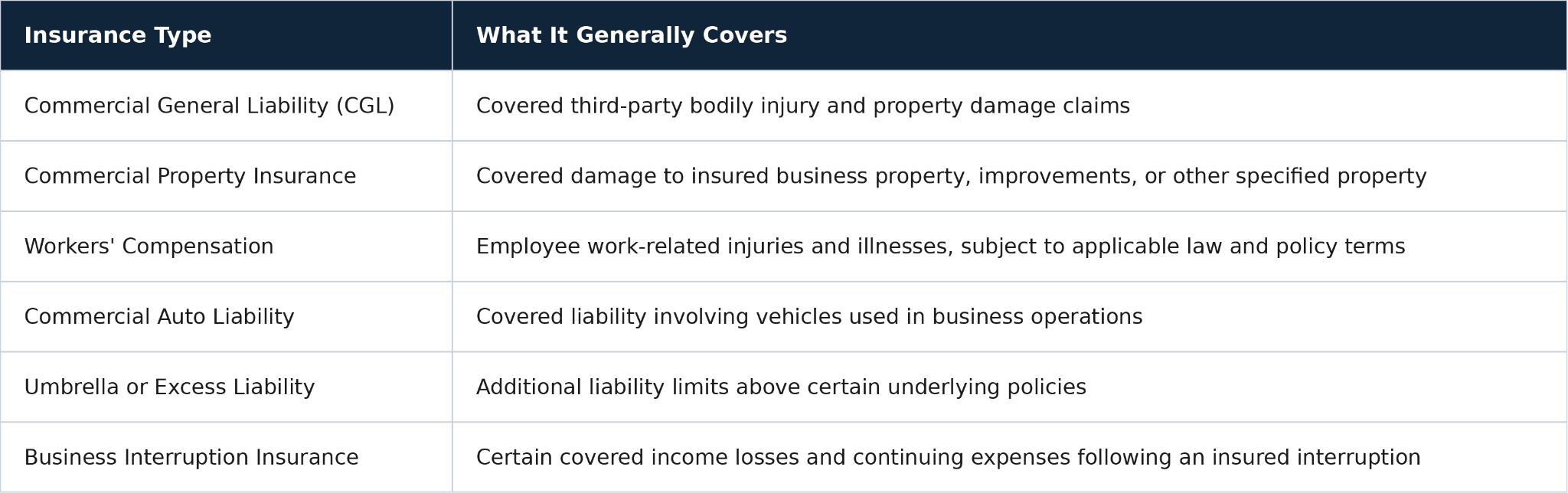
Not every lease requires every type of insurance. Businesses should use the executed agreement as the starting point and confirm appropriate coverage with their insurance advisor.
Also, ACORD 25 primarily summarizes liability insurance. Property insurance requirements may need separate evidence of coverage, depending on the landlord's requirements and the policy involved.
Commercial Lease COI Requirements Checklist
Before submitting or approving a COI, compare the certificate against the insurance provisions in the commercial lease.
The following checklist can help real estate teams identify missing information and potential discrepancies.
- Confirm the named insured. Verify that the business name matches the appropriate tenant entity and that relevant locations or operations are covered as required.
- Verify the insurer and policy information. Check the insurance company, policy numbers, and issuing producer. Contact the insurer or authorized representative when information needs independent confirmation.
- Review required coverage types. Confirm that the tenant maintains the liability, property, workers' compensation, or other insurance required by the lease.
- Compare coverage limits. Review the policy limits against the lease, including each-occurrence and aggregate limits where applicable.
- Check policy effective and expiration dates. Make sure the required coverage is in force for the relevant period and establish when updated evidence will be needed.
- Confirm the certificate holder. Verify that the landlord or other requesting party is correctly identified with the required legal name and address.
- Review additional insured requirements. If the lease requires the landlord or property manager to be an additional insured, confirm that the appropriate policy provisions or endorsements provide that status.
- Check waiver of subrogation provisions. Where required, verify that the applicable policy or endorsement supports the waiver.
- Review other insurance conditions. Confirm requirements such as primary and noncontributory coverage, insurer qualifications, or special policy provisions when specified in the lease.
- Check supporting documents and delivery requirements. Determine whether the landlord requires copies of endorsements, separate evidence of property insurance, or certificates submitted before occupancy and at renewal.
These checks are intended to support contract administration, not replace review by a qualified insurance professional.
Insurance requirements should also be included in the lease abstraction process, so real estate and risk management teams can access the relevant obligations without repeatedly searching the original agreement.
Sample Certificate of Insurance: Step-by-Step Walkthrough
To understand how a commercial lease COI works, consider a hypothetical retail tenant preparing insurance documents for its landlord.
Hawthorne Retail LLC operates a store in a leased shopping center. Its lease requires commercial general liability insurance with limits of $1 million per occurrence and $2 million in general aggregate coverage.
The landlord, Harbor Properties LLC, also requires additional insured status under the applicable liability policy.
The tenant requests a Certificate of Liability Insurance from its insurance broker.
Example COI Details
The following table represents sample information that could appear on an ACORD 25 certificate. It is illustrative, not an issued insurance certificate.
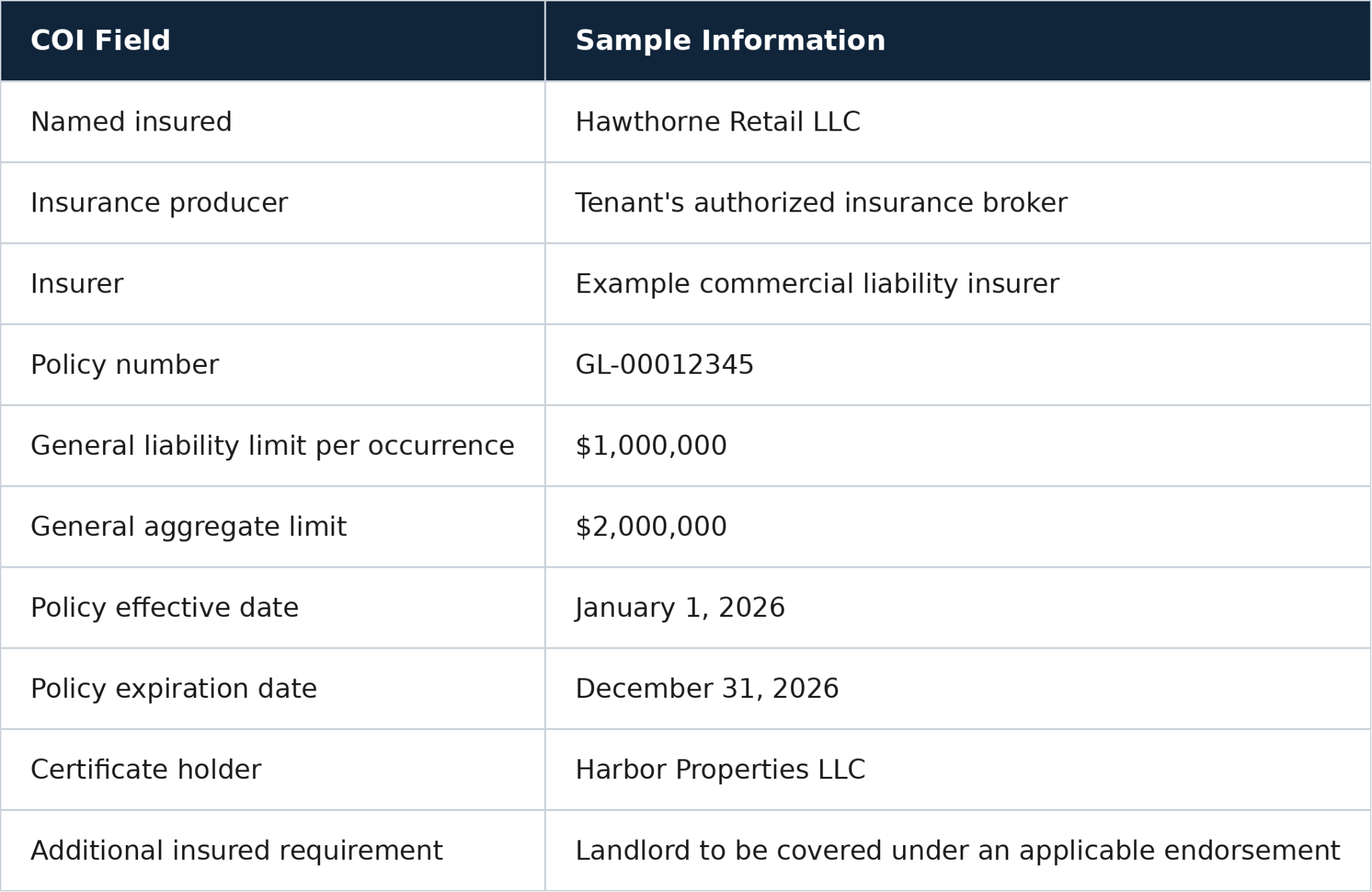
Let's examine how the tenant and landlord should review this information.
Step 1: Check the Named Insured and Insurance Provider
The first section identifies the insurance producer, insurance companies, and named insured.
Hawthorne Retail LLC should appear as the appropriate insured entity. If the lease was executed by a different legal entity, the parties may need clarification about whether the policy covers the actual tenant.
The insurance provider and policy number should also be identifiable so the coverage information can be verified when necessary.
Step 2: Review the Coverage Limits
The sample COI shows commercial general liability coverage of $1 million per occurrence and a $2 million general aggregate limit.
These figures match the hypothetical lease requirements.
However, the distinction between the limits matters. The occurrence limit generally applies to a covered occurrence, while the aggregate limit restricts the insurer's total payments for claims within the applicable aggregate.
If the lease requires higher limits or additional coverage, the certificate may not satisfy the insurance documentation requirements.
Step 3: Verify Policy Dates
The sample policy runs from January 1 through December 31, 2026.
If the tenant is occupying the premises during this period, the listed dates indicate that the policy was scheduled to be effective for that time.
However, policy dates alone do not confirm that coverage has not subsequently been canceled or changed.
The tenant should obtain updated documentation before expiration and confirm continuity of coverage.
Step 4: Confirm the Certificate Holder and Additional Insured
Harbor Properties LLC appears as the certificate holder because it requested proof of insurance.
However, being a certificate holder is not the same as being an additional insured.
Additional insured status must be supported by the applicable policy provisions or endorsements. Listing the landlord in the certificate holder section does not independently create those rights.
Because the sample lease requires additional insured coverage, the landlord should request and review the appropriate endorsement or other supporting policy evidence.
Step 5: Review Additional Conditions
The lease may also require a waiver of subrogation, primary and noncontributory insurance, or particular cancellation notice arrangements.
The insurance broker should confirm whether the policy satisfies those requirements.
A standard COI does not independently guarantee advance cancellation notice. Any rights to notice depend on the applicable policy, endorsements, and law.
The key takeaway: A COI should be checked against the actual lease requirements, not accepted simply because it contains the tenant's name and insurance limits.
Certificate Holder vs. Additional Insured: What's the Difference?
These terms are frequently confused when reviewing commercial lease insurance.
A certificate holder is the person or organization that receives the certificate as evidence of insurance. This status alone does not provide coverage under the insured's policy.
An additional insured is a party that receives coverage under the policy to the extent provided by the applicable policy language or endorsement.
For example, a landlord may request additional insured status under a retail tenant's commercial general liability policy for certain claims connected to the tenant's operations.
Whether that coverage applies depends on the policy language, endorsements, and circumstances of the claim.
This distinction is important because a COI cannot grant additional insured rights merely by including a name or statement.
Common COI Mistakes Commercial Tenants Should Avoid
One common mistake is assuming that submitting a certificate automatically satisfies every insurance obligation in the lease.
A COI may show liability coverage while the agreement also requires property insurance or additional insured endorsements.
Another issue is overlooking policy renewals. Tenants often manage multiple insurance policies with different expiration dates, and an outdated certificate may remain in a shared folder after the underlying policy period ends.
Incorrect business names, insufficient limits, and missing documentation can also delay landlord approval.
For multi-location businesses, the challenge becomes greater when different landlords impose different requirements.
A consistent review process helps identify these issues before they create disputes or interruptions. Insurance renewal dates and documentation deadlines should be managed alongside other critical lease dates.
How to Manage COIs Across Multiple Commercial Locations
Managing insurance documents for one property may be straightforward. Managing them for dozens or hundreds of locations requires a more consistent process.
Real estate teams need a reliable way to store certificates, link them to the appropriate lease, record policy expiration dates, and identify missing documents.
Centralized records also make it easier for finance, legal, facilities, and risk management teams to find the relevant information when questions arise.
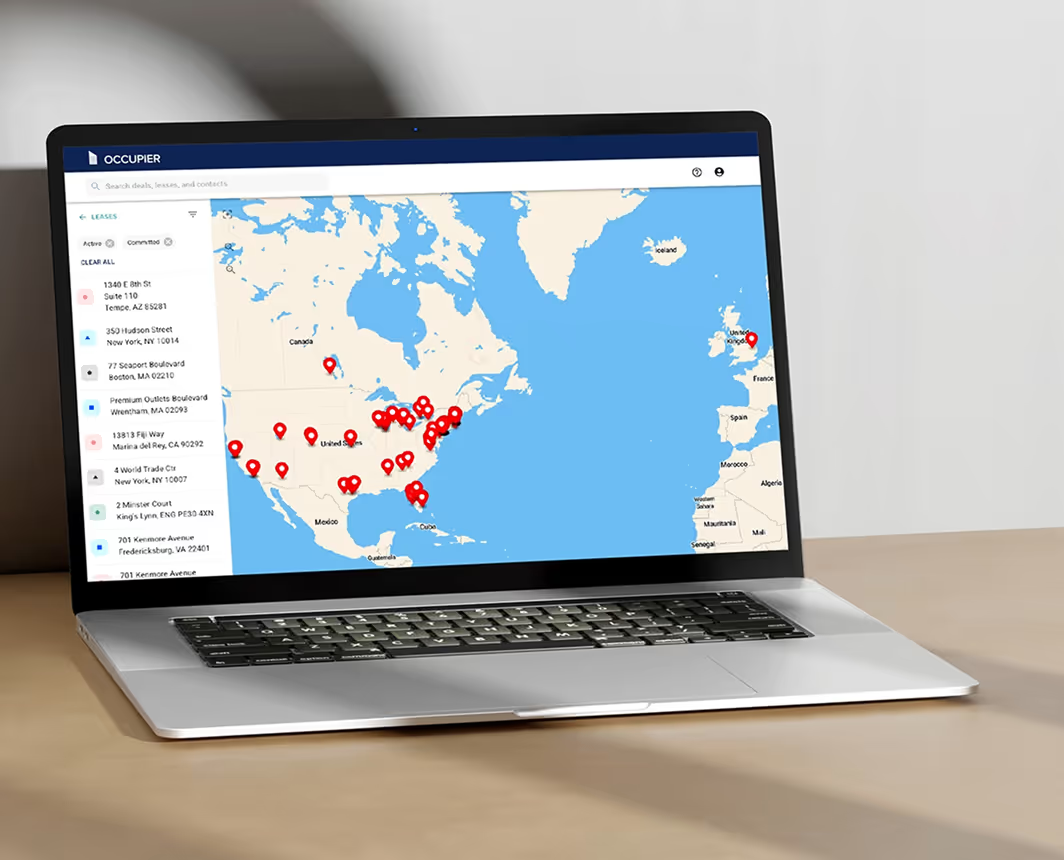
Occupier's lease administration software helps commercial tenants organize lease documents, contractual obligations, and critical dates in one place.
For specialized insurance verification, Occupier has also announced a partnership with Billy, a platform focused on insurance compliance workflows, including COI collection and verification.
The most important part of the process is keeping insurance requirements connected to the underlying lease while assigning clear responsibility for reviewing and renewing documentation.
Frequently Asked Questions About Certificates of Insurance
What Does COI Stand for in Commercial Real Estate?
COI stands for Certificate of Insurance. It is a document used to summarize insurance coverage and provide relevant policy information to landlords, property managers, and other requesting parties.
Is a Certificate of Insurance Required for a Commercial Lease?
Many commercial leases require tenants to provide a COI before occupying the premises and periodically afterward. The specific requirements depend on the lease agreement, insurer documentation, and applicable law.
What Is an ACORD 25 Certificate?
ACORD 25 is a standardized Certificate of Liability Insurance form commonly used to summarize commercial liability coverage, including insurers, policy numbers, coverage limits, and effective dates.
Does a COI Prove That a Landlord Is an Additional Insured?
No. The certificate alone does not establish additional insured rights. The applicable insurance policy or endorsement must provide that coverage.
How Often Should a Commercial Tenant Update a COI?
Tenants typically obtain updated certificates when relevant policies renew or change and whenever their lease or landlord requires new documentation. The certificate should reflect current policy information, and any required endorsements should be maintained.
Can a Landlord Reject a Certificate of Insurance?
A landlord may request corrected or additional documentation when the certificate does not satisfy the insurance requirements of the lease. Disagreements about those requirements should be resolved by reviewing the contract and applicable insurance documents.


Lease management that works for real estate and finance
15,000 sq ft
90 days notice
March 2026
Action required