Kick-Out Clauses in Commercial Leases, Explained
What is a kick-out clause in a commercial lease?
A kick-out clause is a provision allowing a tenant, landlord, or both parties to terminate a lease early when specified conditions are met. In retail leases, the most common condition is sales falling below an agreed threshold.
A kick-out clause is a provision in a commercial lease that allows a tenant, landlord, or both parties to terminate the agreement early when specific conditions are met. In retail leasing, the most common trigger is a store failing to achieve an agreed sales threshold during a defined period.
For commercial tenants, a kick-out clause can provide an important financial safeguard. A retailer may sign a ten-year lease expecting strong sales, only to discover that the location consistently underperforms. Without an early termination right, the business could remain responsible for rent and operating expenses long after the store becomes unprofitable.
However, a kick-out right is not automatic. Sales calculations, measurement periods, notice deadlines, and termination costs all determine whether a tenant can actually exercise the option. Understanding these requirements helps businesses negotiate more practical lease terms and avoid losing valuable rights.
What Is a Kick-Out Clause in a Commercial Lease?
A kick-out clause is a contractual provision that permits early lease termination when an agreed condition occurs. It is commonly used in retail leases where store performance determines whether continuing at a location makes financial sense.
The condition is often tied to gross sales, but the parties can negotiate other triggers, including space requirements or circumstances affecting the property's operations.
For example, a retailer signs a seven-year lease with a kick-out option after the third year. The agreement states that the tenant may terminate if annual gross sales fall below $800,000.
If qualifying sales do not reach that amount, the retailer may exercise the option by following the lease's notice and termination requirements.
The important distinction is that a kick-out clause creates a conditional right, not an unrestricted ability to leave whenever a business wants.
A store might be unprofitable because of high operating expenses but still exceed the sales threshold. In that situation, the tenant may not qualify for termination under a sales-based clause.
How Does a Kick-Out Clause Work?
Most kick-out provisions establish a measurable condition, a testing period, and a deadline for exercising the termination right.
The wording determines when the option becomes available and what steps the tenant must complete.
Sales Thresholds and Measurement Periods
Retail kick-out clauses commonly measure gross sales over one or more specified lease years.
A threshold may be expressed as a fixed annual amount, average sales over several years, or sales per square foot.
For example, a tenant occupying 2,500 square feet may have a minimum annual sales requirement of $400 per square foot.
The corresponding threshold would be $1 million in qualifying annual sales.
The lease also specifies when sales are measured. Some agreements test performance during the third lease year, while others use the average of years two and three.
These approaches can produce different outcomes.
Consider a retailer generating $850,000 in year two and $1.1 million in year three. The store fails a $1 million threshold in year two but exceeds it in year three. Whether the tenant qualifies depends on the exact measurement period and calculation method.
Notice Windows and Termination Conditions
Meeting the sales threshold condition does not necessarily end the lease.
The tenant generally must deliver written termination notice within a specified window.
For example, a lease might allow 60 days after the measurement period to exercise the option, with termination becoming effective 120 days after valid notice.
Missing the notice window may eliminate the right for that testing period.
The agreement may also require the tenant to remain current on rent, provide sales reports, reimburse certain expenses, or surrender the premises in a specified condition.
These requirements should be evaluated alongside the performance test because they determine whether the termination option is practically usable.
Kick-Out Clause Example: A Retail Store
Consider a retailer operating a 3,000-square-foot store in a shopping center.
The business signs a seven-year lease that includes a sales-based kick-out right after the third year.
The agreement establishes the following conditions:
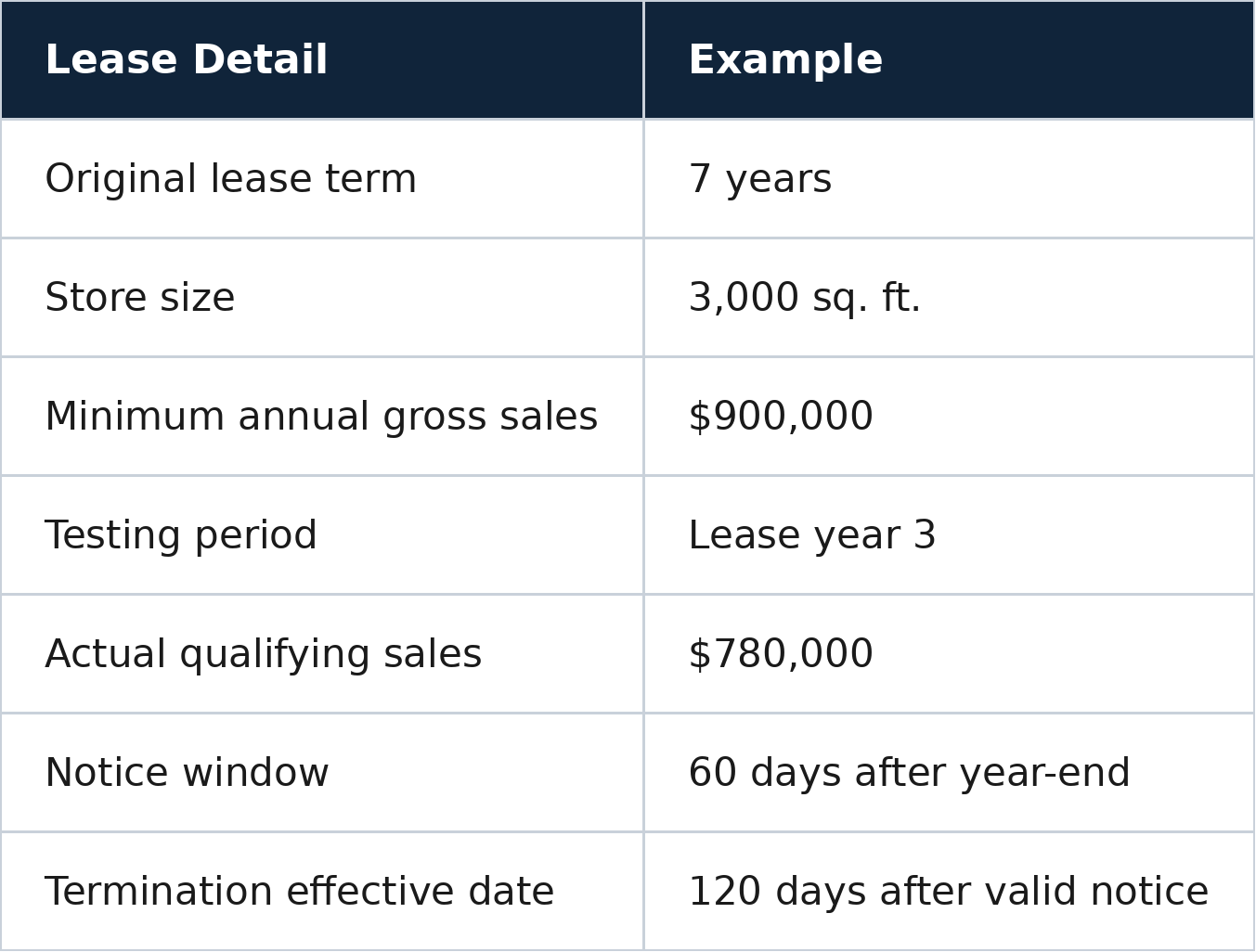
The store generates $780,000 in qualifying sales, falling $120,000 below the threshold.
Because the condition has been satisfied, the retailer becomes eligible to exercise its kick-out right.
However, the tenant must still deliver valid notice within the required 60-day period and satisfy any other contractual obligations.
If the retailer misses that deadline, it may lose the opportunity to terminate, even though the store failed the sales test.
The example illustrates why a kick-out provision cannot be evaluated solely by its sales threshold. The measurement period, notice requirements, and financial consequences are equally important.
Can Both Landlords and Tenants Exercise a Kick-Out Clause?
Yes. A kick-out clause may grant termination rights to the tenant, landlord, or both parties, depending on the lease.
Tenant kick-out rights are particularly valuable when a retailer wants protection against an underperforming location.
If a store fails to achieve agreed sales targets, the tenant may be able to exit instead of continuing to pay rent for several additional years.
Landlord kick-out rights serve a different purpose.
A shopping center owner may want the ability to replace an underperforming tenant with another business that could generate stronger sales or customer traffic.
This can be especially relevant when the landlord receives percentage rent, which ties part of the rental income to the tenant's sales.
However, landlord termination rights create uncertainty for tenants that have invested heavily in their premises.
A tenant negotiating such a provision should consider how long the location is protected from termination, how much notice the landlord must provide, and whether the landlord will compensate the tenant for unamortized improvements.
Mutual kick-out rights may appear balanced, but the practical benefits depend on the conditions and costs assigned to each party.
Kick-Out Clause vs. Early Termination Clause
A kick-out clause is a form of early termination right, but not every early termination provision is a kick-out clause.
The main difference is usually what triggers the right.
A kick-out provision commonly depends on measurable performance, such as gross sales falling below an agreed threshold.
A general early termination option may allow a tenant to leave after a specified date by paying a negotiated termination fee, without demonstrating poor sales.
For example, a business might have the right to terminate after five years by paying six months of rent.
That differs from a retailer that can terminate only when annual sales fall below $750,000.
Both provisions can create flexibility, but they carry different eligibility requirements and financial consequences.
Businesses without an applicable kick-out option may still consider other commercial lease termination options, including negotiated buyouts, assignments, and subleasing.
Kick-Out Clauses and Co-Tenancy Rights
Kick-out clauses are sometimes associated with co-tenancy provisions, particularly in shopping centers and retail developments.
A co-tenancy clause generally establishes conditions involving neighboring businesses, anchor tenants, or overall property occupancy.
For example, a retailer may negotiate a right to reduced rent if a major anchor tenant closes and remains vacant for a specified period.
If the condition continues, the lease may also allow early termination.
However, a co-tenancy clause and a sales-based kick-out test different circumstances.
The sales-based provision focuses on the tenant's own revenue. A co-tenancy provision focuses on conditions involving other occupants or the property.
Occupier's guide to co-tenancy clauses explains how anchor occupancy and other retail conditions can affect tenants' contractual rights.
Some leases contain both provisions, with separate measurement periods and notice deadlines.
Tenants should evaluate them individually rather than assume that qualifying under one automatically satisfies the other.
What Should Tenants Negotiate in a Kick-Out Clause?
A kick-out provision is most valuable when its conditions are clear, measurable, and practical to satisfy.
The sales threshold should reflect realistic expectations for the location, while the testing period should allow enough time to evaluate performance.
Beyond those basic terms, three issues deserve particular attention.
Sales Definitions and Reporting
The lease should clearly explain which transactions count toward gross sales.
A retailer may generate revenue through in-store purchases, online orders fulfilled at the location, promotional sales, and other channels.
The agreement may exclude returns, sales taxes, employee discounts, or specific transaction categories.
These definitions can materially affect whether the store meets its threshold.
For example, a retailer reporting $950,000 in total revenue might have only $870,000 in qualifying gross sales after applying contractual exclusions.
If the threshold is $900,000, the distinction determines whether the kick-out right becomes available.
Tenants should also review reporting requirements, audit rights, and whether the landlord can challenge the sales calculation.
Termination Costs and Landlord Cure Rights
Some kick-out provisions require tenants to reimburse unamortized tenant improvement allowances, brokerage commissions, or other agreed expenses.
For example, a retailer may qualify for early termination but owe $75,000 in remaining improvement reimbursements.
The business should compare that cost against the rent and operating expenses it would otherwise incur.
Certain leases also allow landlords to respond to a termination notice by offering rent concessions or other adjustments.
Whether those concessions can prevent termination depends on the negotiated language.
Tenants should establish whether accepting an alternative arrangement is optional and how any agreement affects future kick-out rights.
Deadlines That Can Eliminate the Right
Kick-out provisions often include several dates that serve different purposes.
The sales measurement period determines eligibility. The reporting deadline determines when financial results must be submitted. The termination notice window establishes when the option can be exercised.
The effective termination date determines when the lease ends.
A tenant may satisfy every financial condition but still lose the option by missing a notice deadline.
Negotiating a reasonable window and tracking these dates accurately is essential to preserving the right.
How Do Kick-Out Clauses Affect Lease Accounting?
Kick-out provisions may affect lease accounting under ASC 842 because termination options can influence the accounting lease term.
When determining the lease term, companies must evaluate relevant options and whether they are reasonably certain to exercise or not exercise them, as required by the standard.
However, the existence of a kick-out clause does not automatically mean the tenant can exclude all payments after the earliest potential termination date from its lease liability.
For example, a tenant with a ten-year lease and a conditional kick-out after year three must evaluate the contractual conditions and relevant economic factors.
If the business later exercises the option, the resulting termination may require adjustments to its right-of-use asset, lease liability, and related accounting entries.
The treatment depends on the timing and circumstances of the termination.
Occupier's guidance on lease termination accounting explains how full and partial terminations can affect existing lease accounting schedules.
Real estate and finance teams should communicate when a kick-out option becomes available, when a termination decision is made, and when the lease will actually end.
Managing Kick-Out Rights Across Retail Locations
For retailers managing multiple locations, kick-out clauses can influence decisions about store closures, relocations, and portfolio performance.
Two stores may generate similar losses but have very different exit options.
One location might have a kick-out right available after its third year, while another remains committed for several more years.
These differences are not necessarily visible in rent schedules or standard financial reports.
Real estate teams need to understand the applicable sales thresholds, testing periods, notice requirements, and termination costs.
Finance teams provide the sales data and evaluate whether exercising the right makes economic sense.
Legal teams confirm that the contractual requirements have been satisfied.
Structured lease abstraction helps organize termination rights and important dates so teams can evaluate their options without repeatedly searching entire agreements.
For a business managing 100 retail locations, this information can make the difference between identifying an available exit option and discovering it after the notice deadline has passed.
Occupier's lease administration software centralizes lease documents, critical dates, and contractual obligations, helping real estate teams track termination rights across the portfolio.
The goal is not simply to close underperforming locations. It is to understand which options exist, evaluate their financial consequences, and exercise them correctly when they support the business's strategy.
Kick-Out Clause FAQs
What is a kick-out clause in a commercial lease?
A kick-out clause is a provision allowing a tenant, landlord, or both parties to terminate a lease early when specified conditions are met. In retail leases, the most common condition is sales falling below an agreed threshold.
Can a landlord use a kick-out clause to terminate a lease?
Yes, if the agreement expressly gives the landlord that right. Landlord kick-out provisions may be tied to minimum sales requirements or other negotiated conditions. The landlord must follow the applicable contractual procedures.
Is a kick-out clause the same as an early termination clause?
A kick-out clause is a type of early termination provision, but it usually depends on a defined trigger. Other early termination rights may be available after a particular date without requiring a performance failure.
What happens if a tenant misses the kick-out deadline?
The tenant may lose the termination option for that testing period. Whether another opportunity becomes available depends on the lease. Tenants should not assume that missing the deadline can be corrected later.
Does exercising a kick-out clause require a termination fee?
Not always. Some agreements allow termination without an additional fee, while others require reimbursement of unamortized improvement allowances, brokerage commissions, or other negotiated expenses.
Can a landlord prevent a tenant from exercising a kick-out clause?
Only if the lease provides an applicable contractual mechanism or the tenant has not met the termination requirements. Some agreements allow landlords to offer concessions or exercise specific cure rights.
Does percentage rent affect a kick-out clause?
It can. Both provisions may use store sales information, but their calculations and thresholds are not necessarily identical. Tenants should review the definitions and measurement periods for each provision separately.
Does exercising a kick-out clause count as a lease default?
Generally, no. Properly exercising a contractual termination option is different from breaching the lease. However, the tenant must still meet all applicable notice, payment, and surrender requirements.



Lease management that works for real estate and finance

15,000 sq ft
90 days notice
March 2026
Action required