Asset Capitalization in Lease Accounting

What is asset capitalization in lease accounting?
Asset capitalization means recognizing a lease-related asset on the balance sheet. Under ASC 842, lessees generally record an ROU asset representing their right to use leased property and a liability for qualifying future lease payments.
Asset capitalization is the process of recording a cost as an asset on the balance sheet rather than recognizing the entire amount as an immediate expense. In lease accounting, this involves recognizing a right-of-use (ROU) asset that represents a company's right to use leased property or equipment.
Under ASC 842, most operating and finance leases require businesses to recognize both an ROU asset and a corresponding lease liability. This means commercial tenants must account for their financial commitments even when they do not own the buildings or equipment they use.
For companies managing multiple locations, capitalization affects more than the initial balance sheet. Discount rates, prepaid rent, landlord incentives, and lease modifications can change accounting calculations throughout the lease term.
Understanding how asset capitalization works helps real estate and finance teams measure lease obligations accurately, recognize expenses, and maintain reliable financial records.
What Is Asset Capitalization in Accounting?
Asset capitalization means recognizing an expenditure as an asset because it provides economic benefits over more than one accounting period.
Instead of recording the entire cost as an immediate expense, a company recognizes the asset and allocates its cost over the appropriate period.
For example, a business purchases equipment for $50,000 and expects to use it for five years. Assuming no residual value and straight-line depreciation, the company records the equipment as an asset and recognizes $10,000 in annual depreciation expense.
This differs from ordinary operating expenses, such as cleaning services, routine repairs, and office supplies, which are generally expensed as incurred.
In lease accounting, capitalization works differently because the company may not own the underlying property.
Instead, the capitalized asset represents the contractual right to use a building, vehicle, or piece of equipment for a specified period.
The obligation to make future lease payments is recorded separately as a liability.
Recognizing a leased asset therefore does not mean the business has acquired ownership of the underlying property.
How Does Asset Capitalization Work Under ASC 842?
ASC 842 requires lessees to recognize ROU assets and lease liabilities for most operating and finance leases.
Under the previous ASC 840 standard, operating leases generally remained off the balance sheet, although certain related assets and liabilities could still be recognized.
ASC 842 changed this treatment by requiring most operating leases to appear on the balance sheet alongside finance leases.
For example, a retailer signing a seven-year storefront lease generally recognizes an asset representing its right to use the location and a liability reflecting the present value of qualifying future lease payments.
The asset and liability are initially recognized at lease commencement, when the underlying property becomes available for the tenant's use.
This may occur before regular rent payments begin.
A landlord might provide two months of free rent while the retailer prepares its store. If the property is available for use, the accounting lease may have commenced even though no cash rent is due.
ASC 842 provides an optional short-term lease recognition exemption for qualifying leases. When properly elected and applicable, this allows companies to avoid recognizing the associated ROU asset and lease liability.
For leases requiring recognition, determining the correct initial measurement is essential.
What Is a Right-of-Use Asset?
A right-of-use asset represents the economic benefit a tenant receives from controlling the use of an identified asset during the lease term.
The ROU asset differs from an asset purchased outright.
For example, a healthcare organization leasing a medical office does not normally recognize the building as an owned fixed asset. Instead, it recognizes an ROU asset representing its right to occupy and use the premises.
The initial measurement generally begins with the lease liability and includes adjustments for prepaid payments, qualifying initial direct costs, and landlord incentives.
These adjustments explain why the ROU asset and lease liability may have different starting balances.
For example, a tenant making a qualifying $10,000 lease payment before commencement may recognize that payment within its initial ROU asset without including it in the future unpaid payments used to calculate the initial lease liability.
Accurately calculating a right-of-use asset is therefore essential when determining the amount that should be capitalized.
After initial recognition, the accounting depends on whether the lease is classified as operating or finance.
Capitalized Assets: Operating Leases vs. Finance Leases
Both operating and finance leases generally require recognition of an ROU asset and lease liability under ASC 842.
However, the classifications produce different expense recognition patterns.
Operating Lease Capitalization
For an operating lease, the company generally recognizes a single lease cost over the lease term, typically on a straight-line basis.
For example, a retailer may lease a storefront for five years with scheduled annual rent increases.
Although cash payments change, the company generally recognizes an even operating lease cost throughout the accounting lease term.
The lease liability increases through interest accretion and decreases as payments are made. The ROU asset is reduced in a manner that produces the required single lease cost.
Operating leases therefore do not normally recognize separate ROU asset amortization and interest expenses on the income statement.
Finance Lease Capitalization
Finance leases also require ROU asset and liability recognition.
However, the company separately recognizes interest expense and ROU asset amortization.
Interest expense is calculated using the outstanding liability, while the asset is amortized systematically over the applicable period.
Because interest expense generally decreases as the liability is repaid, finance leases often produce higher total expenses during earlier periods.
The appropriate classification depends on the ASC 842 criteria, including ownership transfer, purchase options, lease term, present value, and specialized use.
How Do You Calculate Asset Capitalization Under ASC 842?
Calculating a capitalized lease asset begins with determining the initial lease liability.
The liability generally equals the present value of qualifying lease payments remaining unpaid at commencement.
The ROU asset then incorporates applicable adjustments.
Initial ROU Asset = Initial Lease Liability + Prepaid Lease Payments + Initial Direct Costs − Lease Incentives Received
Consider a company signing a four-year office lease.
The agreement requires annual payments of $24,000 at the end of each year, with an annual discount rate of 6%.
Step 1: Calculate the Lease Liability
The company calculates the present value of its four future annual payments.
Lease Liability = $24,000 ÷ 1.06 + $24,000 ÷ 1.06² + $24,000 ÷ 1.06³ + $24,000 ÷ 1.06⁴
Initial Lease Liability = $83,162.53
Although total undiscounted payments equal $96,000, the present value is lower because the calculation reflects the time value of money.
Step 2: Calculate the Initial ROU Asset
Assume the company also has qualifying costs and payments recorded at commencement.
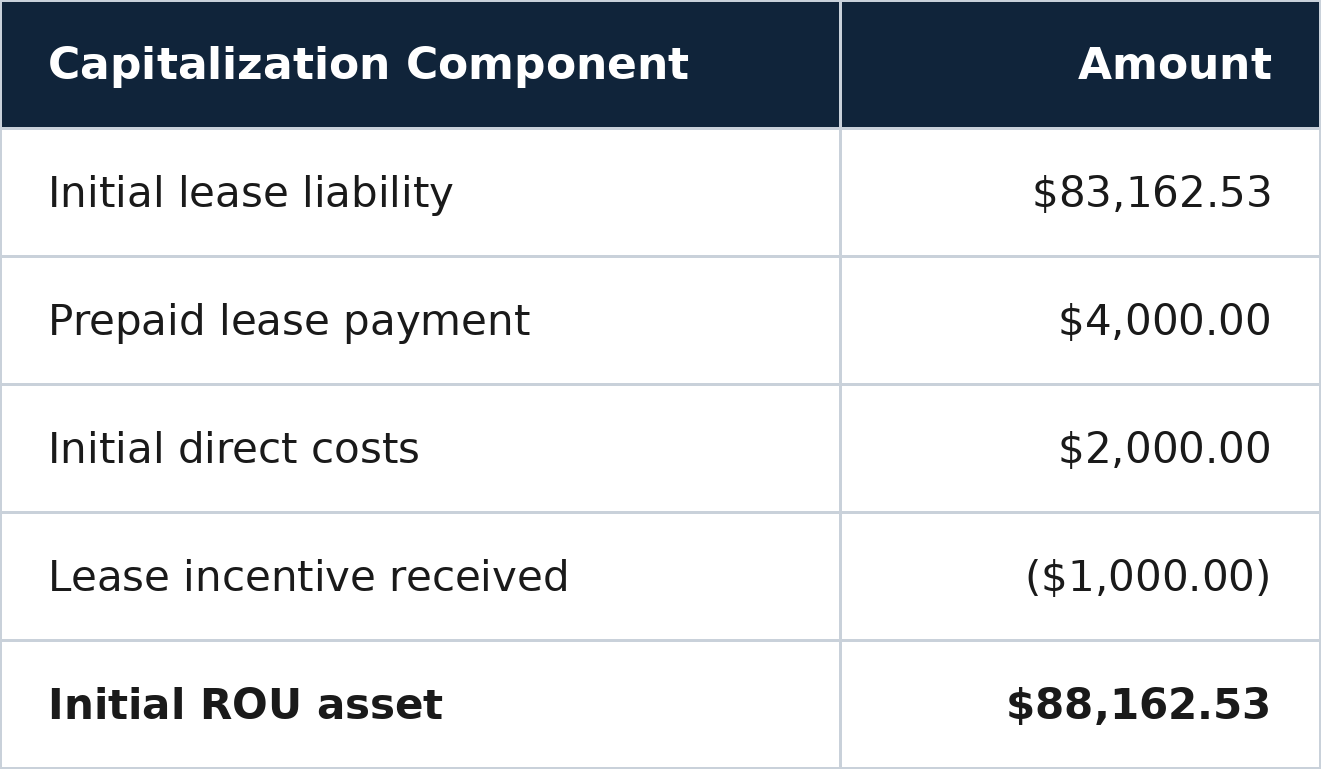
$83,162.53 + $4,000 + $2,000 − $1,000 = $88,162.53
The company recognizes an ROU asset of $88,162.53 and a lease liability of $83,162.53.
The difference represents the net effect of prepaid payments, initial direct costs, and incentives.
This simplified example assumes the $4,000 prepayment is additional to the four future annual payments, and that the $1,000 incentive was received at or before commencement.
What Is the Journal Entry for Asset Capitalization?
At commencement, the company records the initial ROU asset and lease liability.
Assume the prepaid rent, initial direct costs, and landlord incentive were previously recorded in temporary accounts.
The entry would be:
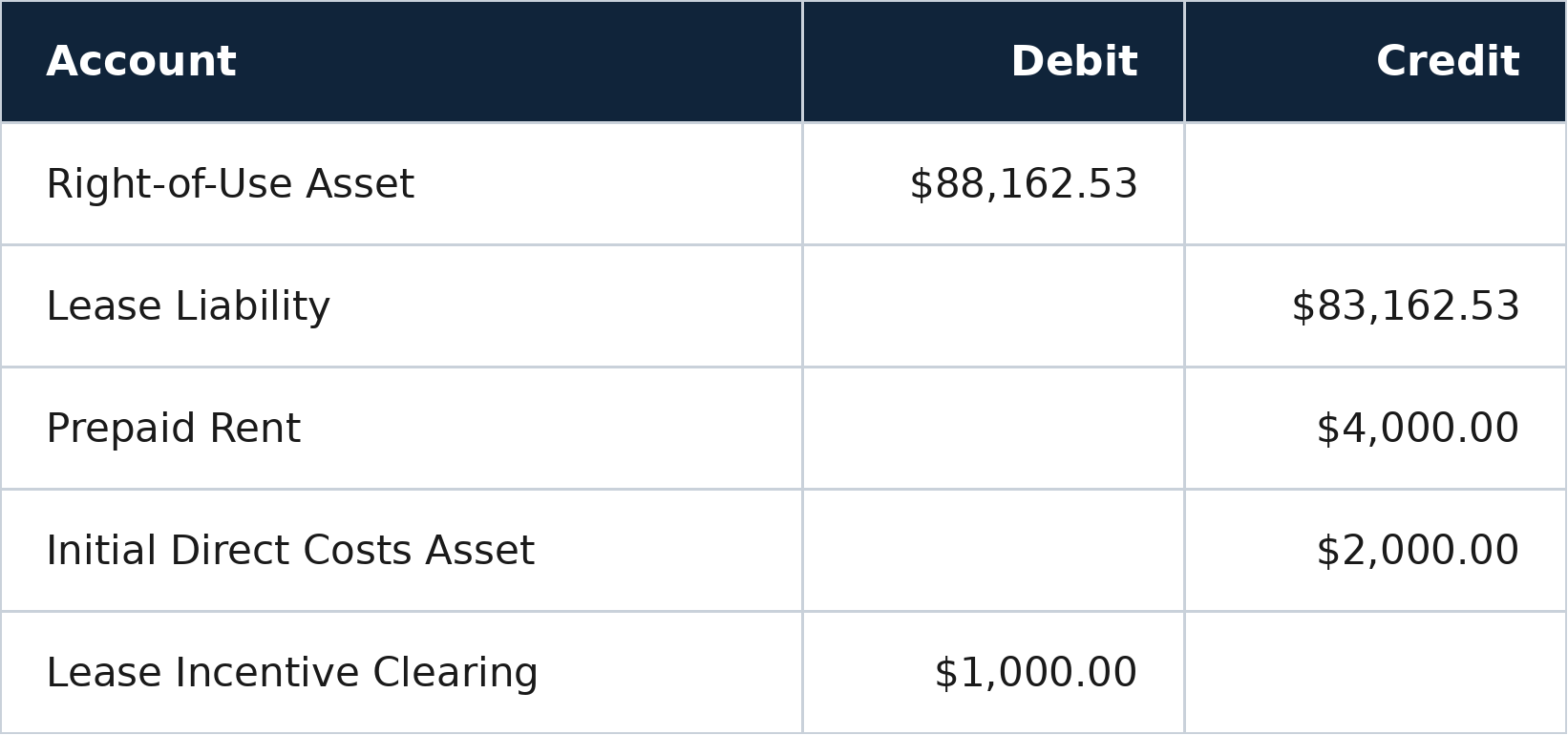
This entry recognizes the capitalized asset and future payment obligation while clearing the previously recorded balances.
The specific general ledger accounts may differ depending on the company's accounting policies.
After commencement, recurring entries reflect lease payments, interest accretion, and changes in the ROU asset.
Occupier's guide to lease accounting journal entries provides examples of how these amounts are recorded throughout the lease term.
The initial capitalization entry is therefore the beginning of the accounting process rather than a one-time adjustment.
How Are Capitalized Lease Assets Amortized?
Once an ROU asset is recognized, the company must account for its carrying value throughout the lease term.
For operating leases, the ROU asset reduction works alongside interest accretion on the liability to produce the single operating lease cost.
For finance leases, the ROU asset is generally amortized separately from interest expense.
Consider a finance lease with an initial ROU asset of $60,000.
Assume the lease term is five years, ownership does not transfer, and the company is not reasonably certain to exercise a purchase option.
If straight-line amortization over five years is appropriate:
Annual ROU Asset Amortization = $60,000 ÷ 5 = $12,000
Interest expense is calculated separately using the outstanding lease liability.
The amortization period may differ if ownership transfers or the tenant is reasonably certain to exercise a purchase option.
In those situations, amortization over the underlying asset's useful life may be appropriate.
Finance teams should therefore evaluate the contractual terms rather than automatically use the lease expiration date.
Asset Capitalization vs. Leasehold Improvements
ROU assets and leasehold improvements both relate to leased property, but they represent different assets.
An ROU asset reflects the tenant's right to use the premises.
Leasehold improvements represent qualifying modifications made to the property.
For example, a retailer leasing an unfinished storefront may spend $150,000 constructing fitting rooms, installing lighting, and completing permanent interior improvements.
If these improvements qualify as tenant-owned assets, the company generally capitalizes them separately from the ROU asset.
The improvements are then depreciated or amortized over the applicable period.
In many cases, the amortization period is the shorter of the improvement's useful life or the remaining lease term, subject to relevant exceptions.
Routine maintenance and ordinary repairs generally do not qualify for capitalization.
The treatment of leasehold improvements under ASC 842 also depends on ownership, useful life, and whether the landlord or tenant controls the improvements.
These distinctions become particularly important when landlords contribute funds toward construction costs.
How Do Landlord Incentives Affect Capitalization?
Landlords frequently offer financial incentives to attract commercial tenants.
These may include cash payments, tenant improvement reimbursements, or other concessions.
Under ASC 842, qualifying incentives received at or before commencement generally reduce the initial ROU asset.
For example, a landlord may provide $50,000 toward improvements that are considered the tenant's assets.
If the payment qualifies as a lease incentive, it affects the lease accounting measurements.
However, the treatment depends on ownership, the reimbursement arrangement, and payment timing.
A landlord-funded improvement that remains the landlord's asset may require different accounting from a reimbursement for tenant-owned construction.
Occupier's explanation of tenant improvement allowance accounting addresses how these ownership and reimbursement arrangements affect lease accounting.
Free rent is another common concession, but it generally reduces the contractual payment schedule instead of being recorded as a separate cash incentive.
Recognizing the same concession twice could overstate the benefit and misstate the ROU asset.
What Happens to Capitalized Assets When a Lease Changes?
Lease capitalization does not end when the original balances are recorded.
Changes to lease terms may affect the ROU asset, liability, and future expense recognition.
For example, a business may extend an office lease, reduce its leased space, or negotiate different rental payments.
Depending on the circumstances, these changes may require the company to remeasure its lease liability and adjust the ROU asset.
Consider a retailer that extends an existing five-year lease for another three years.
If the extension is a lease modification or qualifying reassessment, the company may need to update its accounting schedules.
The discount rate and classification requirements depend on the nature of the change.
Reducing leased space may also require accounting for a partial termination, including reductions to the ROU asset and lease liability.
Not every amendment receives the same accounting treatment. Some modifications qualify as separate contracts, while others adjust the existing lease.
Understanding how lease modifications affect ASC 842 measurements helps finance teams determine when existing capitalization schedules must change.
Common Mistakes in Lease Asset Capitalization
Several common accounting errors can cause capitalized lease balances to be misstated.
Incorrect discount rates: Using an inappropriate rate affects the present value of payments and can misstate both the liability and ROU asset.
Including the wrong payments: Variable payments based on future sales are generally excluded from the initial liability unless specific inclusion criteria apply.
Double-counting prepaid rent: Recording the same amount as a separate asset after incorporating it into the ROU asset can overstate assets.
Capitalizing routine expenses: Ordinary maintenance and repairs generally should not be recorded as capital improvements.
Missing lease changes: Unrecorded amendments, extensions, or partial terminations can leave accounting schedules based on outdated contractual terms.
These errors become more difficult to identify when companies maintain numerous leases across different locations.
Regular reconciliation between signed agreements, payment records, and accounting schedules helps maintain accurate measurements.
How Does Asset Capitalization Affect Financial Reporting?
Asset capitalization affects the balance sheet, income statement, and financial ratios.
Recognizing ROU assets increases reported assets, while lease liabilities reflect contractual payment obligations.
This provides greater visibility into long-term lease commitments.
The impact on reported expenses depends on classification.
Operating leases generally recognize a single lease cost, while finance leases separately recognize interest and amortization.
These differences may affect profitability measures, leverage ratios, and other financial metrics.
For example, a retailer managing a large store portfolio may report substantial ROU assets and lease liabilities even though the business does not own the underlying properties.
Finance teams can also use these balances when evaluating renewals, relocations, and other real estate decisions.
Accurate capitalization supports both financial reporting and long-term business planning.
Managing Capitalized Lease Assets Across Multiple Locations
For businesses managing numerous commercial leases, asset capitalization is an ongoing accounting responsibility.
Each agreement may include different payment schedules, discount rates, incentives, and renewal options.
One location may have prepaid rent, another may include landlord-funded improvements, and a third may have an amendment extending the lease term.
These arrangements require different accounting adjustments.
Real estate teams manage the contractual details, while finance teams calculate the resulting ROU assets, liabilities, and expenses.
When information is maintained in separate spreadsheets, differences may arise between signed agreements and reported accounting balances.
Occupier's lease accounting software connects lease information with ASC 842 calculations, amortization schedules, and journal entries, helping teams maintain consistent accounting records as their portfolios change.
Keeping lease data and financial calculations aligned supports more accurate reporting, forecasting, and audit preparation.
Asset Capitalization in Lease Accounting FAQs
What is asset capitalization in lease accounting?
Asset capitalization means recognizing a lease-related asset on the balance sheet. Under ASC 842, lessees generally record an ROU asset representing their right to use leased property and a liability for qualifying future lease payments.
Are operating leases capitalized under ASC 842?
Yes. Most operating leases require an ROU asset and lease liability. Qualifying short-term leases may be exempt when the company elects the applicable accounting policy.
What is the difference between capitalizing an asset and expensing it?
Capitalization recognizes an asset that provides future economic benefits, while expensing records a cost in the current period. Capitalized assets are generally recognized as expenses over time.
How is an ROU asset calculated?
The initial ROU asset generally equals the lease liability, plus qualifying payments made at or before commencement and initial direct costs, less applicable lease incentives received.
Are leasehold improvements included in the ROU asset?
Qualifying tenant-owned improvements are generally capitalized separately from the ROU asset. Their accounting depends on ownership, useful life, and lease terms.
Do capitalized lease assets require depreciation?
Finance lease ROU assets generally require systematic amortization. Operating lease ROU assets are reduced as part of the single lease cost accounting model.
Can capitalized lease assets change after commencement?
Yes. Qualifying lease modifications, term reassessments, impairments, and other events may require adjustments to the ROU asset or lease liability.
Does asset capitalization affect financial ratios?
Yes. Recognizing ROU assets and lease liabilities can affect leverage, asset turnover, and other financial ratios, depending on the company's lease portfolio.



Lease management that works for real estate and finance
15,000 sq ft
90 days notice
March 2026
Action required