
Under ASC 842, every lease over 12 months puts a right-of-use (ROU) asset and a lease liability on the lessee’s balance sheet, and both need journal entries: one set at commencement, and recurring entries every period after that. The initial entry debits the ROU asset and credits the lease liability; what happens next depends on whether the lease is classified as finance or operating. Here are the entries, with a full worked example.
If you’re on a finance team, these are the entries that have to tie out at every close, for every lease. If you’re on a real estate team, every amendment, renewal, or termination you negotiate changes them. This guide covers the entry mechanics; for the full definitional breakdown of what an ROU asset is and how it’s measured, start with our right-of-use asset guide.
What Feeds the Journal Entry: The ROU Asset Formula
Before any entry gets recorded, the initial measurement has to be right. The ROU asset is built from four components:
The formula:
ROU Asset = Initial Lease Liability + Initial Direct Costs + Prepayments − Lease Incentives
The lease liability side is the present value of the remaining payments, discounted at the rate implicit in the lease if readily determinable, otherwise the lessee’s incremental borrowing rate. For a step-by-step walkthrough of the measurement itself, see how to calculate an ROU asset.
The Initial Recognition Entry
At lease commencement, the lessee records the same entry regardless of lease classification:
- Debit ROU Asset
- Credit Lease Liability
- Debit Cash / Credit ROU Asset (for any lease incentive received)
If there are no initial direct costs, prepayments, or incentives, the ROU asset and lease liability are recorded at the same amount, and they diverge from there.
Worked Example: From Lease Signing to Year-One Entries
Scenario: (Financial Lease) A company signs a 4-year equipment lease with $60,000 due annually, paid at the start of each year. The incremental borrowing rate is 6%. Initial direct costs total $3,000, and there are no prepayments or incentives.
Step 1: Calculate the lease liability. Discounting four annual payments of $60,000, paid in advance, at 6%, gives a present value of $220,381.
Step 2: Calculate the ROU asset.
ROU Asset = $220,381 (lease liability) + $3,000 (initial direct costs) + $0 (prepayments) − $0 (incentives) = $223,381
Step 3: Build the liability amortization schedule.
Step 4: Record the entries.
At commencement:
- Debit ROU Asset: $223,381
- Credit Lease Liability: $220,381
- Initial direct costs: $3,000
First payment (made at commencement, since payments are due at the start of each year):
- Debit Lease Liability: $60,000
- Credit Cash: $60,000
During Year 1 (interest accrual on the outstanding balance):
- Debit Interest Expense: $9,623
- Credit Lease Liability: $9,623
Year 1 ROU amortization (finance lease, straight-line over 4 years):
- Debit Amortization Expense: $55,845
- Credit Accumulated Amortization – ROU Asset: $55,845
Because payments are made in advance, each payment reduces the liability in full when it’s paid, and interest then accrues on the remaining balance through the year. That’s exactly what the schedule shows: $220,381 minus the $60,000 payment leaves $160,381, which accrues $9,623 of interest to end the year at $170,004.
Subsequent Entries: Finance Lease vs. Operating Lease
The initial recognition entry is identical for both lease types. Every entry after that differs:
A typical monthly operating lease entry looks like:
- Debit Lease Expense (straight-line amount)
- Credit Lease Liability (accrued interest portion)
- Credit ROU Asset (the difference)
That last credit is where most spreadsheet-based processes break down. The operating-lease ROU asset isn’t amortized on its own schedule; it’s a residual that keeps the balance sheet consistent with a level expense, and it has to be recalculated every period as the liability changes.
Journal Entries for Impairments, Modifications, and Terminations
Impairment. When an ROU asset is impaired under ASC 360, the entry is a debit to impairment loss and a credit to the ROU asset, writing it down to fair value. The lease liability is not adjusted. The triggers, the two-step test, and a worked example are covered in our lease impairment guide.
Modification. When a lease is modified and not accounted for as a separate contract, the liability is remeasured using a new discount rate, with the offset recorded against the ROU asset.
Termination. At early termination, the lessee derecognizes both the ROU asset and the lease liability, with any difference (plus or minus termination payments) recognized as a gain or loss.
Why Journal Entries Go Wrong in Practice
The math above is mechanical. Feed it the right lease term, discount rate, and cost inputs, and the entries resolve cleanly. Where they actually go wrong is the two-team handoff: the real estate team negotiates an amendment, renewal, or early termination, and finance hears about it after the close it affected. A missed renewal option changes the “reasonably certain” assumption behind the whole schedule. An amendment that reaches finance a month late means a quarter of entries get built on stale numbers, then corrected.
How Occupier Keeps Journal Entries Accurate
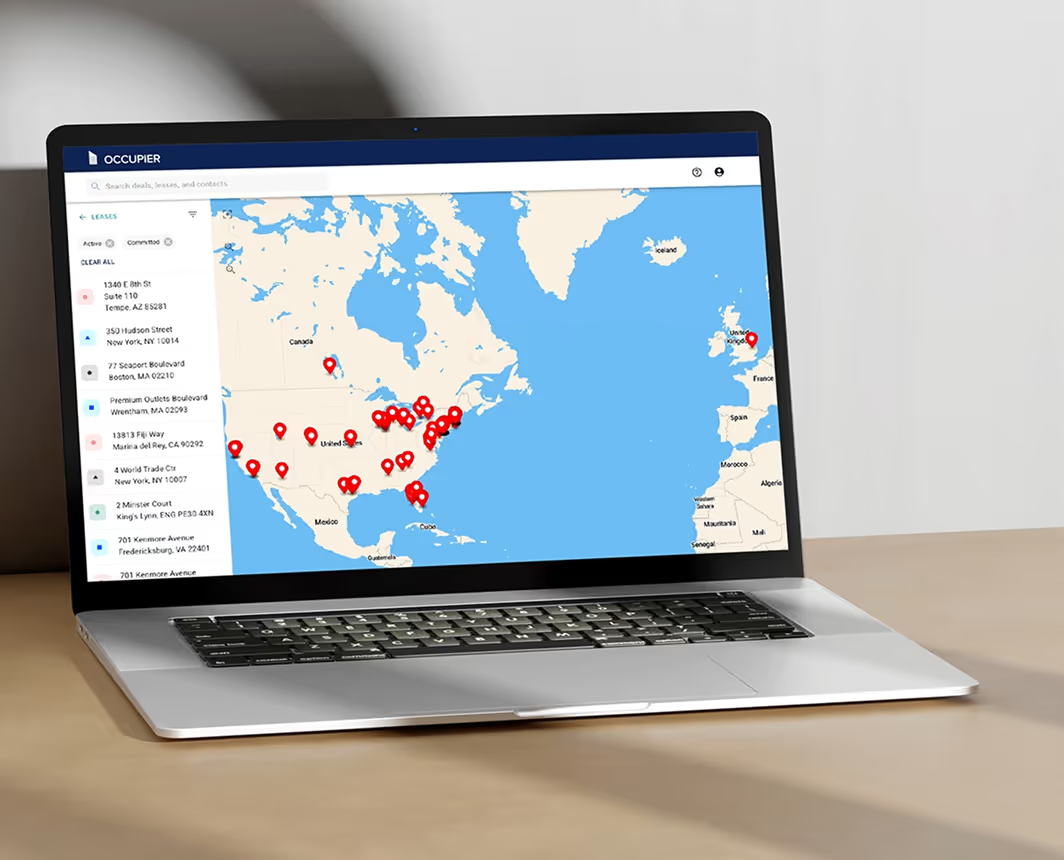
Occupier generates amortization schedules and journal entries from the same lease record your real estate team actively works from, so a signed amendment updates the numbers feeding your entries instead of waiting in someone’s inbox. AI-powered lease abstraction pulls key terms directly out of lease documents at signing, so the inputs to the initial recognition entry are accurate from day one.
One platform. Two teams. Zero compromise.
See how Occupier handles ROU asset and lease liability calculations →
ROU Asset Journal Entry FAQs
What is the journal entry for an ROU asset? At commencement: debit the ROU asset and credit the lease liability, with cash credited for any initial direct costs and the ROU asset reduced by any incentives received. After that, finance leases record separate interest and amortization entries, while operating leases record a single straight-line lease expense.
Should the ROU asset equal the lease liability? Only at commencement, and only if there are no initial direct costs, prepayments, or lease incentives. Any of those three items makes the two amounts differ from day one.
Do you depreciate or amortize an ROU asset? Amortize. Finance lease ROU assets amortize straight-line, recorded separately from interest. Operating lease ROU assets aren’t amortized independently; the balance is recalculated each period as part of the single lease cost.
Can an ROU asset journal entry exceed the asset’s fair market value? Yes. ASC 842 doesn’t cap the ROU asset at the underlying asset’s fair value the way earlier guidance did, though accurate inputs remain essential to avoid distorted balances.
What entry records an ROU asset impairment? Debit impairment loss, credit the ROU asset, writing the carrying value down to fair value. Subsequent amortization runs off the new, lower balance.



Lease management that works for real estate and finance
15,000 sq ft
90 days notice
March 2026
Action required