Good Guy Clauses and Personal Guarantees in Commercial Leases

What is a good guy clause in a commercial lease?
A good guy clause is a limited personal guaranty that can release an individual from specified future lease obligations after the business tenant provides required notice, pays applicable amounts, and properly surrenders the premises.
A good guy clause is a provision in a commercial lease guaranty that limits an individual's personal liability when the business tenant properly vacates and surrenders the premises. Unlike a traditional personal guarantee, which may extend through the entire lease term, a good guy guaranty can release the individual from specified future obligations once the agreement's conditions are satisfied.
For business owners, this distinction can have significant financial consequences. A company may sign a five-year lease expecting steady growth, only to close or relocate before the term expires. If the owner has personally guaranteed the lease, the landlord may be able to pursue that individual for unpaid obligations.
A good guy clause offers a potential middle ground. It gives landlords additional protection while allowing guarantors to limit their personal exposure by meeting specific notice, payment, and surrender requirements.
However, the clause does not automatically terminate the lease or release the business tenant from its contractual obligations. Understanding that difference is essential before signing.
What Is a Good Guy Clause in a Commercial Lease?
A good guy clause, also called a good guy guaranty, is a form of limited personal guarantee used in commercial leasing.
It generally allows an individual guarantor to end liability for certain future lease obligations once the tenant vacates the property and satisfies the conditions established in the guaranty.
The guarantor is often a business owner, principal, or another individual associated with the tenant company.
For example, a restaurant owner may sign a commercial lease through an LLC. The landlord might require the owner to personally guarantee the company's rental obligations because the business has a limited operating history.
Instead of accepting an unlimited guarantee, the owner could negotiate a good guy provision.
If the restaurant later closes, the owner may be released from specified future personal liability by giving the required notice, paying obligations covered through the surrender date, and returning the property in the required condition.
The protection depends on the actual agreement. It is not an automatic legal right or a standard term included in every commercial lease.
How Does a Good Guy Guaranty Work?
A good guy guaranty establishes conditions that must be satisfied before an individual's personal liability ends.
The specific requirements vary, but most agreements address advance notice, payment obligations, and surrender of the premises.
Advance Written Notice
The tenant or guarantor generally must provide advance written notice of the intention to vacate.
The notice period is negotiated and may range from 60 to 180 days or another period specified in the agreement.
For example, a guaranty might require 90 days' notice before surrender.
If the tenant plans to vacate on September 30, the notice must be delivered by the applicable deadline using the method required by the agreement.
Missing the deadline can delay or prevent the release of the guarantor.
Payment of Outstanding Obligations
Many good guy guaranties require the tenant to remain current on rent and other specified obligations through the surrender date.
These obligations may include base rent, additional rent, operating expenses, utilities, or other amounts defined in the agreement.
A guarantor should not assume that paying base rent alone is sufficient.
Some agreements also preserve liability for obligations that accrued before surrender, even when the payment becomes due afterward.
Proper Surrender of the Premises
The tenant must generally return the property vacant and in the condition required by the lease and guaranty.
This may involve removing furniture, equipment, and personal property, returning keys, and completing required restoration work.
The agreement may also require the premises to be free of subtenants and other occupants.
Simply stopping operations or moving employees elsewhere does not necessarily constitute legal surrender.
The landlord's acknowledgment of possession can help establish when the applicable conditions were satisfied.
Good Guy Clause vs. Personal Guarantee: What's the Difference?
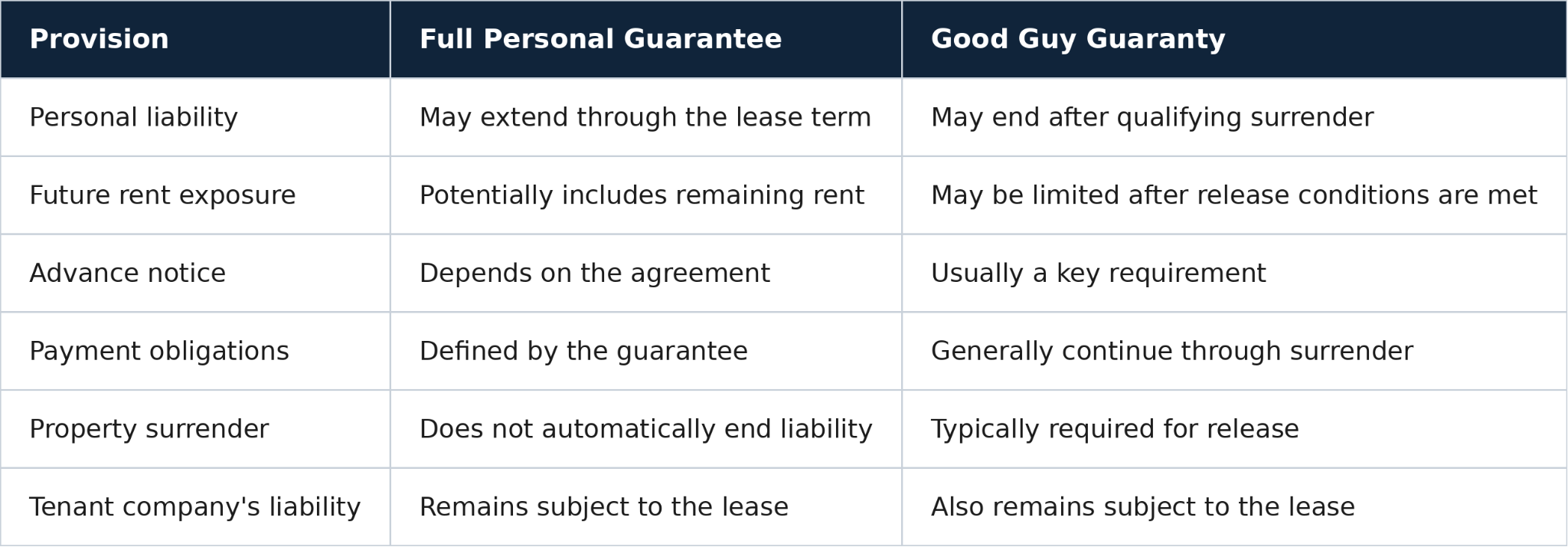
A traditional personal guarantee and a good guy guaranty both provide landlords with additional financial protection.
The difference is how far the individual's liability extends.
Under a full personal guarantee, an individual may remain responsible for the tenant company's obligations throughout the lease term, subject to the guarantee's terms and applicable law.
A good guy guaranty generally provides a mechanism to end specified future personal liability after compliant surrender.
The distinction becomes particularly important when a business experiences financial difficulties.
For example, a tenant company may cease operating with several years remaining on its lease.
Under a full guarantee, the individual may remain exposed to substantial future obligations.
With a properly negotiated good guy guaranty, the individual may have a defined way to limit that exposure.
The agreement should be reviewed alongside the broader commercial lease proposal, particularly when personal liability is being discussed before lease execution.
Does a Good Guy Clause Release the Tenant From the Lease?
No. This is one of the most important distinctions in a good guy guaranty.
The provision generally limits the individual's liability under the guaranty. It does not necessarily terminate the lease or eliminate the tenant company's obligations.
For example, a retail business may have three years remaining on its lease when it vacates the property.
If the owner satisfies the good guy conditions, the owner's personal liability for specified future obligations may end.
However, the landlord may still have contractual claims against the tenant company for remaining rent, damages, or other obligations.
The outcome depends on the lease, the guaranty, applicable law, and any separate termination agreement.
This is why a good guy clause should not be treated as an unrestricted early termination option.
Tenants seeking a complete release from future lease obligations may need a separate agreement with the landlord.
Occupier's guide to getting out of a commercial lease explains how negotiated terminations, buyouts, assignments, and other exit arrangements affect continuing liability.
Good Guy Guaranty Example: A Business Closing Early
Consider a small retailer that signs a five-year commercial lease through an LLC.
The business owner personally guarantees the agreement, but the landlord agrees to include a good guy provision.
The lease has the following terms:
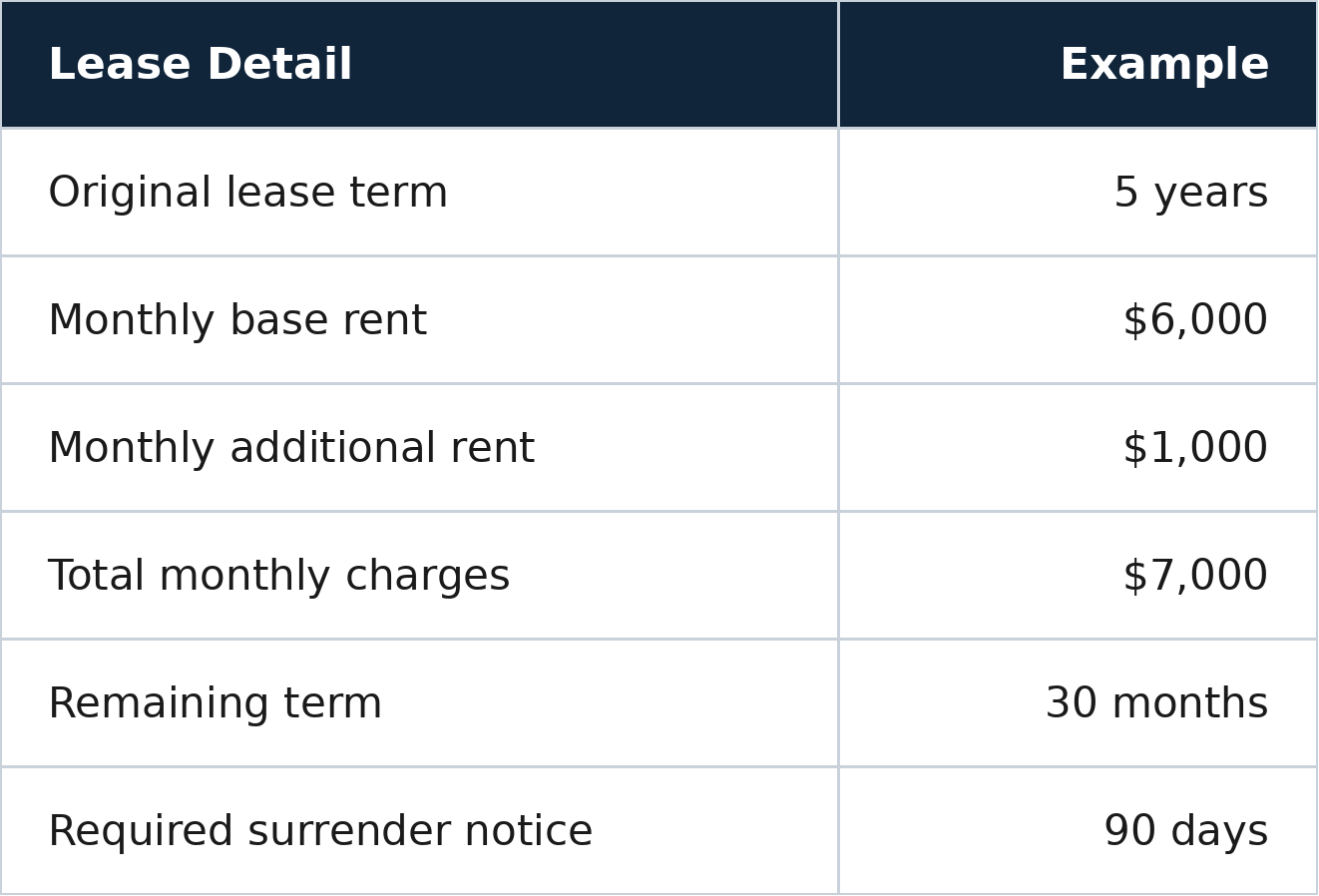
After two and a half years, the retailer decides to close because the location is not generating enough revenue.
The owner gives the required 90-day notice, remains current on applicable payments, and properly surrenders the premises.
Under the simplified assumptions, the remaining contractual charges before surrender are:
3 months × $7,000 = $21,000
The scheduled charges for the 30 months originally remaining would otherwise total:
30 months × $7,000 = $210,000
If the good guy guaranty releases the owner from the 27 months remaining after compliant surrender, the scheduled future charges outside the guaranty would be:
27 months × $7,000 = $189,000
In this example, the provision substantially limits the owner's personal exposure compared with a guarantee covering all remaining scheduled charges.
However, the calculation excludes any separately guaranteed damages, restoration expenses, legal costs, or other surviving obligations.
The tenant LLC may also remain liable for obligations under the lease after surrender.
The example demonstrates the value of the personal liability limitation without treating the clause as a complete cancellation of the lease.
Why Do Landlords Agree to Good Guy Clauses?
Landlords generally prefer tenants that remain financially stable and fulfill their lease obligations.
However, commercial landlords also recognize that businesses sometimes close or experience financial difficulties.
A tenant that cannot afford rent but continues occupying the premises can create substantial problems.
The landlord may face unpaid rent, delays in regaining possession, and additional legal costs before marketing the space to another business.
A good guy guaranty encourages the tenant to surrender the property responsibly.
The individual guarantor has an incentive to provide notice, remain current on required obligations, and return the premises in an acceptable condition.
In exchange, the landlord agrees to limit specified future claims against that individual.
The arrangement can therefore benefit both parties.
Landlords gain a clearer path to recovering possession, while business owners receive a potential limit on their personal liability.
The balance depends on the negotiated terms rather than the name of the clause.
What Should Tenants Negotiate in a Good Guy Clause?
The value of a good guy guaranty depends on whether its release conditions are realistic and clearly defined.
Several provisions can materially affect the guarantor's protection.
Notice Period and Delivery Requirements
The guaranty should specify how much notice is required, who must receive it, and how it must be delivered.
A notice requirement that is difficult to satisfy may reduce the practical value of the clause.
Tenants should also determine whether notice can be provided before a default occurs and whether the landlord must acknowledge receipt.
Definition of Surrender
The agreement should explain precisely what constitutes surrender.
Terms such as vacant, broom-clean, and good condition may have different implications depending on the lease.
For example, a restaurant could vacate its premises but leave specialized equipment or improvements that the landlord requires it to remove.
If surrender has not occurred under the contractual definition, the guarantor's release may be delayed.
Scope of Personal Liability
Tenants should establish which obligations remain personally guaranteed before and after surrender.
A guaranty may cover more than base rent.
Additional rent, maintenance charges, property damage, holdover rent, and legal expenses may also be included.
Some agreements preserve personal liability for claims arising before surrender, even after the guarantor has otherwise been released.
The wording should distinguish obligations that end from those that survive.
Confirmation of Release
A written acknowledgment can help prevent disputes over whether the release conditions were met.
Tenants may negotiate a requirement for the landlord to confirm that possession was returned and the guarantor's release became effective.
This does not replace compliance with the agreement, but it creates useful documentation if questions arise later.
Can a Good Guy Clause Protect an LLC Owner's Personal Assets?
A limited liability company generally separates business obligations from the personal obligations of its owners.
However, a personal guarantee creates a separate contractual obligation.
If an owner signs an enforceable personal guaranty, the landlord may pursue that individual under its terms even though the tenant is an LLC.
A good guy provision can limit the duration or scope of that personal exposure.
For example, an owner may be willing to guarantee rent while the company occupies the premises but unwilling to guarantee several years of future rent after the business closes.
The good guy structure addresses that concern by establishing conditions for ending specified obligations.
However, it does not eliminate personal liability for unrelated guarantees, fraudulent conduct, or other obligations that may exist under applicable law.
The guarantor should review the actual signed documents rather than rely on the assumption that operating through an LLC provides complete protection.
Are There Alternatives to a Good Guy Guaranty?
A good guy clause is not the only way to negotiate personal liability in a commercial lease.
Tenants may propose other forms of security or limitations depending on their financial position and the landlord's requirements.
Capped guarantees limit personal exposure to a defined dollar amount or number of months of rent.
Burn-off guarantees reduce or eliminate personal liability after the tenant satisfies specified conditions, such as maintaining a strong payment history over several years.
Corporate guarantees may allow a financially established parent or affiliated company to guarantee obligations instead of an individual owner.
Security deposits and letters of credit provide different forms of financial protection without necessarily requiring an unlimited personal guaranty.
For example, a landlord may agree to a larger deposit in exchange for limiting the owner's personal liability. Negotiating commercial security deposit burndowns may also allow tenants to reduce the amount of security held over time as they meet agreed financial or performance conditions.
Another alternative is a letter of credit, which allows a bank to provide a defined form of financial security subject to the instrument's terms.
These alternatives involve different costs, liquidity requirements, and risks.
The appropriate arrangement depends on tenant creditworthiness, landlord preferences, and the overall lease economics.
How Does a Good Guy Clause Affect Lease Termination?
A good guy guaranty can influence a business owner's willingness to close or relocate, but it should not be confused with an early termination right.
If the tenant vacates under the guaranty without terminating the lease, the tenant company may continue to owe contractual amounts.
The landlord may pursue remedies available under the lease and applicable law, while the guarantor's obligations are determined separately.
By contrast, a negotiated termination agreement can establish a new lease expiration date and address the release of the tenant's future obligations. Understanding the potential consequences of breaking a commercial lease is important because surrendering a property does not automatically eliminate the tenant's financial or legal responsibilities.
This distinction also matters for lease accounting.
Under ASC 842, the accounting treatment depends on the tenant's enforceable rights and obligations, not simply whether the individual guarantor has been released.
If the lease remains enforceable after surrender, the tenant may still have lease liabilities requiring recognition.
An executed termination, modification, or abandonment may produce different accounting consequences.
Real estate, legal, and finance teams should review the lease and guaranty together before making an early exit decision.
Managing Good Guy Clauses Across Commercial Lease Portfolios
For companies operating multiple retail stores, restaurants, or other commercial locations, guarantee provisions can differ significantly between leases.
One location may have an unlimited personal guaranty. Another may have a capped guarantee, while a third includes a good guy release tied to notice and surrender.
These differences can affect decisions about closures, relocations, and lease negotiations.
A lease summary that records only whether a guarantee exists may not provide enough information.
Teams also need to know who signed the guaranty, which obligations it covers, when the release can become effective, and what conditions must be satisfied.
Those details may be contained in separate exhibits rather than the main lease document.
Occupier's lease administration software helps commercial tenants organize lease agreements, supporting documents, critical dates, and contractual obligations in one system.
Maintaining the guaranty alongside its associated lease makes it easier for real estate and legal teams to locate the relevant provisions when evaluating an exit.
For business owners and multi-location tenants, accurate documentation can help distinguish a manageable surrender process from an unexpected personal liability dispute.
Good Guy Clause FAQs
What is a good guy clause in a commercial lease?
A good guy clause is a limited personal guaranty that can release an individual from specified future lease obligations after the business tenant provides required notice, pays applicable amounts, and properly surrenders the premises.
Does a good guy clause let a tenant break a lease?
Not necessarily. A good guy clause generally limits the individual's liability under the guaranty. It does not automatically terminate the tenant company's lease or eliminate its remaining obligations.
Is a good guy clause the same as a personal guarantee?
A good guy clause is a particular form of limited personal guarantee. Unlike an unlimited guarantee, it typically provides a conditional mechanism for ending specified future personal liability.
How much notice is required under a good guy guaranty?
The notice period depends on the agreement. Some require 60, 90, or 180 days of advance written notice. The guarantor must follow the specific timing and delivery requirements.
Can a landlord still sue the tenant after a good guy surrender?
Potentially, yes. Even if the individual guarantor is released from specified obligations, the tenant company may remain liable under the lease unless it receives a separate release or the lease is otherwise terminated.
Does a good guy guaranty cover unpaid rent?
It often covers rent and other specified obligations through the surrender date. Liability for amounts accruing before surrender, including charges billed afterward, depends on the guaranty's terms.
Are good guy clauses required in commercial leases?
No. They are negotiable contractual arrangements rather than universally required lease provisions. Their availability and enforceability depend on the transaction, applicable law, and agreed language.
Can a good guy clause be negotiated after signing?
Potentially, if the landlord agrees to amend the guaranty. However, tenants generally have more leverage to negotiate personal liability limits before executing the original lease.
What is the difference between a good guy guaranty and a capped guarantee?
A good guy guaranty generally links the release of future personal liability to qualifying surrender. A capped guarantee limits liability to a specified amount. The parties may also negotiate an agreement combining both protections.


Lease management that works for real estate and finance

15,000 sq ft
90 days notice
March 2026
Action required