Straight Line Rent Expense: Calculation, Example & Excel

What is a straight-line rent expense?
Straight line rent expense is the recognition of qualifying operating lease costs evenly across the lease term. Instead of matching expense to actual monthly rent payments, tenants generally recognize a consistent amount, even when the lease includes scheduled increases or free-rent periods.
Straight-line rent expense is an accounting method that spreads the total cost of an operating lease evenly across the lease term, rather than recognizing expense based on the actual rent paid each month. Under ASC 842, commercial tenants generally recognize a single operating lease expense on a straight-line basis, even when their lease agreements include rent increases or free-rent periods.
For accounting and finance teams managing office, retail, or other commercial properties, calculating this expense correctly is essential for accurate financial reporting. The process involves three main steps:
- Determine the total qualifying lease payments and relevant adjustments.
- Divide the total lease cost by the number of accounting periods.
- Record the expense consistently while tracking lease liability and right-of-use (ROU) asset balances.
This guide explains the calculation, provides a worked example, and shows how to calculate straight-line rent in Excel under ASC 842.
What Is a Straight Line Rent Expense?
Straight line rent expense is the recognition of lease costs in equal amounts over the lease term, regardless of when contractual payments are made.
For example, a commercial lease may require lower rent during the first year and higher payments in later years. Although monthly cash payments increase, the tenant generally recognizes the same operating lease expense each month.
This approach reflects the cost of using the leased property across the period in which the tenant receives its economic benefits.
Under ASC 842, operating leases also require recognition of an ROU asset and lease liability on the balance sheet, unless an applicable recognition exemption is elected.
The income statement generally reports a single operating lease expense, while the ROU asset and liability are adjusted throughout the lease.
How Do You Calculate Straight-Line Rent Expense?
The basic calculation divides total lease cost by the number of periods included in the lease term.
Straight-Line Rent Expense = (Total Lease Payments + Initial Direct Costs − Lease Incentives) ÷ Lease Term
For monthly reporting, the lease term is expressed in months. Annual calculations use the corresponding number of years.
The calculation requires four important inputs.
1. Total Lease Payments
Start with the fixed payments required throughout the lease term, including scheduled rent increases and fixed payments that qualify for inclusion under ASC 842.
For leases with annual escalations, calculate each year's rent separately before determining the total.
Variable payments based on future sales or usage are generally excluded from this calculation and recognized when the related obligation arises.
2. Lease Term
The accounting lease term includes the noncancelable period and certain optional periods when the tenant is reasonably certain to exercise a renewal option or not exercise a termination option.
For example, a five-year agreement with a renewal option does not automatically become a ten-year accounting lease.
The determination depends on the applicable accounting criteria and facts surrounding the arrangement.
3. Initial Direct Costs
Qualifying initial direct costs are incremental expenses that would not have been incurred if the lease had not been executed.
For example, certain commissions paid specifically because a lease was signed may qualify.
These costs affect the total lease expense recognized over the operating lease term.
4. Lease Incentives
Lease incentives reduce the total consideration paid by the tenant.
They may include qualifying landlord reimbursements or payments made on the tenant's behalf. Rent-free periods also reduce the contractual payments included in the calculation.
The Deloitte ASC 842 accounting guidance</a> explains how lease payments, incentives, and initial direct costs affect operating lease expense recognition.
Straight Line Rent Expense Calculation: Worked Example
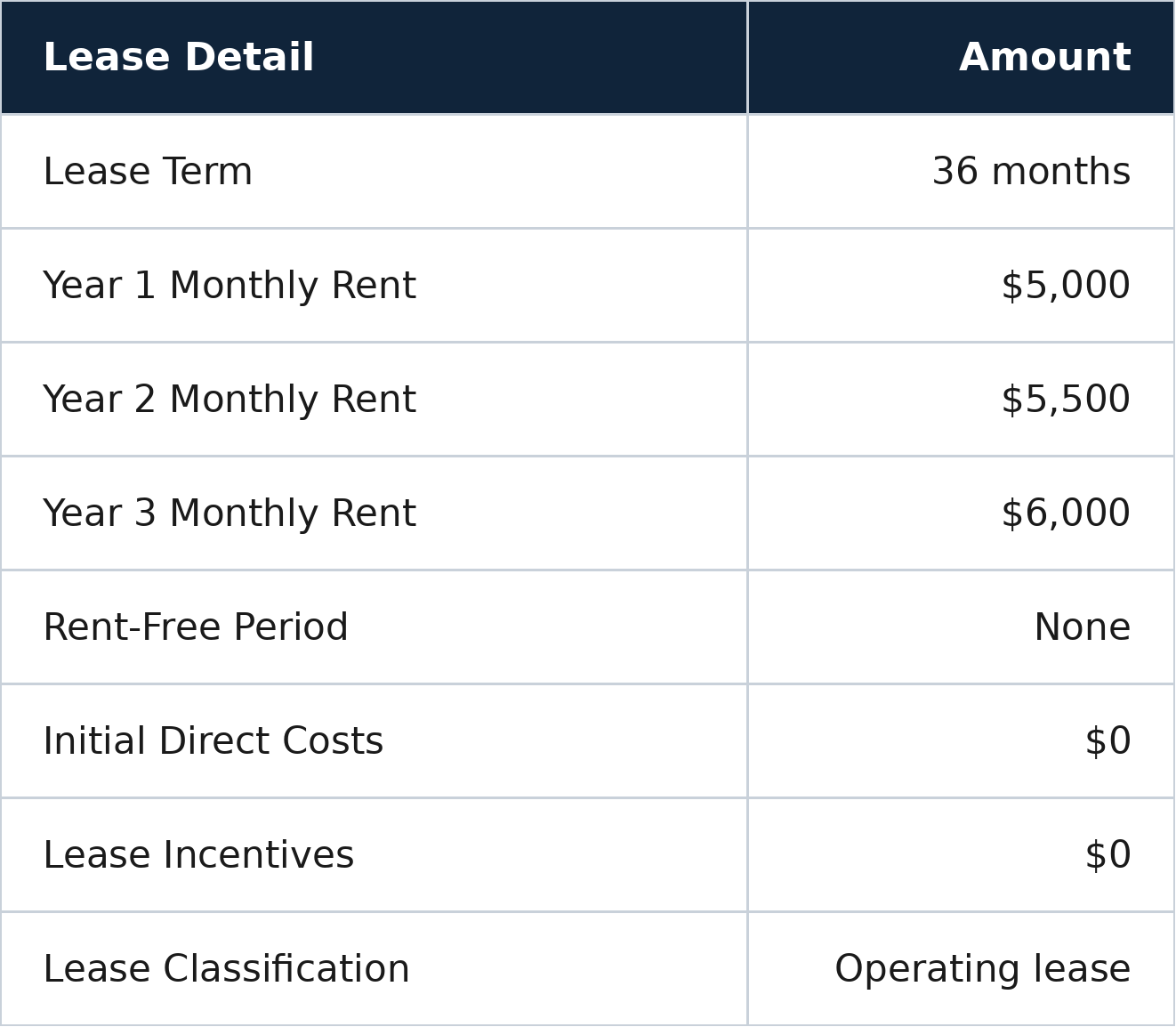
Consider a retail business signing a three-year operating lease with scheduled annual rent increases.
The lease includes these terms:
Step 1: Calculate Total Lease Payments
First, calculate the annual rent for each year.
Year 1: $5,000 × 12 = $60,000
Year 2: $5,500 × 12 = $66,000
Year 3: $6,000 × 12 = $72,000
Total lease payments:
$60,000 + $66,000 + $72,000 = $198,000
Step 2: Calculate Monthly Straight-Line Rent
Divide the total lease payments by 36 months.
$198,000 ÷ 36 = $5,500 per month
The tenant recognizes $5,500 in operating lease expense every month, even though the actual monthly payments change annually.
Step 3: Compare Cash Rent and Recognized Expense
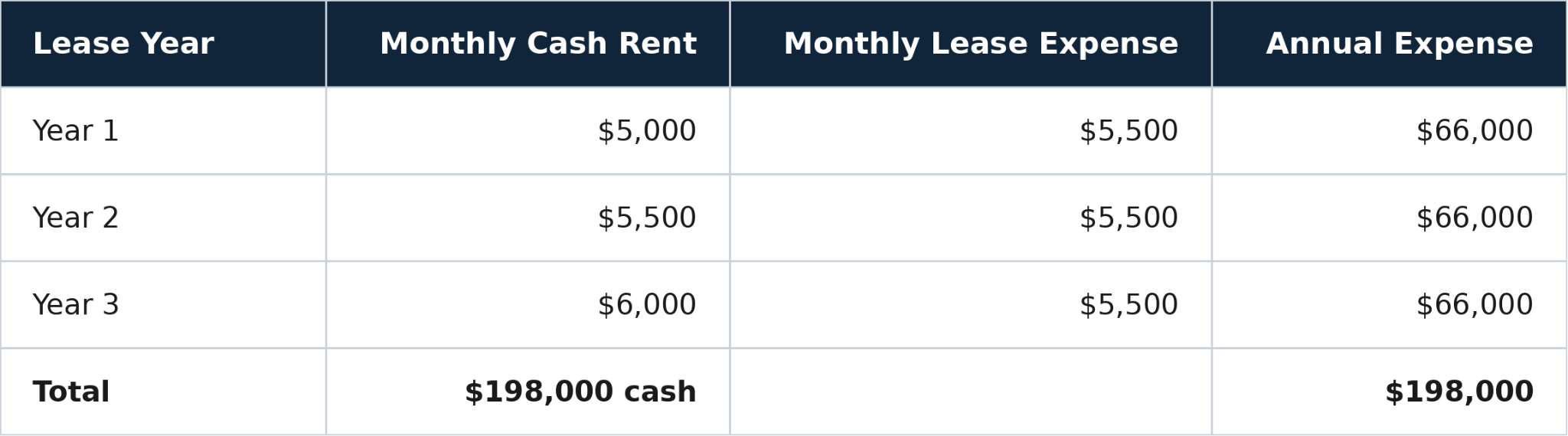
During Year 1, the recognized expense exceeds cash payments by $6,000.
In Year 2, annual rent payments and recognized expenses are equal.
During Year 3, cash payments exceed recognized expense by $6,000, reversing the earlier difference.
Over the complete lease term, total recognized expense equals total qualifying lease payments.
How Do Free Rent Periods Affect Straight-Line Rent?
Landlords sometimes offer free rent to attract tenants or provide time for construction and occupancy preparation.
Under straight-line accounting, a rent-free period does not necessarily mean zero operating lease expense during those months.
Consider a 24-month operating lease requiring $4,000 monthly rent, with the first two months free.
The tenant makes 22 payments:
22 × $4,000 = $88,000
Monthly straight-line rent expense:
$88,000 ÷ 24 = $3,666.67
The tenant generally recognizes approximately $3,666.67 each month, including the two months when no base rent is paid.
The monthly differences between payments and expense are reflected through the operating lease accounting balances under ASC 842.
For further explanation of these differences, see Occupier's guide to deferred rent under ASC 842.
How to Calculate Straight Line Rent Expense in Excel
Excel provides a practical way to calculate straight-line rent when managing a small number of leases with straightforward payment schedules.
Using the three-year example, create the following worksheet:
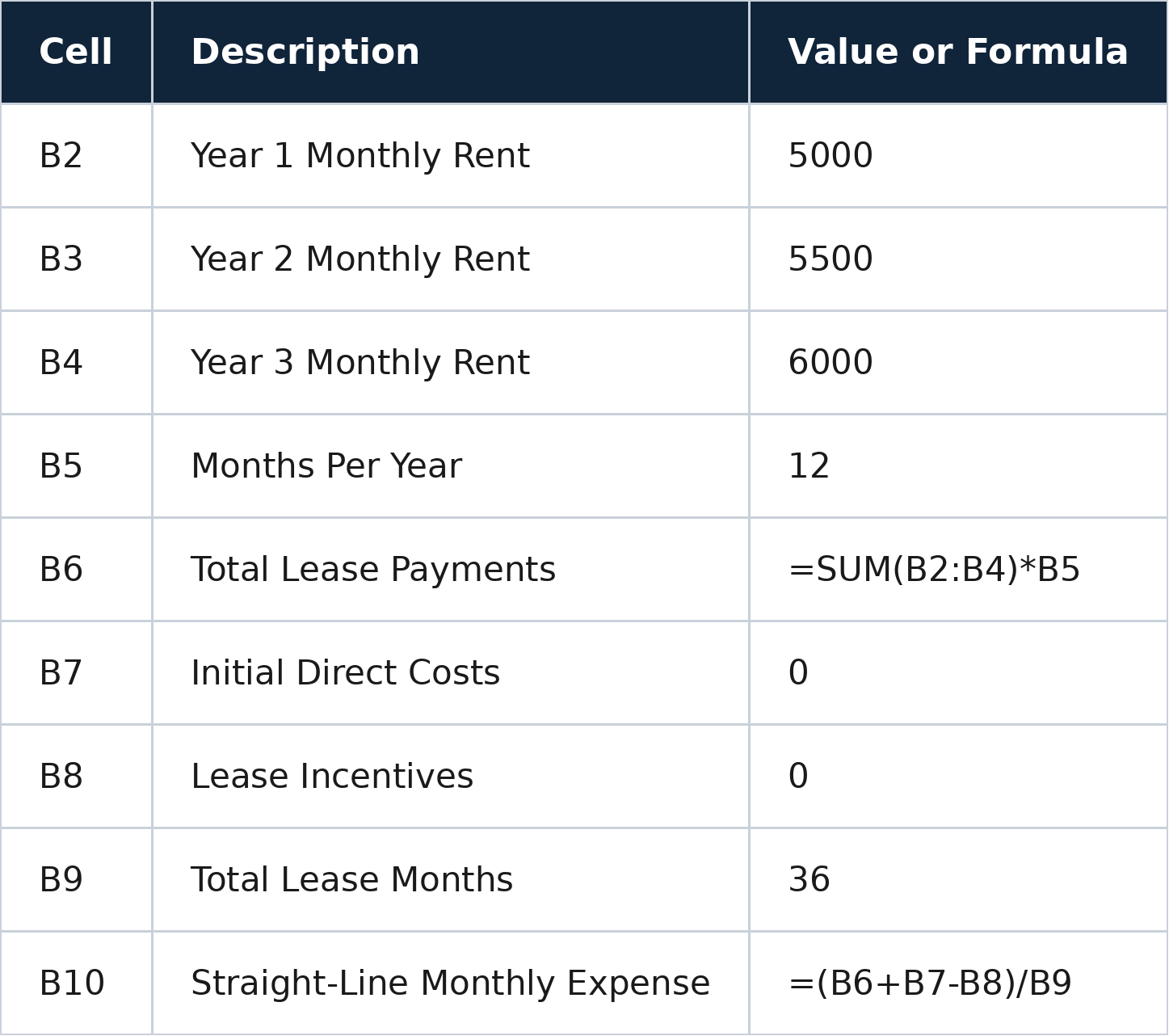
The formula returns $5,500 in monthly expense.
Accounting for Different Payment Schedules
For leases with irregular rent increases or free-rent periods, create a separate row for each month.
Include columns for payment date, contractual rent, qualifying lease incentives, and the straight-line lease cost.
Use Excel's SUM function to calculate total payments and divide by the appropriate lease term.
However, straight-line expense alone does not calculate the ASC 842 lease liability or ROU asset. Those measurements also require payment timing, an appropriate discount rate, and other accounting inputs.
Occupier provides a free Lease Amortization Schedule Excel Template for tracking lease liabilities, payments, interest accretion, and ROU asset activity.
How Is Straight-Line Rent Expense Recorded Under ASC 842?
ASC 842 requires operating lease accounting to reflect both the expense recognized on the income statement and the associated balances on the balance sheet.
At lease commencement, a tenant generally records an ROU asset and lease liability based on the present value of qualifying future payments, with applicable adjustments.
After commencement, the liability increases through interest accretion and decreases when payments are made.
The ROU asset is reduced by the difference between the single operating lease expense and the liability accretion.
For example, assume a tenant has the following monthly amounts:
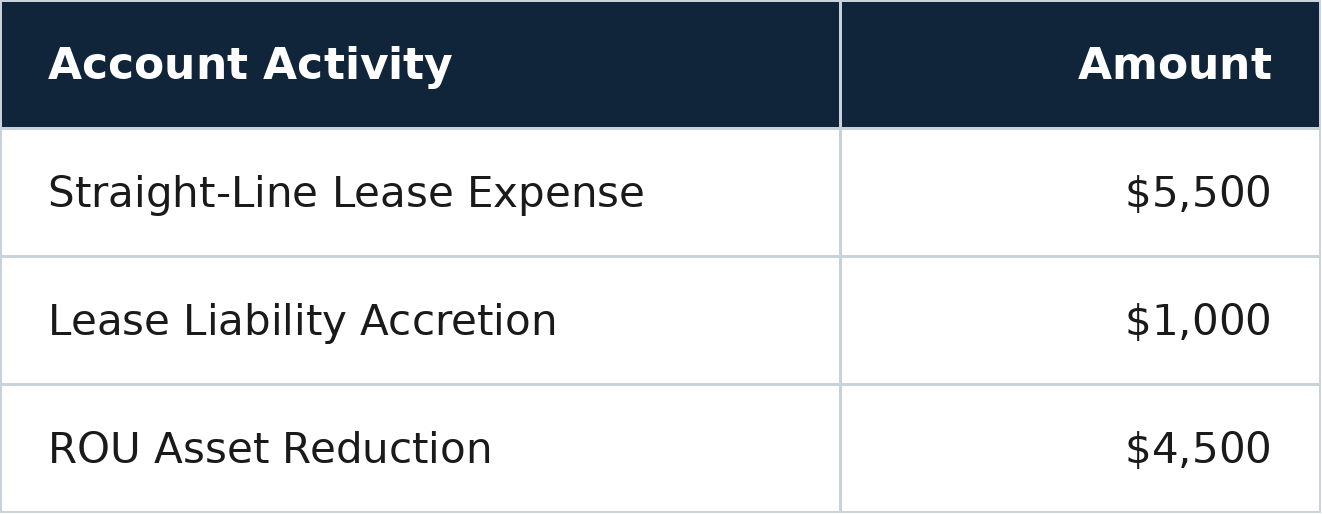
The expense recognition entry would be:
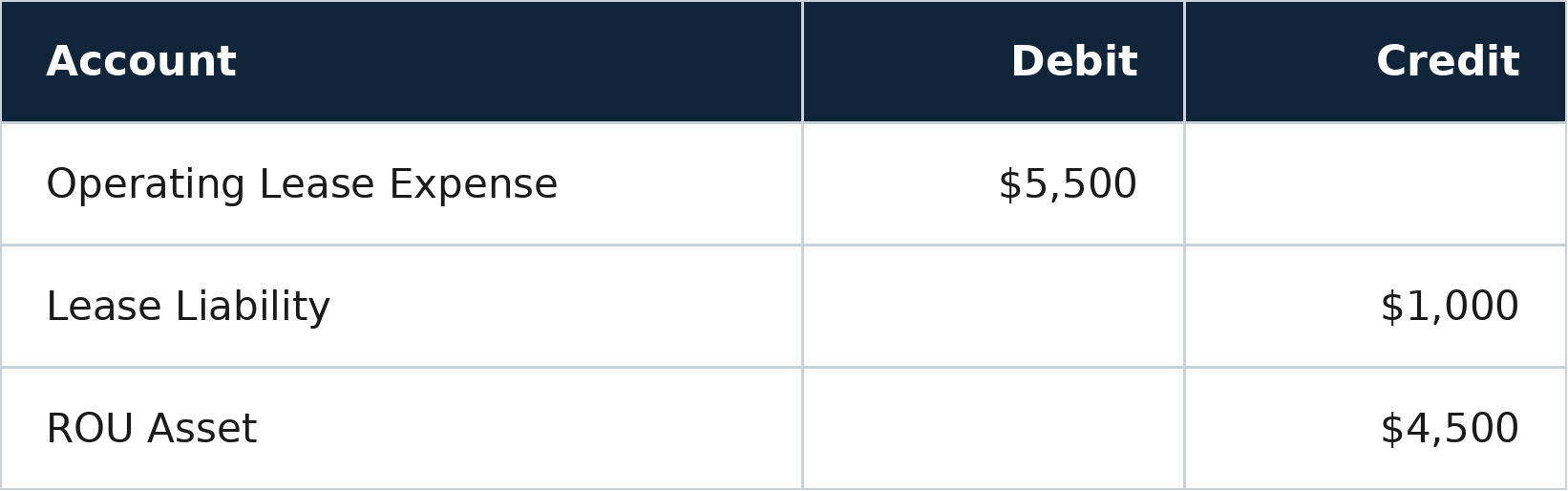
The actual cash payment is recorded separately against the lease liability.
Under the operating lease model, the $1,000 accretion is not presented as separate interest expense. Instead, the income statement recognizes the single $5,500 operating lease expense.
The Deloitte lease accounting disclosure guidance discusses the single lease cost requirement under ASC 842.
Straight-Line Rent Expense vs. Straight-Line Depreciation
Straight-line rent expense and straight-line depreciation both allocate costs over time, but they apply to different accounting situations.
Straight-line rent expense concerns lease costs associated with the right to use an asset under an operating lease.
Straight-line depreciation allocates the depreciable cost of an owned tangible asset over its estimated useful life.
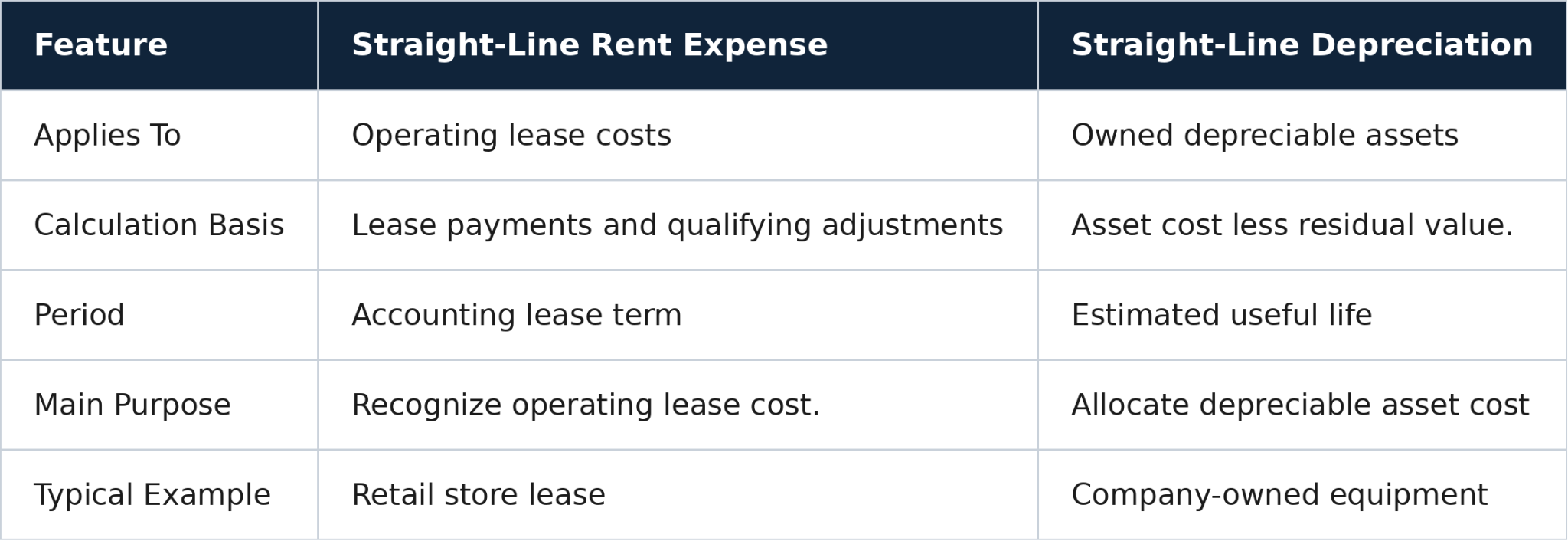
For example, a business leasing retail space may recognize a constant monthly operating lease expense while separately depreciating furniture and equipment that it owns.
These calculations should not be treated as interchangeable.
What Are the Advantages and Limitations of Straight-Line Rent Expense?
Straight-line rent expense provides a consistent method of recognizing operating lease costs over time.
It makes expenses easier to compare between accounting periods, particularly when contractual rents increase annually.
The method also prevents rent-free periods from creating artificial fluctuations in recognized operating lease expense.
However, it does not show the actual amount of cash leaving the business each month.
Finance teams must therefore maintain separate payment schedules and lease accounting records to understand cash requirements, lease liabilities, and ROU asset balances.
Straight-line calculations may also require adjustment when lease terms change, including modifications, reassessments, or impairment events.
How Can Software Simplify Straight-Line Rent Calculations?
Excel can handle straightforward lease calculations, but managing numerous commercial properties introduces additional challenges.
Different commencement dates, escalation schedules, incentives, and amendments can make manual models difficult to maintain.
Changes to lease terms may also affect the remaining lease expense, liability, and ROU asset.
Occupier's lease accounting software helps finance teams calculate operating lease expenses, manage amortization schedules, and generate accounting entries from centralized lease records.
For multi-location businesses, connecting lease documents and accounting information also reduces the risk of finance teams working with outdated payment schedules.
Accurate straight-line rent accounting ultimately depends on correct lease inputs, consistent expense recognition, and timely updates when agreements change.
Straight Line Rent Expense FAQs
1. What is a straight-line rent expense?
Straight line rent expense is the recognition of qualifying operating lease costs evenly across the lease term. Instead of matching expense to actual monthly rent payments, tenants generally recognize a consistent amount, even when the lease includes scheduled increases or free-rent periods.
2. What is the formula for straight-line rent expense?
The basic formula is total qualifying lease payments plus initial direct costs, minus lease incentives, divided by the number of periods in the lease term. For monthly expenses, use the number of months. The calculation may change following lease modifications or other accounting adjustments.
3. How do you calculate straight-line rent with annual increases?
Calculate the total rent due over the entire accounting lease term, including each scheduled increase. Add any qualifying initial direct costs, subtract applicable incentives, and divide by the total number of months. The resulting amount represents the periodic straight-line operating lease expense.
4. Is straight-line rent required under ASC 842?
ASC 842 generally requires a single lease expense for operating leases, recognized on a straight-line basis unless another systematic and rational method better reflects the pattern of benefits received. Finance leases use a different expense recognition approach, with separate interest and ROU asset amortization.
5. Is straight-line rent the same as deferred rent?
No. Straight-line rent refers to the method used to recognize lease expense. Deferred rent historically represented the difference between expense and cash payments under previous accounting guidance. Under ASC 842, those timing differences are generally reflected through ROU asset and lease liability accounting rather than a separate deferred rent balance.
6. Can you calculate straight-line rent expense in Excel?
Yes. Excel can calculate straight-line expense by summing qualifying payments, adjusting for eligible costs and incentives, and dividing by the lease term. However, a complete ASC 842 model also needs liability present value calculations, ROU asset tracking, payment schedules, and accounting entries.



Lease management that works for real estate and finance

15,000 sq ft
90 days notice
March 2026
Action required