Tenant Representation: How Tenant Rep Brokers Work
When it comes to navigating the intricate world of real estate—especially with a multi-location portfolio—it's a bit like winding your way through a complex maze. But here's the thing: there's absolutely no reason you should navigate this challenging
Tenant representation is a commercial real estate service in which a broker represents a business looking to lease property. Instead of working for the landlord, a tenant rep broker helps the tenant find suitable space, evaluate market conditions, negotiate lease terms, and make real estate decisions that support its business goals.
For businesses managing several locations, tenant representation can be particularly valuable. A company opening new stores, renewing office leases, or entering unfamiliar markets needs reliable information about rental rates, operating expenses, and available properties.
However, choosing the right broker involves more than finding someone with access to listings. Understanding how tenant representation works, what brokers charge, and how their responsibilities are defined can help businesses establish a more effective partnership.
What Is Tenant Representation in Commercial Real Estate?
Tenant representation is the process of engaging a commercial real estate broker to represent the interests of a tenant during a property search, lease negotiation, renewal, or relocation.
A tenant rep broker works on behalf of the business occupying the space rather than the property owner. Their responsibility is to help the tenant evaluate available options, understand market conditions, and negotiate terms that align with its requirements.
For example, a restaurant company planning to open five locations may need assistance identifying suitable properties, comparing rental costs, and negotiating tenant improvement allowances. A tenant representative can coordinate these activities while keeping the company's expansion goals in mind.
Tenant representation services apply to office, retail, industrial, healthcare, restaurant, and other commercial properties. Depending on the engagement, brokers may assist with individual transactions or provide ongoing support across an entire portfolio.
Tenant Rep Broker vs. Landlord Broker: What's the Difference?
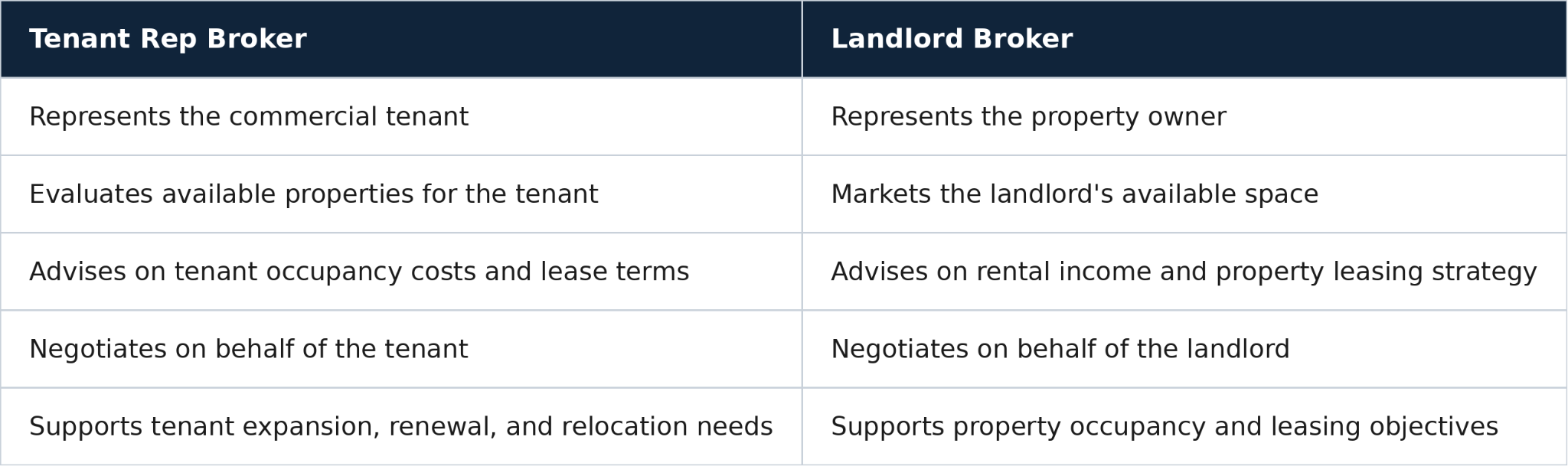
Both tenant representatives and landlord brokers participate in commercial leasing transactions, but they represent different interests.
A tenant rep broker focuses on the needs of the business leasing the property. A landlord broker works on behalf of the property owner, typically marketing available space and negotiating terms that serve the landlord's objectives.
Some brokerages provide both services through different professionals. Representation arrangements, including any permitted dual agency, should be disclosed and handled according to applicable state laws.
Before working with a broker, confirm exactly whose interests they represent and whether any relationships could create a conflict.
What Does a Tenant Rep Broker Do?
A tenant rep broker's responsibilities extend beyond showing available properties. Their work begins with understanding the company's real estate requirements and continues through negotiations and lease execution.
Market Research and Site Selection
Tenant representatives research available properties, rental rates, market conditions, and competing locations.
For example, a retailer entering a new market may need to compare customer demographics, accessibility, nearby competitors, and occupancy costs before deciding where to open.
Brokers combine local knowledge with property information and market research. Businesses may also use site selection software to compare opportunities and evaluate locations against defined business requirements.
Financial Analysis and Lease Negotiations
Commercial leases involve more than base rent. Tenants must also evaluate operating expenses, rent increases, security deposits, tenant improvements, and renewal options.
A tenant rep broker helps compare proposed financial terms and negotiate an agreement that reflects the company's priorities.
For example, one property may offer lower initial rent but higher annual increases, while another includes a larger tenant improvement allowance. A broker helps the tenant understand these trade-offs before committing to a location.
A clear lease negotiation strategy is especially important when comparing several offers.
Transaction Coordination
Tenant reps also coordinate property tours, proposals, letters of intent, landlord communication, and transaction milestones.
They may work alongside legal, finance, operations, and construction teams to keep the transaction moving.
Although brokers negotiate business terms, commercial real estate attorneys should review legal provisions and advise on contractual risks before the tenant signs the agreement.
How Does the Tenant Representation Process Work?
The tenant representation process generally follows five stages, although the timeline and responsibilities vary by transaction.
Step 1: Define the Tenant's Requirements
The broker begins by understanding the business's location needs, budget, preferred market, space requirements, and expansion plans.
For multi-location companies, this may also involve reviewing existing leases and identifying upcoming expirations or relocation opportunities.
Step 2: Research and Compare Properties
Using the agreed criteria, the broker identifies suitable properties and prepares a shortlist.
The tenant then reviews available options, attends property tours, and compares factors such as location, size, rental rates, accessibility, and estimated occupancy costs.
The goal is to narrow the search to properties that meet both operational and financial requirements.
Step 3: Prepare Proposals and Negotiate Terms
Once the tenant identifies a preferred property, the broker helps prepare a proposal or letter of intent.
Negotiations may cover base rent, lease duration, free rent, operating expenses, tenant improvement allowances, and renewal rights.
The broker communicates with the landlord's representative while keeping the tenant informed about proposals and counteroffers.
Step 4: Coordinate Reviews and Approvals
Before lease execution, internal stakeholders may need to review the transaction.
Finance evaluates the financial commitments, legal counsel reviews the agreement, and operations confirms that the property meets the company's needs.
The broker helps coordinate outstanding items and maintain communication between the parties.
Step 5: Execute the Lease and Plan the Handoff
After the parties finalize the agreement, the tenant signs the lease and prepares for occupancy.
Important terms, payment schedules, and notice deadlines should then be transferred into the company's lease records.
For businesses managing multiple transactions, deal management software can help keep property comparisons, negotiations, approvals, and transaction information organized throughout this process.
How Much Does Tenant Representation Cost?
One of the most common questions businesses ask is whether they must pay a tenant rep broker directly.
In many U.S. commercial leasing transactions, the landlord pays the brokerage commission. The landlord's broker and tenant's broker may then divide that commission according to their agreements.
However, tenant representation is not automatically free for every tenant.
Brokerage compensation is negotiable, and payment arrangements can vary by market, property type, transaction, and representation agreement.
How Are Tenant Rep Broker Fees Calculated?
Commercial leasing commissions are often based on a negotiated percentage of rent over the lease term. Some agreements use other calculations, including flat fees or fees based on leased square footage.
Consider a five-year commercial lease with annual base rent of $100,000.
The total scheduled base rent would be $500,000. If the negotiated brokerage commission were 4% of that amount, the total commission would equal $20,000.
That $20,000 might be shared between the landlord's broker and tenant representative under their commission agreement.
This is an illustrative calculation, not a universal commission rate. Actual commissions may depend on different rent definitions, payment schedules, negotiated percentages, and other contractual terms.
When Might a Tenant Pay the Broker?
A tenant may have a direct payment obligation when the representation agreement provides for a fee that is not fully covered by the landlord or another party.
Separate arrangements may also apply to advisory services, portfolio strategy, renewals, or transactions where no landlord-paid commission is available.
Before signing a representation agreement, tenants should clarify the commission structure, exclusivity requirements, payment responsibilities, and what happens if a transaction does not close.
A landlord-paid commission does not mean brokerage costs have no economic effect on the transaction. Tenants should evaluate the overall lease terms rather than assuming representation will automatically produce savings.
What Are the Benefits of Hiring a Tenant Rep Broker?
For companies without dedicated real estate teams, tenant representatives provide specialized market knowledge and transaction experience.
They can help businesses evaluate alternatives, understand local leasing conditions, and negotiate terms that might otherwise be overlooked.
A broker can also reduce the administrative burden of coordinating property searches and landlord communication.
For multi-location businesses, the value extends beyond individual transactions. A tenant representative familiar with the company's portfolio may help identify renewal opportunities, evaluate expansion plans, and coordinate transactions across several markets.
However, the quality of representation depends on the broker's experience, understanding of the business, and ability to work effectively with internal stakeholders.
Questions to Ask Before Hiring a Tenant Rep Broker
Selecting a tenant representative requires evaluating more than the brokerage company's reputation.
The following questions can help tenants understand whether a broker is suited to their needs.
- What experience do you have representing businesses like ours? Ask about relevant property types, industries, transaction sizes, and previous clients.
- How well do you know our target markets? Determine whether the broker has current experience with local rental rates, available properties, and market conditions.
- Who will pay your commission, and what fees could we owe? Request a clear explanation of compensation, exclusivity, and any direct tenant payment obligations.
- Do you represent any landlords or have potential conflicts of interest? Understand the broker's relationships and how conflicts would be disclosed and managed.
- How do you evaluate lease proposals? Ask whether the broker compares total occupancy costs, concessions, operating expenses, and long-term financial commitments.
- How will you communicate with our team? Discuss reporting frequency, access to transaction information, and how the broker coordinates with finance and legal stakeholders.
- Can you provide relevant client references? Look for examples involving similar property types, markets, and business requirements.
A qualified broker should be able to explain their process, provide relevant examples, and discuss limitations without relying on broad promises about savings or lease terms.
How to Work Effectively With Your Tenant Rep Broker
Hiring a broker is only the beginning of a productive relationship.
Real estate teams should establish clear communication expectations, identify decision-makers, and provide the information needed to evaluate opportunities.
For example, a company planning several store openings should share its target markets, budgets, location requirements, and expected timelines. Without this context, brokers may recommend properties that appear attractive but don't support the business's actual needs.
Ongoing collaboration matters just as much. If a lease is approaching expiration, the broker should have enough notice to research alternatives and develop a negotiating strategy.
Keeping brokers connected to the company's lease information makes this easier.
Occupier's platform for broker teams supports shared client portfolios, transaction pipelines, lease information, and critical dates. It helps tenant representatives coordinate deals while maintaining visibility into upcoming real estate decisions.
After a lease is signed, information should remain accessible through the company's lease administration process, including renewal options, payment obligations, and important notice deadlines.
For businesses with multiple locations, this continuity helps maintain a more consistent relationship between the broker, real estate team, and finance department.
Frequently Asked Questions About Tenant Representation
What Is Tenant Representation?
Tenant representation is a commercial real estate service in which a broker represents a business seeking to lease, renew, or relocate commercial property. The broker advises the tenant on property options, market conditions, and lease negotiations.
Who Pays a Tenant Rep Broker?
The landlord commonly pays the brokerage commission in U.S. commercial leasing transactions. However, payment arrangements are negotiable, and tenants may have direct fee obligations depending on their representation agreements.
Do I Need a Tenant Rep Broker to Lease Commercial Space?
No. A business can negotiate a commercial lease without a tenant representative. However, an experienced broker can provide market knowledge, property comparisons, and negotiation support, particularly when the transaction is complex.
When Should I Hire a Tenant Rep Broker?
It is generally best to involve a tenant rep before beginning a serious property search or renewal negotiation. Early involvement gives the broker time to understand requirements, research alternatives, and develop a strategy before important decisions are made.
Can a Tenant Rep Broker Help With Lease Renewals?
Yes. Tenant representatives can help evaluate market rents, review existing lease terms, compare relocation alternatives, and negotiate renewals. Compensation for renewal services should be clarified before the engagement begins.



Lease management that works for real estate and finance

15,000 sq ft
90 days notice
March 2026
Action required