GASB 87 Lease Accounting: Requirements & Examples
When did GASB 87 become effective?
GASB 87 became effective for reporting periods beginning after June 15, 2021, following amendments to the original implementation timeline. It is an established reporting requirement rather than a new standard awaiting adoption.
GASB 87 is the governmental accounting standard that establishes how state and local governments recognize and report leases in their financial statements. It generally requires government lessees to record a lease liability and an intangible right-to-use lease asset, while government lessors recognize a lease receivable and a deferred inflow of resources.
Issued by the Governmental Accounting Standards Board, GASB Statement No. 87 replaced the previous operating and capital lease classification approach with a single accounting model for most qualifying leases. The standard became effective for reporting periods beginning after June 15, 2021.
For public schools, universities, municipal agencies, and other governmental organizations, GASB 87 affects how property and equipment agreements are evaluated, measured, and reported.
This guide explains the standard's requirements, provides a practical calculation and journal-entry example, and outlines the information governments need to maintain accurate lease accounting records.
What Is GASB 87?
GASB 87, formally known as Statement No. 87, Leases, establishes accounting and financial reporting requirements for qualifying lease arrangements involving state and local governmental entities.
The standard is based on the principle that a lease represents the financing of the right to use an underlying asset.
Instead of distinguishing between operating and capital leases under the previous framework, GASB 87 generally requires governments to recognize financial assets and obligations associated with leases extending beyond the short-term lease exception.
For example, a city leasing office space for five years generally recognizes an intangible lease asset and a corresponding lease liability for qualifying future payments.
Similarly, a public university leasing property to an outside organization may recognize a lease receivable and deferred inflow of resources, depending on the arrangement.
The objective is to provide greater transparency into the financial commitments and resources associated with government leasing activities.
Who Must Follow GASB 87?
GASB 87 applies to qualifying lease arrangements reported by state and local governments and other entities following governmental accounting standards.
Organizations commonly affected include public school districts, municipal governments, public colleges and universities, government-operated hospitals, transportation authorities, and special-purpose districts.
The standard applies whether a government is leasing an asset from another party or acting as the lessor.
For example, a school district renting administrative office space must evaluate its obligations as a lessee.
A municipal authority renting part of a publicly owned facility to a private business must evaluate the arrangement from the lessor's perspective.
GASB 87 does not govern federal financial reporting, which follows a different accounting framework.
It also does not automatically apply to every organization receiving public funding. The entity's applicable financial reporting requirements determine which standards govern its transactions.
What Qualifies as a Lease Under GASB 87?
GASB 87 defines a lease as a contract that conveys control of the right to use another entity's nonfinancial asset for a period of time in an exchange or exchange-like transaction.
The arrangement must involve an identified underlying asset, such as a building, vehicle, equipment, or land.
The government must also have the right to obtain the present service capacity of the asset and determine the nature and manner of its use within the contract's limitations.
For example, a county renting a particular office building and controlling how it is used may have a lease.
An agreement for general transportation services may not contain a lease when the service provider controls which vehicles are used and how those vehicles operate.
Contracts involving both leasing and services require further evaluation.
Governments should separate lease and non-lease components when required rather than treating every service payment as a lease obligation.
Certain arrangements fall outside GASB 87's scope, including contracts governed by other specific governmental accounting guidance.
How Does GASB 87 Differ From Previous Lease Accounting?
Before GASB 87, governmental lease accounting distinguished between operating and capital leases.
Operating leases generally resulted in rental expense or expenditure recognition, while capital leases were accounted for differently.
GASB 87 changed that approach for most qualifying agreements.
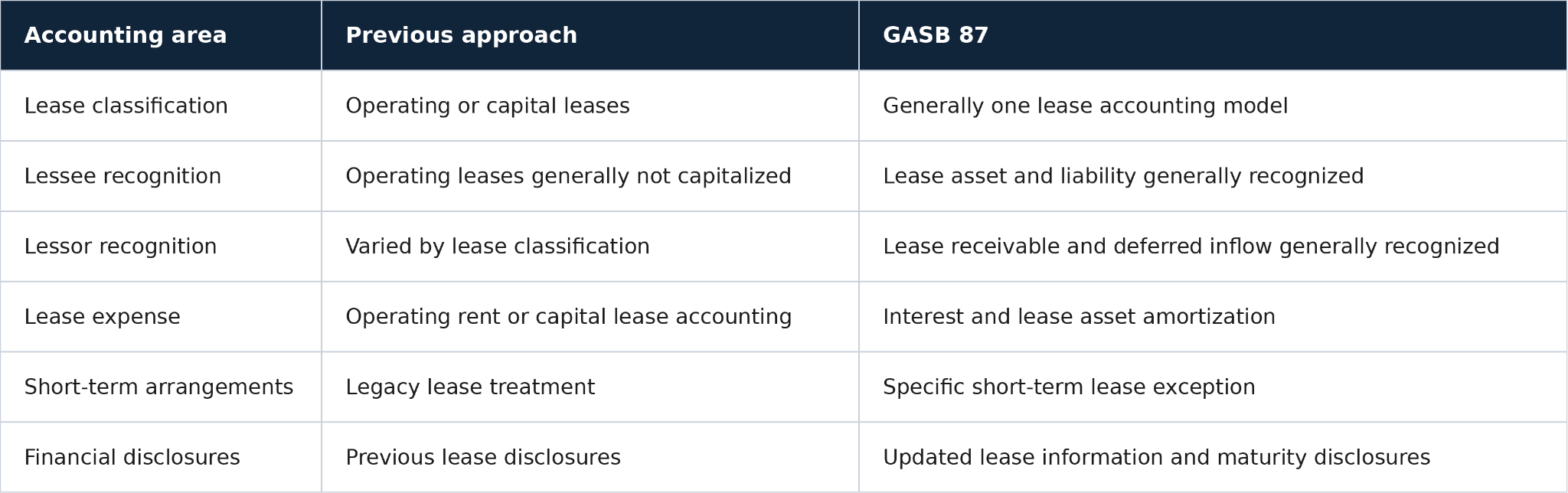
The changes increased the importance of identifying contractual payment obligations, calculating present values, and maintaining reliable lease information.
For government finance departments, the transition also required closer coordination with procurement, facilities management, and legal teams.
How Are Lease Liabilities Calculated Under GASB 87?
A government lessee generally measures its initial lease liability using the present value of qualifying payments expected to be made during the lease term.
The calculation depends on the payment schedule, lease term, and applicable discount rate.
The discount rate is generally the interest rate the lessor charges the lessee, which may be implicit in the lease. When that rate cannot be readily determined, the lessee uses its estimated incremental borrowing rate.
Qualifying payments generally include fixed payments, certain variable payments dependent on an index or rate, and other amounts specified by the standard.
Variable payments based on future usage or performance are generally excluded from initial measurement unless they are fixed in substance.
For example, a government may pay a fixed annual amount for leased equipment plus additional charges based on actual usage.
The fixed payments generally form part of the initial liability, while qualifying usage-based amounts are recognized according to the relevant requirements when incurred.
The lease liability is subsequently reduced as payments are made, while interest is recognized over time.
GASB 87 Lease Accounting Example
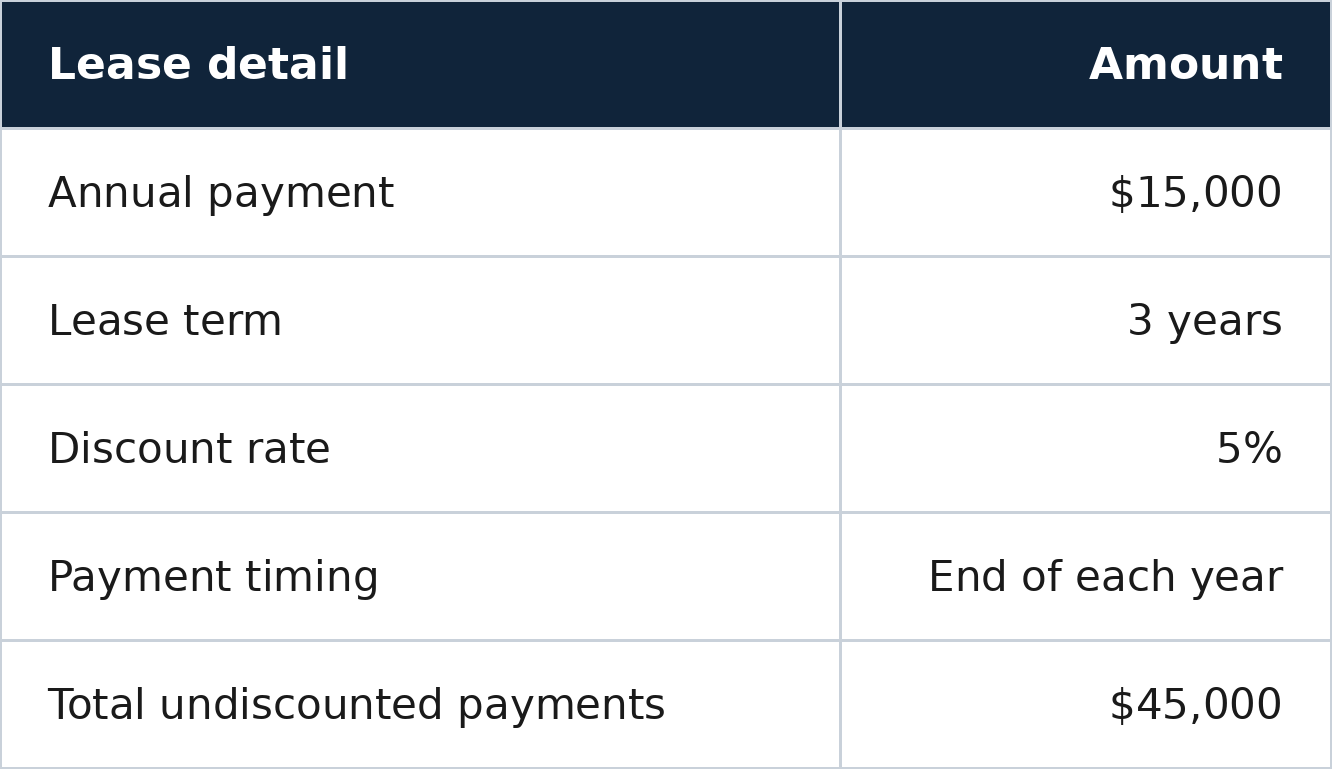
Consider a municipal agency entering a three-year equipment lease.
Assume the agreement requires annual payments of $15,000 at the end of each year, with a discount rate of 5%.
The arrangement has no incentives, initial direct costs, prepayments, restoration obligations, or modifications.
Step 1: Calculate the Initial Lease Liability
The present value of the three payments is calculated using:
Present Value = Payment × [1 − (1 + r)^−n] ÷ r
Where the payment is $15,000, the annual discount rate is 0.05, and the lease term is three years.
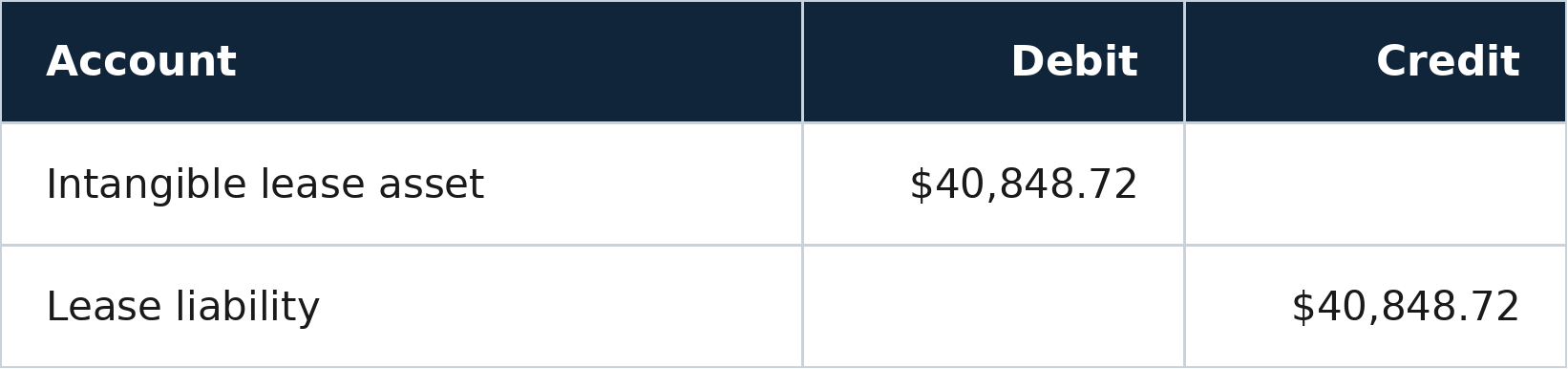
The calculation produces an initial lease liability of approximately $40,848.72.
Step 2: Measure the Lease Asset
Under these simplified assumptions, the initial lease asset equals the lease liability because there are no additional qualifying adjustments.
The initial intangible lease asset is therefore $40,848.72.
In practice, relevant payments made at or before commencement, lease incentives, and certain direct costs can affect the initial asset measurement.
Step 3: Recognize Interest and Payments
During the first year, interest is approximately:
$40,848.72 × 5% = $2,042.44
After the $15,000 year-end payment, the liability is reduced to approximately $27,891.16.
The agency continues recording interest and payments using the applicable amortization schedule.
GASB 87 Journal Entries
At commencement, the government records:
At the end of year one, interest is recorded:
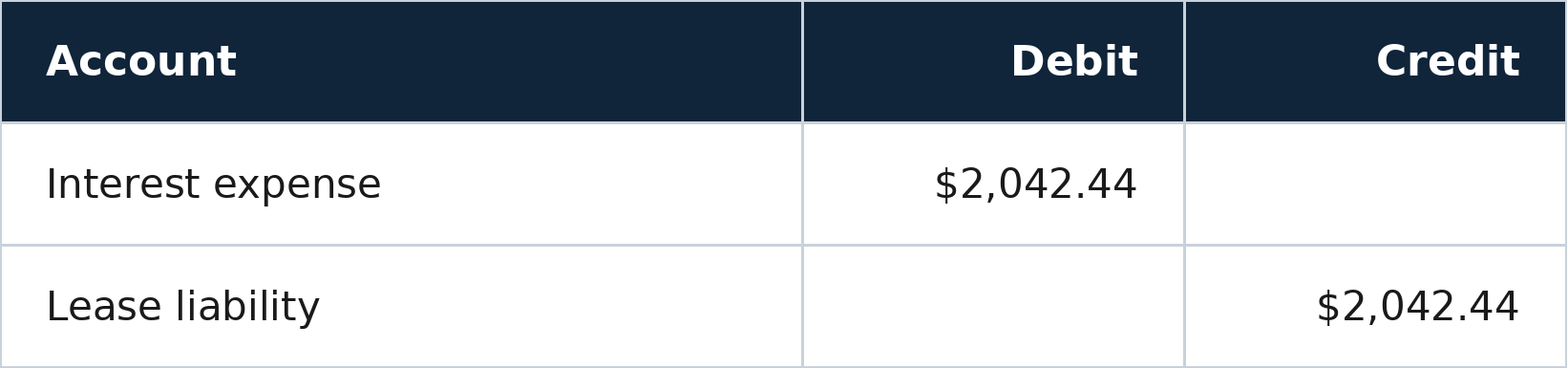
The agency then records its annual payment:
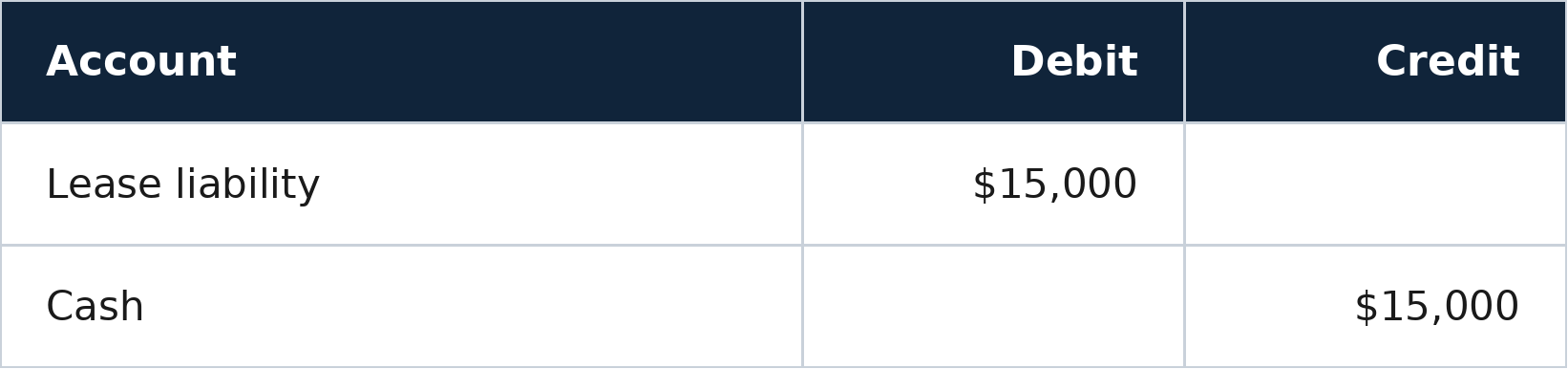
Assuming straight-line amortization over three years, annual lease asset amortization is approximately $13,616.24.
These entries illustrate accounting in statements using the economic resources measurement focus. Governmental fund statements may require different presentation and entries.
For additional context on accounting schedules and reconciliations, see Occupier's lease accounting overview.
How Do Government Lessors Account for Leases?
GASB 87 also changes how governmental entities account for qualifying arrangements when they are the lessor.
A government lessor generally recognizes a lease receivable and a deferred inflow of resources at the beginning of the lease term.
The receivable is measured using the present value of qualifying payments expected to be received.
The deferred inflow generally reflects the value associated with the lease arrangement and is recognized as revenue systematically over the lease term.
For example, a municipality leasing a government-owned building to a private organization may record a receivable for expected lease payments.
As payments are received, the municipality reduces the receivable and recognizes applicable interest revenue.
The deferred inflow is recognized over the appropriate period.
This treatment differs from simply recognizing the entire contractual rent as revenue when cash is received.
Lessors must also evaluate relevant exemptions, lease modifications, and the specific reporting requirements that apply to the arrangement.
Which Leases Are Exempt From GASB 87 Recognition?
The most important recognition exception concerns qualifying short-term leases.
Under GASB 87, a short-term lease has a maximum possible term of 12 months or less at commencement, including all options to extend, regardless of whether those options are likely to be exercised.
This differs from evaluating only the expected occupancy period.
For example, a six-month equipment rental with an option to extend for another twelve months generally does not qualify as a short-term lease because the maximum possible term exceeds one year.
Conversely, a six-month agreement with no extension rights may qualify.
For qualifying short-term leases, lessees recognize payments as outflows of resources based on the contract's payment provisions rather than recording the standard lease asset and liability.
Lessors similarly recognize inflows of resources under the applicable short-term guidance.
Contracts transferring ownership and certain other arrangements also require separate treatment under the relevant governmental standards.
Unlike IFRS 16, GASB 87 does not provide a general low-value asset exemption. Governments should not assume that a small equipment lease is automatically excluded because its value is low.
How Do Renewal and Cancellation Options Affect the Lease Term?
The lease term affects both the initial liability and subsequent accounting.
Under GASB 87, the term generally includes the noncancelable period and qualifying optional periods that are reasonably certain to occur.
This assessment may involve extension options, termination rights, and economic incentives.
For example, a government leasing a specialized facility may be reasonably certain to extend the agreement because relocating essential operations would involve substantial costs.
The corresponding renewal period may therefore be included in the accounting lease term.
However, periods where both parties can terminate without permission from the other party, or where both must agree to an extension, require particular consideration under the standard.
Fiscal funding or cancellation clauses do not automatically shorten the accounting lease term. They generally affect it only when exercise is reasonably certain.
Governments should document these judgments rather than simply using the expiration date listed in a contract summary.
What Happens When a Government Lease Changes?
Lease agreements can change after commencement.
A government may extend a property lease, reduce leased space, modify payment obligations, or terminate an arrangement early.
Such changes may require remeasurement or modification accounting.
For example, a municipal department may renew its office lease for an additional three years after determining that relocation is impractical.
If the event meets the relevant reassessment criteria, the lease liability and associated asset may need to be updated.
Not every change produces the same accounting result.
Finance teams should identify whether the event represents a contract modification, a required reassessment, or another accounting event under GASB 87.
Executed amendments, updated payment schedules, and documentation of relevant decisions should be retained.
A lease roll forward report can help finance departments explain how lease asset and liability balances changed between reporting dates.
What Disclosures Does GASB 87 Require?
GASB 87 requires relevant information about lease arrangements to be disclosed in governmental financial statements.
For lessees, disclosures generally include descriptions of leasing arrangements, the amount of lease assets recognized, and principal and interest requirements for outstanding lease liabilities.
Governments also need to consider disclosures relating to significant variable payments, commitments, and other matters specified by the standard.
Lessor disclosures address relevant leasing arrangements and recognized amounts.
A common challenge is collecting consistent information across departments.
A school district, for example, may have separate contracts for administrative offices, maintenance facilities, and equipment.
Accounting teams need accurate data about each arrangement to prepare complete financial statement disclosures.
Supporting schedules should reconcile to the general ledger and provide sufficient documentation for review.
Common GASB 87 Reporting Challenges
One of the largest challenges is identifying all qualifying lease agreements.
Government contracts may be managed by procurement, facilities, finance, or other departments, making it difficult to maintain one complete lease inventory.
Another challenge is determining the correct accounting lease term.
Extension options, termination provisions, and fiscal funding clauses can require judgments that are not apparent from basic contract summaries.
Discount rates and payment schedules also require attention because errors in these inputs affect the initial liability and subsequent accounting.
Finally, governments need processes for identifying modifications throughout the reporting period.
A signed amendment that remains with a facilities department may not reach the accounting team before financial statements are prepared.
Clear responsibilities, periodic contract reviews, and documented reconciliations help reduce these risks.
Occupier's lease accounting audit checklist provides broader guidance on organizing documentation and reviewing lease accounting records.
GASB 87 vs. GASB 96: What's the Difference?
GASB 87 and GASB 96 address different types of arrangements.
GASB 87 primarily governs qualifying leases of nonfinancial assets, including property and equipment.
GASB 96 addresses subscription-based information technology arrangements, commonly called SBITAs.
For example, a government leasing physical office equipment may need to evaluate the contract under GASB 87.
A qualifying agreement to access subscription-based software may instead fall under GASB 96.
Although both standards can involve recognized intangible right-to-use assets and related liabilities, their scope and requirements are not identical.
Governments should therefore evaluate whether a contract is a traditional lease, a technology subscription arrangement, or an agreement requiring other accounting treatment.
The contract's substance determines the applicable accounting guidance.
Managing GASB 87 Compliance Across Multiple Agreements
Once initial implementation is complete, the ongoing challenge is maintaining accurate lease information as contracts change.
Government organizations need consistent processes for collecting executed agreements, identifying relevant payment obligations, calculating balances, and documenting amendments.
Centralized records also help finance teams respond to audit requests and investigate unusual account movements.
For organizations managing substantial lease portfolios, software may assist with amortization schedules, accounting entries, reconciliations, and financial reporting.
Occupier's lease accounting software supports GASB 87 alongside other lease accounting standards and helps teams organize contractual and financial information.
When evaluating software, governmental entities should confirm that the solution supports their specific fund reporting, accounting policies, disclosures, integrations, and GASB 87 requirements.
Frequently Asked Questions About GASB 87
When did GASB 87 become effective?
GASB 87 became effective for reporting periods beginning after June 15, 2021, following amendments to the original implementation timeline. It is an established reporting requirement rather than a new standard awaiting adoption.
Does GASB 87 apply to federal agencies?
No. GASB 87 applies to state and local governmental financial reporting. Federal entities follow the applicable federal accounting standards.
Are all government leases reported on the balance sheet?
Most qualifying leases require asset and liability recognition in financial statements using the economic resources measurement focus. Short-term leases and certain other arrangements receive different treatment.
Does GASB 87 have a low-value lease exemption?
No. GASB 87 does not provide a general low-value exemption equivalent to the one available under IFRS 16.
How are operating leases classified under GASB 87?
GASB 87 generally replaces the previous operating-versus-capital lease distinction with a single accounting model for qualifying leases.
What is the difference between GASB 87 and ASC 842?
GASB 87 applies to state and local governmental accounting, while ASC 842 applies to entities reporting under U.S. GAAP within its scope. Their lease classification, recognition, measurement, and reporting requirements differ.


Lease management that works for real estate and finance
15,000 sq ft
90 days notice
March 2026
Action required