Medical Office Leases: A Guide for Healthcare Tenants

What is a medical office lease?
A medical office lease is a commercial agreement for property used to provide healthcare services. It establishes the tenant's rent, permitted use, improvement rights, maintenance responsibilities, and other obligations associated with occupying the facility.
A medical office lease is a commercial lease agreement for space used to provide healthcare services, including physician offices, dental practices, outpatient clinics, and specialty treatment facilities. Unlike a traditional office lease, it often involves additional requirements for patient accessibility, medical equipment, plumbing, ventilation, privacy, and specialized improvements.
For healthcare tenants, choosing the right space is about more than location and monthly rent. A medical practice may invest hundreds of thousands of dollars preparing a facility, only to discover that the building cannot support new equipment or that the lease assigns unexpected maintenance costs to the tenant.
These issues become more complicated when healthcare organizations manage multiple clinics or plan to expand.
Understanding how medical office leases work, which provisions deserve attention, and how to evaluate the total cost of occupancy helps healthcare tenants make better long-term real estate decisions.
What Is a Medical Office Lease?
A medical office lease is an agreement that allows a healthcare provider to occupy commercial property for medical or related professional services.
The agreement establishes the rent, lease term, permitted use, maintenance responsibilities, improvement rights, and other obligations between the landlord and healthcare tenant.
Medical leases share many features with conventional office agreements, but the operational requirements can be substantially different.
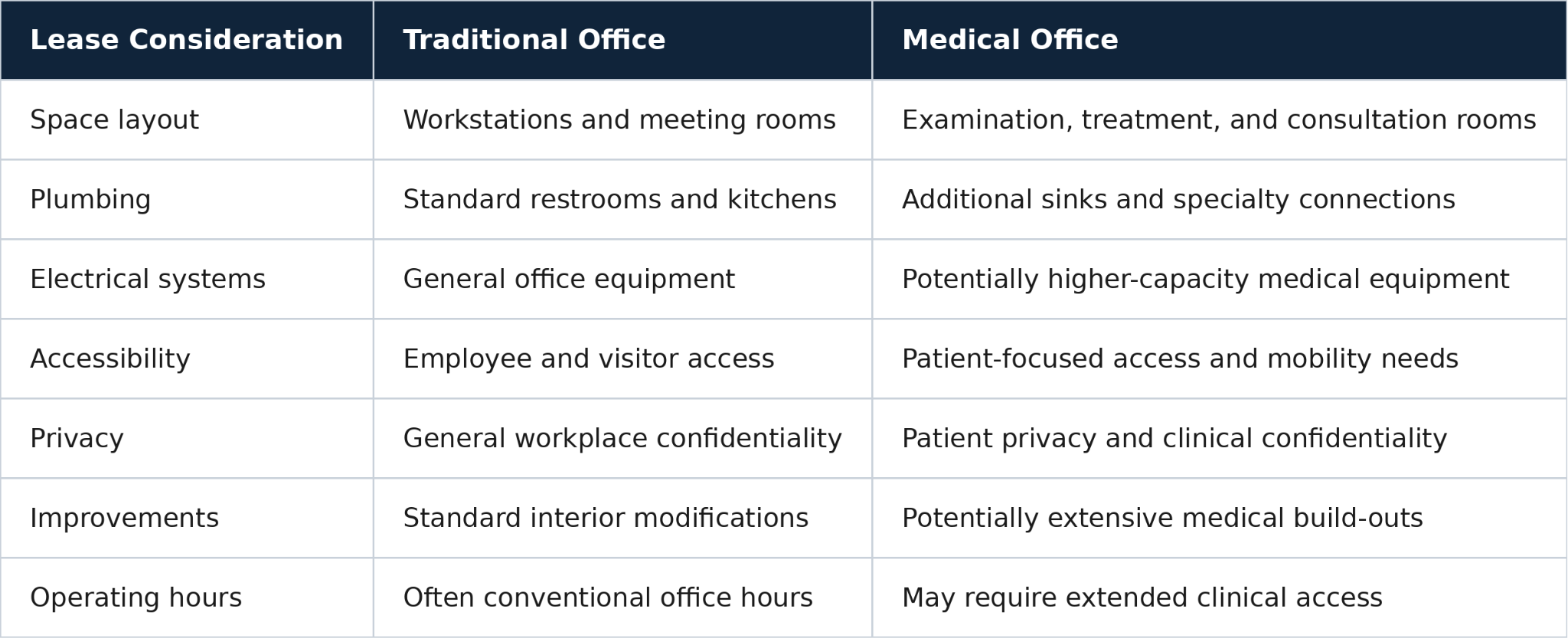
A general office tenant may need desks, meeting rooms, and standard utilities. A medical practice may require examination rooms, specialized plumbing, accessible treatment areas, medical equipment connections, and facilities designed around patient privacy.
The lease should reflect these differences rather than relying entirely on standard office provisions.
For example, a dermatology clinic may require additional electrical capacity for treatment equipment, while a dental practice needs specialized plumbing and infrastructure for dental chairs.
The intended medical use should be confirmed before the tenant commits to the property.
How Are Medical Office Leases Different From Traditional Office Leases?
Medical office leases frequently involve more specialized infrastructure, higher improvement costs, and operational considerations that do not apply to most conventional office tenants.
The distinction matters because a property suitable for administrative work may not be appropriate for delivering healthcare services.
Not every healthcare facility needs the same improvements.
A counseling practice may operate successfully in a conventional office suite, while an imaging center may require substantial structural, electrical, and equipment-related modifications.
The lease should be evaluated against the specific services the practice intends to provide.
What Should Healthcare Tenants Look for in Medical Office Space?
Selecting medical office space requires evaluating whether the location supports patient access, clinical operations, and future business needs.
A property with attractive rent may become expensive if significant modifications are needed before opening.
Patient Accessibility and Location
Medical practices depend on patients being able to reach the facility comfortably.
Parking availability, accessible entrances, nearby transportation, and convenient drop-off areas can affect the patient experience.
For example, a physical therapy clinic serving patients with limited mobility may prioritize ground-floor access and nearby parking over visibility from a major road.
A specialty practice receiving referrals from other healthcare providers may benefit from proximity to hospitals or established medical campuses.
Location decisions should reflect the practice's patient population rather than general commercial real estate preferences.
Clinical Layout and Infrastructure
Healthcare tenants should evaluate whether the available space can accommodate examination rooms, treatment areas, waiting rooms, staff facilities, and administrative operations.
Plumbing, electrical capacity, ventilation, and equipment requirements deserve particular attention.
A property that already contains medical infrastructure may reduce construction costs compared with a vacant commercial shell.
However, existing improvements are not automatically suitable for every specialty.
A former primary care office may still require significant changes before becoming a dental clinic or diagnostic facility.
Zoning and Permitted Use
Before signing, confirm that the property can legally support the intended healthcare services.
Local zoning rules, building codes, licensing requirements, and permitted-use restrictions may affect whether the practice can operate.
For example, a lease allowing general professional office use may not expressly permit certain outpatient procedures or medical services.
Tenants should verify these requirements with the appropriate authorities and qualified professionals before committing to construction.
Shell Space vs. Second-Generation Medical Office Space
Healthcare tenants frequently compare unfinished shell space with offices previously occupied by another medical practice.
The choice can significantly affect construction costs, opening timelines, and design flexibility.
Shell space generally requires a more extensive build-out, including interior walls, plumbing, electrical systems, fixtures, and finishes.
It provides greater freedom to design the facility around specific clinical workflows but may involve longer construction schedules and higher upfront costs.
Second-generation medical space already contains some healthcare-related improvements.
For example, a former physician's office may include examination rooms, sinks, cabinetry, and reception areas.
These features can reduce construction requirements, but tenants must still verify their suitability and condition.
Existing plumbing may be poorly positioned for a new specialty, or the electrical system may not support additional equipment.
The lower initial construction estimate should therefore be weighed against the cost of adapting the space.
What Lease Terms Matter Most for Medical Practices?
Medical office leases often create long-term obligations because healthcare facilities can be expensive to relocate or rebuild.
The most important provisions extend beyond the initial rental rate.
Rent Structure and Operating Expenses
Medical office leases may use full-service gross, modified gross, or triple net structures.
Under a full-service arrangement, some building operating expenses are included in the quoted rental rate. A triple net lease typically requires the tenant to pay property taxes, insurance, and certain maintenance expenses in addition to base rent.
Modified gross leases allocate these costs according to negotiated terms.
Understanding the complete commercial rent structure helps healthcare tenants compare properties on a consistent basis.
A lower base rent may not represent the least expensive option when additional operating charges are considered.
Maintenance and Building Systems
Medical facilities can depend heavily on reliable HVAC, plumbing, electricity, and other building systems.
The lease should identify which party is responsible for repairs, replacements, routine maintenance, and emergency service.
For example, an outpatient clinic may require temperature-controlled treatment rooms or uninterrupted access to essential equipment.
If the HVAC system fails, the financial and operational consequences could extend beyond a normal office disruption.
Tenants should clarify responsibility for existing equipment, specialized systems, after-hours HVAC service, and major capital replacements.
Lease Term and Renewal Options
Medical practices often negotiate longer lease terms to recover the cost of specialized improvements.
However, longer commitments can limit flexibility if patient demand, staffing requirements, or service offerings change.
Renewal options are important because relocating an established practice may involve construction expenses, patient communication, licensing updates, and operational downtime.
Healthcare tenants should understand renewal notice requirements, future rent adjustments, and the length of available extension periods.
Occupier's guide to lease renewal negotiations explains how tenants can evaluate extension options and negotiate terms before their agreements expire.
How Do Tenant Improvement Allowances Work in Medical Office Leases?
Medical office build-outs can be expensive because healthcare facilities often require more extensive modifications than traditional offices.
These expenses may include additional plumbing, treatment room construction, electrical upgrades, accessible facilities, and specialized ventilation.
A tenant improvement allowance (TIA) is an amount the landlord agrees to contribute toward qualifying improvements.
For example, a landlord might provide $60 per square foot toward construction costs for a 3,000-square-foot medical suite.
The total allowance would be:
3,000 sq. ft. × $60 = $180,000
If the project's total improvement cost reaches $300,000, the remaining $120,000 must be funded through other sources, subject to the negotiated agreement.
Tenants should verify which expenses qualify, when reimbursement becomes available, and what documentation must be submitted.
Some landlords reimburse completed construction costs rather than providing funds upfront. This can create cash-flow pressure for practices financing their own build-outs.
The treatment of allowances also affects lease accounting. Occupier's guide to tenant improvement allowance accounting explains how these incentives are evaluated under ASC 842.
The accounting treatment depends on the underlying arrangement, including whether the improvements are considered tenant or landlord assets.
Medical Office Lease Example: Evaluating Total Occupancy Costs
Consider a healthcare practice planning to open a 3,000-square-foot outpatient clinic.
The landlord offers a seven-year lease at $32 per square foot annually, with additional operating expenses of $10 per square foot.
The practice also expects substantial improvements before opening.
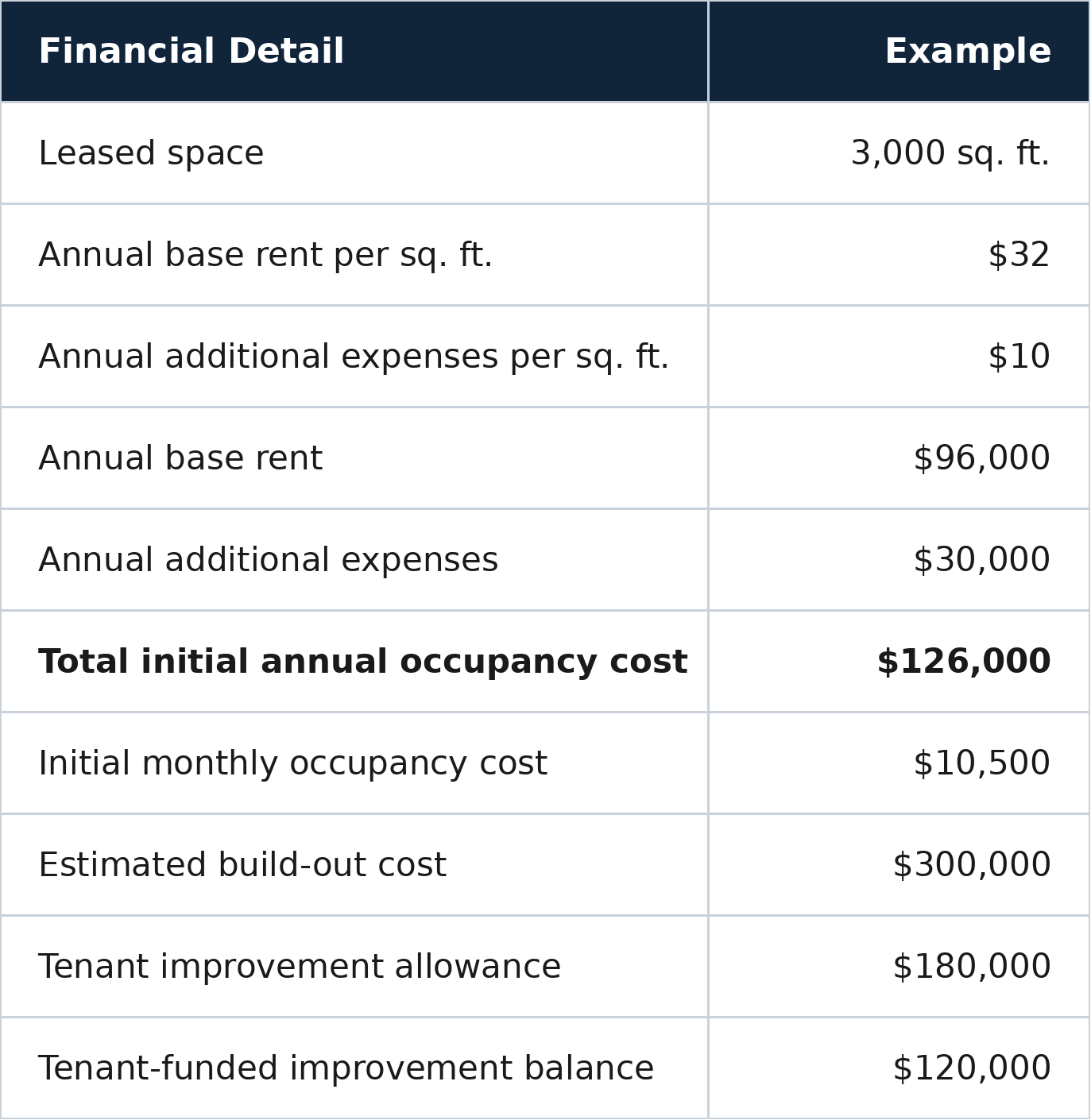
The clinic's initial annual occupancy cost is $126,000, excluding utilities or other charges not included in the assumptions.
The tenant must also finance $120,000 of improvements after applying the landlord's allowance.
If base rent increases by 3% annually, the initial $96,000 base rent would reach approximately $114,627 in the seventh lease year.
Additional operating expenses could also increase independently.
The practice should compare these long-term costs against projected patient volume, reimbursement revenue, staffing expenses, and expected profitability.
The example illustrates why medical office leases should be evaluated using total occupancy costs and required capital investment, rather than the quoted rental rate alone.
What Compliance Requirements Affect Medical Office Leases?
Healthcare tenants must consider several regulatory and operational requirements when selecting and preparing commercial space.
However, compliance obligations vary by medical specialty, location, building characteristics, and services provided.
Accessibility and Building Requirements
Medical offices may need to comply with applicable accessibility requirements, including the Americans with Disabilities Act (ADA), as well as state and local building codes.
Entrances, restrooms, corridors, parking facilities, and treatment areas should be assessed based on the practice's intended use.
The lease should clearly identify responsibility for required modifications.
A landlord may be responsible for certain common areas, while the tenant may be assigned obligations within its leased premises. Contractual allocations do not necessarily eliminate either party's statutory responsibilities.
Patient Privacy and Healthcare Operations
Healthcare providers subject to HIPAA must protect patient information and maintain appropriate administrative, physical, and technical safeguards.
The lease itself does not establish HIPAA compliance.
However, the physical layout can affect privacy through reception areas, consultation rooms, conversations, record storage, and access to clinical spaces.
Practices should also evaluate applicable requirements for medical waste, infection control, equipment installation, and specialized ventilation.
These matters should be reviewed with healthcare design, legal, and compliance professionals before finalizing the property.
Who Pays for Medical Office Repairs and Improvements?
Responsibility for repairs depends on the lease rather than simply whether the property is used for healthcare.
Some agreements make landlords responsible for structural components and major building systems, while tenants maintain interior improvements and specialized equipment.
Other leases assign broader maintenance responsibilities to tenants.
For example, a healthcare tenant may install specialized electrical equipment that requires ongoing inspections and servicing.
The lease should distinguish between maintaining tenant-installed systems and repairing building infrastructure supplied by the landlord.
Tenants should also review what happens if equipment becomes obsolete or requires replacement.
The treatment of these costs may affect the accounting for leasehold improvements, particularly when improvements provide benefits over several years.
Clear responsibility provisions help prevent disputes and reduce uncertainty when repairs disrupt clinical operations.
How Should Healthcare Tenants Plan for Expansion?
Medical practices may need additional space as patient demand increases, new providers join, or services expand.
A facility that comfortably accommodates three physicians today may become inadequate when the practice adds examination rooms, staff, or specialized equipment.
Expansion rights can provide flexibility without requiring a complete relocation.
For example, a medical tenant might negotiate a right of first offer or another option involving adjacent space when it becomes available.
However, these rights depend on the lease's exact language and may be subject to existing tenant rights or other conditions.
Assignment and subleasing provisions also deserve attention.
Healthcare organizations may restructure ownership, merge practices, or transfer operations to another entity. Restrictions on assigning the lease can complicate these transactions.
Planning for growth should include both physical capacity and the contractual ability to change how the premises are used.
Managing Medical Office Leases Across Multiple Locations
Medical office leases become more difficult to administer as healthcare organizations expand across clinics, specialties, and markets.
Each location may have different rent structures, equipment requirements, maintenance obligations, renewal deadlines, and improvement agreements.
A regional healthcare group managing 30 clinics, for example, may need to monitor HVAC responsibilities at one location, a tenant improvement reimbursement at another, and a renewal notice approaching at a third.
These obligations often involve different departments.
Real estate teams manage lease negotiations and landlord relationships. Facilities teams coordinate repairs and infrastructure requirements. Finance teams monitor rent payments, allowances, and accounting schedules.
When information is scattered across spreadsheets and shared folders, identifying current obligations becomes unnecessarily time-consuming.
Occupier's lease administration software helps healthcare tenants centralize lease records, contractual obligations, critical dates, and financial information.
Having consistent records allows teams to review responsibilities across locations and prepare for important lease decisions before deadlines arrive.
For healthcare organizations investing heavily in specialized facilities, accurate lease information supports more predictable operations and long-term portfolio planning.
Medical Office Lease FAQs
What is a medical office lease?
A medical office lease is a commercial agreement for property used to provide healthcare services. It establishes the tenant's rent, permitted use, improvement rights, maintenance responsibilities, and other obligations associated with occupying the facility.
How long is a typical medical office lease?
Medical office lease terms vary, but practices requiring substantial improvements may seek longer commitments to recover their investment. Five- to ten-year terms are common in some markets, although shorter and longer agreements are available.
Are medical office leases more expensive than traditional office leases?
They can be, particularly when specialized construction, equipment infrastructure, or compliance-related improvements are necessary. However, the actual cost depends on the location, property condition, lease structure, and scope of required work.
What is a tenant improvement allowance in a medical lease?
A tenant improvement allowance is money the landlord agrees to contribute toward qualifying improvements. It may help cover construction, plumbing, electrical upgrades, and other approved modifications, subject to the lease terms.
Can a regular office building be used as medical office space?
Potentially. However, the property must support the intended medical use and satisfy applicable zoning, building, accessibility, and healthcare-related requirements. The tenant should verify these conditions before signing.
Who is responsible for HVAC repairs in a medical office?
Responsibility depends on the lease. Some landlords maintain central building systems, while tenants may be responsible for specialized equipment, interior HVAC components, or additional service requirements.
Can a medical practice negotiate its lease terms?
Yes. Healthcare tenants can negotiate rent, tenant improvement allowances, maintenance responsibilities, renewal options, expansion rights, and other provisions. The available flexibility depends on the property, market, and negotiating circumstances.
What happens if a medical practice needs to relocate before its lease expires?
The practice may be able to negotiate early termination, assign the lease, or sublease the premises if the agreement permits. These options may involve landlord approval, financial obligations, and other contractual conditions.


Lease management that works for real estate and finance

15,000 sq ft
90 days notice
March 2026
Action required