What Is ASC 842? The Lease Accounting Standard, Explained
ASC 842 is the FASB lease accounting standard that requires companies reporting under US GAAP to put nearly all leases on the balance sheet as a right-of-use asset and a lease liability. It replaced ASC 840, applies to real estate and equipment leases alike, and changed how finance teams classify, measure, and disclose leases. Most companies adopted it years ago, but staying compliant, and implementing it correctly for new leases and portfolio changes, is an ongoing job, not a one-time project.
If you’re on a real estate team, ASC 842 is the reason every lease term, option, and amendment now has to be tracked with more precision than a spreadsheet was built for. If you’re on a finance team, it’s the reason month-end close now includes a lease schedule that has to tie out exactly, every time. Here’s what the standard requires, how to implement it, and what it takes to stay ahead of it.
What Is ASC 842, Exactly?
ASC 842, also called Topic 842, is FASB’s current lease accounting standard. It was created to give investors and lenders better visibility into a company’s lease obligations, which were largely invisible under the old standard, ASC 840. Under ASC 842, lessees record a right-of-use (ROU) asset and a corresponding lease liability for nearly every lease with a term over 12 months, whether that lease is classified as operating or finance.
In practice, this means leases that used to live in a footnote now live on the balance sheet, which changes how a company’s leverage, liquidity ratios, and overall financial position get evaluated by lenders, auditors, and investors.
Who Does ASC 842 Apply To, and When Did It Take Effect?
ASC 842 applies to any organization reporting under US GAAP that leases real estate, equipment, vehicles, or other assets for a term of more than 12 months. The effective dates rolled out in two phases:
- Public companies: Fiscal years beginning after December 15, 2018.
- Private companies and nonprofits: Originally fiscal years beginning after December 15, 2019, then delayed twice (once for implementation feedback, once for COVID-19) to fiscal years beginning after December 15, 2021. Most private companies adopted the standard for their 2022 fiscal year.
If your company hasn’t formally adopted ASC 842 yet, that window has closed. The work now is implementing it correctly for every new lease and staying compliant as leases get added, modified, renewed, and terminated.
What Counts as a Lease Under ASC 842?
ASC 842 defines a lease as a contract, or part of a contract, that conveys the right to control an identified asset for a period of time in exchange for payment. “Control” has a specific meaning here: your company has to get substantially all of the economic benefit from the asset and direct how it’s used for the contract’s duration.
That definition pulls in more arrangements than most teams expect, including embedded leases buried inside service contracts, equipment agreements, and vendor contracts that were never labeled “lease” anywhere in the document. Real estate teams are usually confident about which contracts are leases. Finding the ones hiding inside other agreements is where most companies get caught off guard, and where completeness risk lives for an auditor.
A few categories are explicitly out of scope under ASC 842-10-15-1: leases of intangible assets like software (ASC 350), leases for exploring or using non-regenerative natural resources like oil, gas, and minerals (ASC 930/932), leases of biological assets (ASC 905), inventory leases (ASC 330), and leases of assets under construction (ASC 360).
ASC 842 vs. ASC 840: What Actually Changed
How to Implement ASC 842: A Step-by-Step Overview
Whether you’re implementing ASC 842 for the first time or bringing a newly acquired portfolio into compliance, the process breaks down into a consistent set of steps:
- Identify every lease. Review traditional leases, service contracts, and vendor agreements for embedded leases. This step needs finance, legal, real estate, and operations at the table together; embedded leases in particular get missed when only one function reviews contracts.
- Gather and centralize lease data. Terms, payments, commencement dates, renewal and termination options. A spreadsheet can work for a handful of leases; it stops working once modifications, multiple lease types, and multiple reviewers enter the picture.
- Choose your transition method. Covered in detail below, this determines how existing leases move onto the new standard.
- Classify each lease. Operating or finance for lessees; operating, sales-type, or direct financing for lessors. Classification drives how the lease liability, ROU asset, and related expenses get measured and presented.
- Recognize the lease liability and ROU asset. Calculate the present value of future payments, then build the ROU asset from that liability, adjusted for initial direct costs, prepayments, and incentives.
- Establish ongoing management and disclosure processes. ASC 842 compliance doesn’t end at go-live. Every new lease, renewal, and modification needs to flow through the same process, and disclosures need to stay current every reporting period.
- Put technology behind the process. Manual tracking scales poorly past a handful of leases. Centralized lease accounting software reduces the risk of a missed embedded lease, a stale discount rate, or a modification that never reaches the general ledger.
Choosing a Transition Method
This is worth getting exactly right, because it’s an area where it’s easy to describe the options incorrectly. ASC 842 permits only the modified retrospective transition approach; it does not permit a full retrospective approach. Within modified retrospective transition, an entity chooses between two dates of initial application:
- Beginning of the earliest comparative period presented, which requires recasting prior comparative periods to reflect ASC 842.
- Beginning of the period of adoption, which does not require adjusting comparative periods; instead, the entity records a cumulative-effect adjustment to the opening balance of retained earnings.
Most companies elect the second option, since it avoids restating prior-period financials. Either way, this is a one-time election made at adoption, not something companies implementing ASC 842 today for new leases need to revisit, but it’s worth understanding correctly if you’re evaluating how a past transition was handled, or bringing a newly acquired entity onto the standard.
How ASC 842 Classifies Leases for Lessees
Every lease a lessee holds is either an operating lease or a finance lease, and the classification changes both the balance sheet presentation and where the expense shows up on the income statement.
If none of the five criteria are met, it’s an operating lease. That single classification decision determines whether the lease expense is a single straight-line number (operating) or split into interest and amortization on separate income statement lines (finance), and whether the cash flow statement treats the payments as operating or partly financing activity.
ASC 842 Journal Entry Examples
Operating lease example. A company signs a 5-year office lease for $100,000 annually, paid at the start of each year, with a 5% incremental borrowing rate. The present value of those payments becomes the initial lease liability and ROU asset, roughly $432,948.
At commencement, the entry is a debit to the ROU asset and a credit to the lease liability for that amount. Each year after, the company records a single straight-line lease expense, splits the cash payment between principal and imputed interest on the liability, and amortizes the ROU asset.
Finance lease example. Same company, same terms, except the lease includes a bargain purchase option the company is reasonably certain to exercise, which makes it a finance lease. The initial entry looks identical: debit ROU asset, credit lease liability for $432,948. Where it diverges is every year after: interest expense and ROU amortization expense are now recognized as two separate line items on the income statement, instead of one combined lease expense, and principal payments move to financing activities on the cash flow statement.
For more worked entries, including the subsequent monthly entries for both lease types, see our ROU asset journal entries guide.
How Does ASC 842 Apply to Lessors?
Lessor accounting changed less than lessee accounting under ASC 842. Lessors classify leases into one of three categories, covered in full under ASC 842-30:
One notable change from ASC 840: leveraged leases were eliminated. Lessors can no longer originate new leveraged lease arrangements; only leases with a commencement date before the entity’s ASC 842 adoption date can still use that treatment, under ASC 842-50.
For a side-by-side look at how each party records a lease, see our lessee vs. lessor accounting guide.
What Discount Rate Should You Use Under ASC 842?
- Use the rate implicit in the lease if it’s readily determinable.
- If not, use your incremental borrowing rate (IBR), the rate you’d pay to borrow a similar amount, over a similar term, on a similar collateral basis.
- Private companies get a practical expedient: they can elect to use a risk-free rate instead of calculating an IBR.
For the full mechanics of determining an IBR, see our Incremental Borrowing Rate guide.
What Are Initial Direct Costs Under ASC 842?
Initial direct costs are direct and incremental costs of a lease that wouldn’t have been incurred if the lease hadn’t been executed, and they get capitalized into the ROU asset rather than expensed immediately. Common examples include lease commissions and incentive payments made to a party other than the lessor for securing the lease. Legal fees for negotiating and drafting a lease generally don’t qualify, since they’re typically incurred whether or not the lease is ultimately executed.
What Practical Expedients Are Available Under ASC 842?
- The package of three expedients: not reassessing whether existing contracts contain leases, not reassessing lease classification for existing leases, and not reassessing initial direct costs for existing leases.
- Short-term lease expedient: skip ROU asset and liability recognition for leases with a term of 12 months or less.
- Risk-free rate expedient (private companies only): use a risk-free rate instead of calculating an incremental borrowing rate.
- Hindsight expedient: use hindsight when assessing lease term and impairment for transition-period leases.
How Do Lease Modifications Work Under ASC 842?
A lease modification is any change to the scope or consideration of a lease that wasn’t part of the original terms. Modifications that grant additional right-of-use assets at a price consistent with standalone market rates are accounted for as a separate, new lease. All other modifications require remeasuring the lease liability using an updated discount rate, with a corresponding adjustment to the ROU asset. Partial or full terminations require derecognizing the corresponding portion of the liability and ROU asset, with any difference recorded as a gain or loss.
How Does Sale-Leaseback Accounting Work Under ASC 842?
In a sale-leaseback, a company sells an asset and simultaneously leases it back from the buyer. The seller-lessee first determines whether the transaction qualifies as a sale under ASC 606. If it does, the seller-lessee recognizes the full gain from the sale at that point, then accounts for the leaseback under standard lessee rules. This is a meaningful difference from IFRS 16, covered in the comparison below.
What Are the ASC 842 Disclosure Requirements?
At minimum, companies need to disclose a qualitative description of leases and significant judgments, lease cost by category, weighted-average remaining lease term and discount rate, a five-year maturity analysis of lease liabilities, and cash paid for amounts included in lease liability measurement. These disclosures are exactly where audits tend to stall when the underlying lease data isn’t centralized and verified.
ASC 842 vs. IFRS 16: A Detailed Comparison
ASC 842 is the US GAAP standard. IFRS 16 is its international counterpart, and while FASB and the IASB aimed for convergence, several real differences remain, beyond the well-known operating/finance distinction.
The sale-leaseback and transition rows are the two most likely to trip up a company operating under both frameworks, since they affect a one-time gain recognized on the income statement and a foundational election made at adoption, not just an ongoing calculation difference. For the ROU asset calculation differences specifically, see our right-of-use asset guide, and read the full IFRS 16 vs. ASC 842 comparison for every difference between the two standards.
ASC 842 Lease Accounting Software
Beyond compliance itself, lease accounting software built for ASC 842 typically covers a few things spreadsheets struggle to scale: centralized lease data real estate and finance both work from, automated present value and amortization calculations, day-two accounting for modifications and remeasurements, and disclosure reports generated directly from the same underlying data instead of rebuilt from scratch every quarter.
Why ASC 842 Compliance Is Harder Than the Standard Itself
None of the rules above are the hard part. Every item on this page is documented, precedented, and has a defensible answer. The hard part is what we’d call the two-team compliance gap: lease data scattered across PDFs, emails, and spreadsheets; real estate teams who know the lease terms but aren’t the ones doing the accounting; and finance teams who own the compliance reporting but are stuck waiting on data they can’t independently verify.
That gap is where ASC 842 risk actually lives. A missed renewal option changes the “reasonably certain” assumption driving your liability calculation. An amendment that doesn’t reach finance in time means a journal entry gets built on stale terms. None of that is a FASB problem. It’s a workflow problem, and it’s the reason companies with clean accounting policies still fail audits.
How Occupier Keeps Real Estate and Finance Audit-Ready Under ASC 842
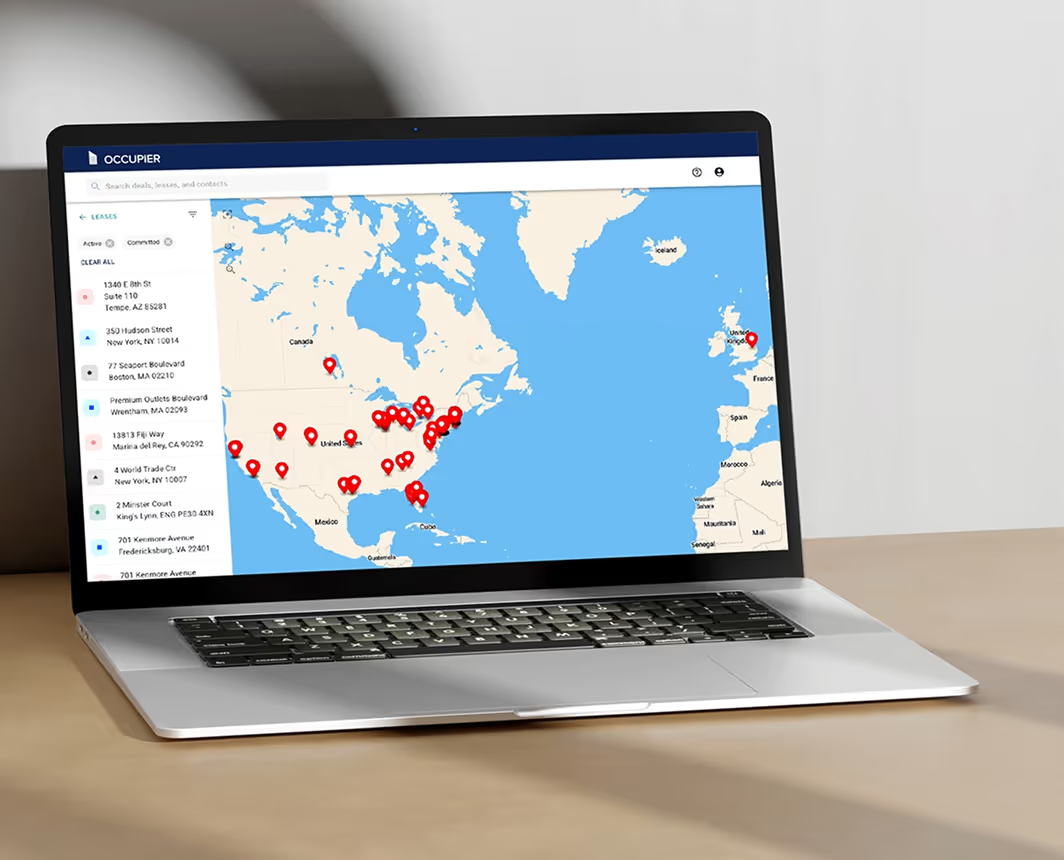
Occupier was built around that exact gap. Real estate and finance teams work from the same centralized lease repository, so the terms driving your ASC 842 calculations, discount rates, classifications, modification triggers, are the same terms your real estate team is actively managing, not a static export from months ago.
Our team supports the lease abstraction process, pulling key terms, dates, and clauses directly out of your lease documents, so the data feeding your right-of-use asset and lease liability calculations is accurate from the start. Automated journal entries and disclosure reports stay current as leases get modified, renewed, or terminated, so audit prep stops being a month-end fire drill.
One platform. Two teams. Zero compromise.
See how Occupier handles ASC 842 compliance →
ASC 842 FAQs
Is ASC 842 still in effect in 2026? Yes. ASC 842 is the current FASB lease accounting standard for all companies reporting under US GAAP, including public companies, private companies, and nonprofits.
What transition methods does ASC 842 allow? Only the modified retrospective approach, with a choice of two dates of initial application. ASC 842 does not permit a full retrospective transition, unlike IFRS 16.
Does ASC 842 apply to short-term leases? Leases with a term of 12 months or less qualify for a practical expedient allowing lessees to skip ROU asset and lease liability recognition.
What’s the difference between an operating lease and a finance lease under ASC 842? Both go on the balance sheet, but operating leases get a single straight-line lease expense, while finance leases split the expense into separate interest and amortization line items.
Do private companies have to comply with ASC 842? Yes. Private companies and nonprofits were required to adopt ASC 842 for fiscal years beginning after December 15, 2021.
Does ASC 842 apply to specialized industries, like natural gas storage arrangements? Yes. ASC 842’s lease definition applies across industries; specialized capacity or storage arrangements still need to be evaluated against the standard’s lease criteria (control of an identified asset for a period of time), regardless of the asset type involved.
What’s the biggest difference between ASC 842 and IFRS 16 for a sale-leaseback? Under ASC 842, the seller-lessee recognizes the full gain on a qualifying sale-leaseback. Under IFRS 16, gain recognition is limited, which can make the same transaction look meaningfully different across the two standards.
Do I need software to implement ASC 842? Not strictly, for a very small lease portfolio. Past a handful of leases, or once modifications and multiple lease types enter the picture, manual tracking becomes the primary source of compliance risk, not the accounting rules themselves.



Lease management that works for real estate and finance
15,000 sq ft
90 days notice
March 2026
Action required