How to Account for Free Rent and Rent Abatement Under ASC 842

Is free rent recognized as an expense under ASC 842?
Yes. For an operating lease, the tenant generally recognizes a single lease cost over the lease term, including rent-free periods. The expense is typically allocated on a straight-line basis unless another systematic method better reflects the benefit received.
Rent abatement is a period during a commercial lease when a tenant is not required to pay rent or receives a temporary reduction in rental payments. Under ASC 842, free rent periods included in the original lease are reflected in the payment schedule, while operating lease expense is generally recognized on a straight-line basis throughout the lease term.
For commercial tenants, this creates an important distinction between cash payments and accounting expense. A business may receive three months of free rent when opening a new location, but that does not necessarily mean it records zero lease expense during those months.
The accounting treatment becomes more complicated when rent increases over time, landlords grant concessions after commencement, or tenants receive access to different portions of a property at different dates.
Understanding how rent abatement affects lease liabilities, right-of-use (ROU) assets, and journal entries helps real estate and finance teams maintain accurate financial reporting under ASC 842.
What Is Rent Abatement in a Commercial Lease?
Rent abatement is a contractual arrangement that temporarily reduces or eliminates a tenant's obligation to pay rent.
Landlords commonly offer rent abatements during lease negotiations, particularly when a tenant needs time to move into a property, complete improvements, or establish operations.
For example, a retailer signing a five-year lease may negotiate three months of free base rent before regular payments begin.
The business receives the right to use the property during the rent-free period but does not owe the abated base rent.
Rent abatement can take several forms:
- Full abatement: The tenant owes no specified rent during the agreed period.
- Partial abatement: The tenant pays a reduced amount, such as 50% of base rent.
- Conditional abatement: The concession depends on requirements established in the lease.
- Negotiated rent relief: The landlord agrees to reduce payments after the lease has already commenced.
The exact language determines whether additional expenses, such as common area maintenance (CAM), property taxes, and insurance, remain payable.
It also determines whether abated rent is permanently forgiven or becomes repayable under specified circumstances.
How Does ASC 842 Treat Free Rent Periods?
Under ASC 842, rent-free periods included in the original lease are reflected in the initial lease payment schedule.
A tenant generally recognizes a lease liability based on the present value of qualifying payments that remain unpaid at commencement.
Months with no rent due do not create payments to include in that calculation.
However, for an operating lease, the tenant generally recognizes a single lease cost on a straight-line basis over the lease term, unless another systematic and rational basis better represents the benefit received.
This means lease expense can be recognized even when no cash payment is required.
Consider a company leasing an office for 24 months, with the first two months free.
The tenant begins using the office immediately, but regular rent payments start in month three.
Under ASC 842, the rent-free months are included in the accounting lease term when the underlying property is already available for use.
The distinction between the lease commencement date and the rent commencement date is therefore important.
The lease commencement date generally determines when the ROU asset and lease liability are initially recognized.
The rent commencement date identifies when contractual rent payments begin.
These dates are not necessarily the same.
How Do You Calculate Straight-Line Rent With Abatement?
For a straightforward operating lease, straight-line lease expense is calculated by dividing total qualifying lease cost by the applicable lease term.
The calculation includes periods when the tenant is entitled to use the property but does not make rent payments.
Step 1: Identify the Total Lease Payments
Assume a company signs a two-year office lease with the following terms:
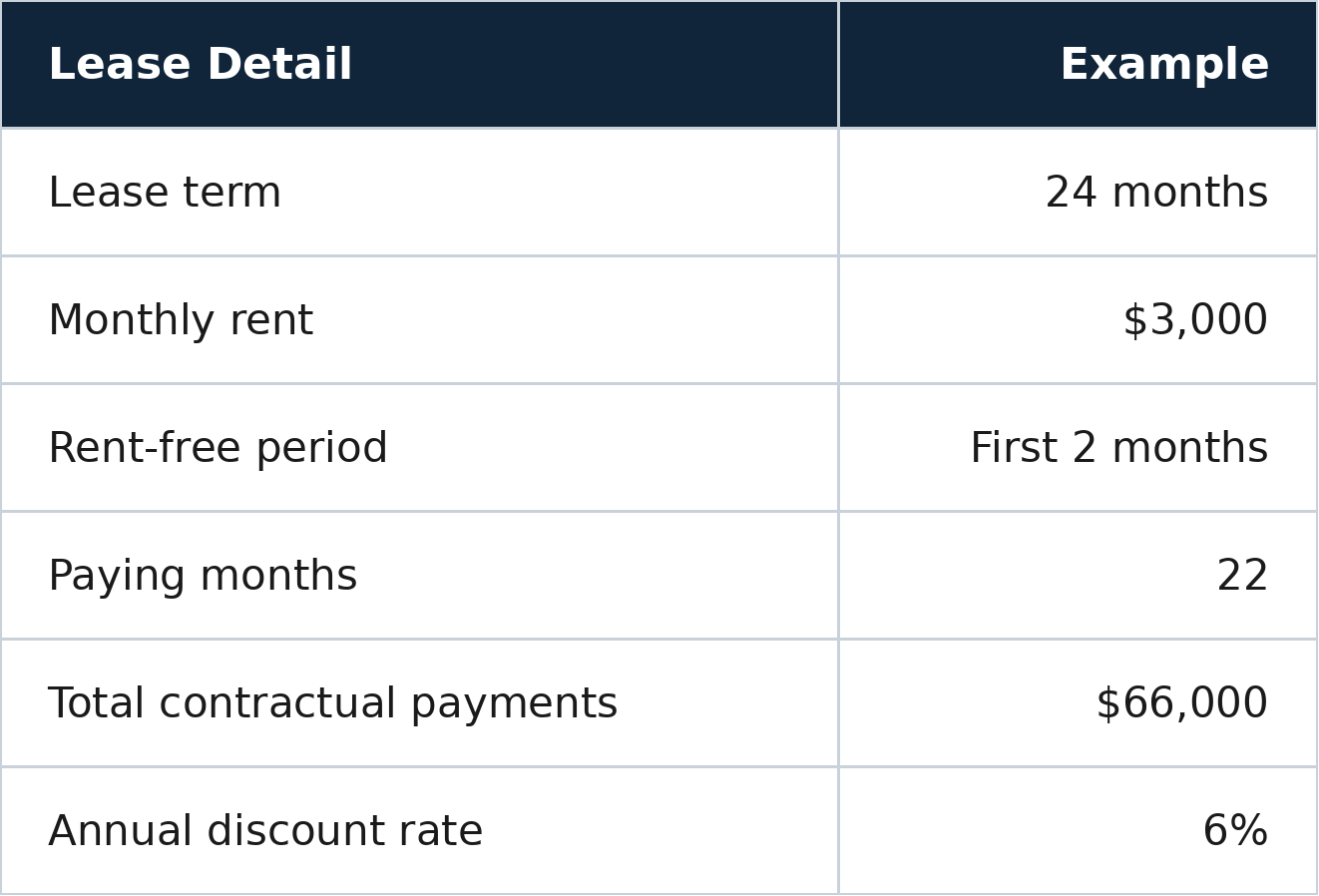
The tenant pays no rent during the first two months.
Beginning in month three, it pays $3,000 each month for the remaining 22 months.
Total payments are:
22 × $3,000 = $66,000
Step 2: Calculate Straight-Line Lease Expense
The tenant receives the right to use the office throughout all 24 months.
Assuming there are no additional lease components, initial direct costs, or lease incentives, straight-line lease expense is:
$66,000 ÷ 24 months = $2,750 per month
The tenant recognizes $2,750 in operating lease expense during each month, including the first two months when no rent is paid.
Step 3: Compare Cash Payments With Lease Expense
The payment schedule and accounting expense will differ during the lease.
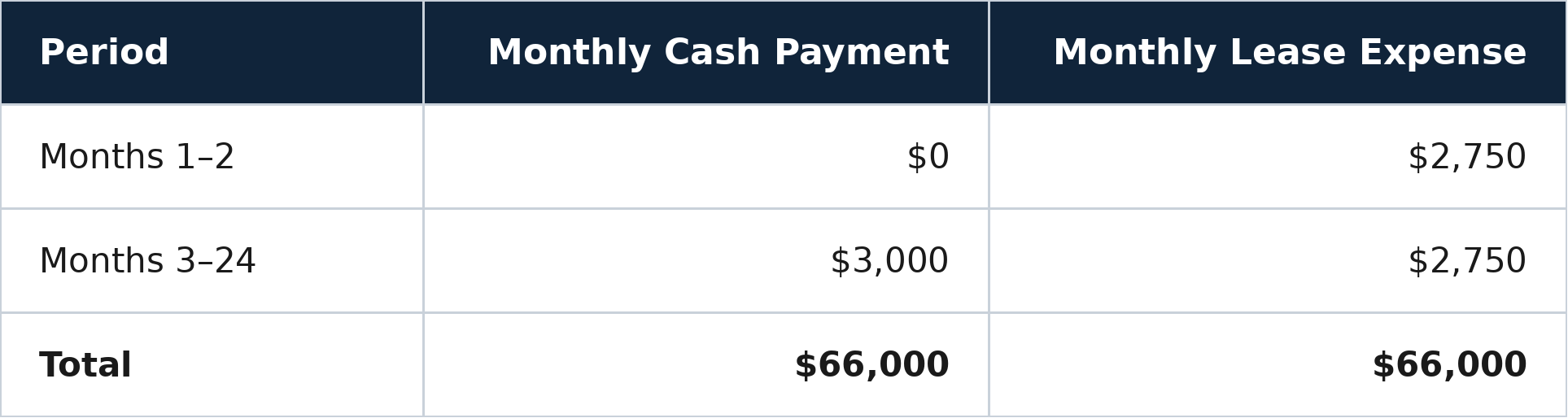
The total expense equals the total contractual payments over the lease term.
However, the timing differs because ASC 842 separates cash payment activity from the recognition of operating lease cost.
This difference is reflected through the lease liability and ROU asset balances rather than a separate deferred rent liability.
How Does Rent Abatement Affect the Lease Liability and ROU Asset?
Rent abatement affects both the initial measurement and subsequent accounting of lease assets and liabilities.
At commencement, the lease liability represents the present value of qualifying future payments.
The ROU asset generally starts with the lease liability, adjusted for prepaid payments, initial direct costs, and lease incentives.
For the two-year example, assume payments occur at the end of each paying month and the 6% annual discount rate is applied as 0.5% monthly.
The present value of the 22 payments beginning at the end of month three is approximately:
Initial Lease Liability = $61,733.30
With no other adjustments:
Initial ROU Asset = $61,733.30
The two amounts begin at the same value.
During the rent-free months, the tenant recognizes operating lease expense even though no cash payments are made.
Interest accretes on the outstanding lease liability, while the ROU asset is reduced to produce the required single operating lease cost.
By the end of the lease, assuming no modifications or other adjustments, both balances are fully reduced.
Occupier's guide to right-of-use assets explains how initial measurements and subsequent amortization affect lease accounting.
Rent Abatement Journal Entries Under ASC 842
The journal entries for rent abatement depend on lease classification and the timing of payments.
For an operating lease, the tenant records the initial ROU asset and lease liability at commencement.
It then recognizes lease expense throughout the lease term, including the rent-free months.
Initial Recognition at Lease Commencement
Using the two-year example:
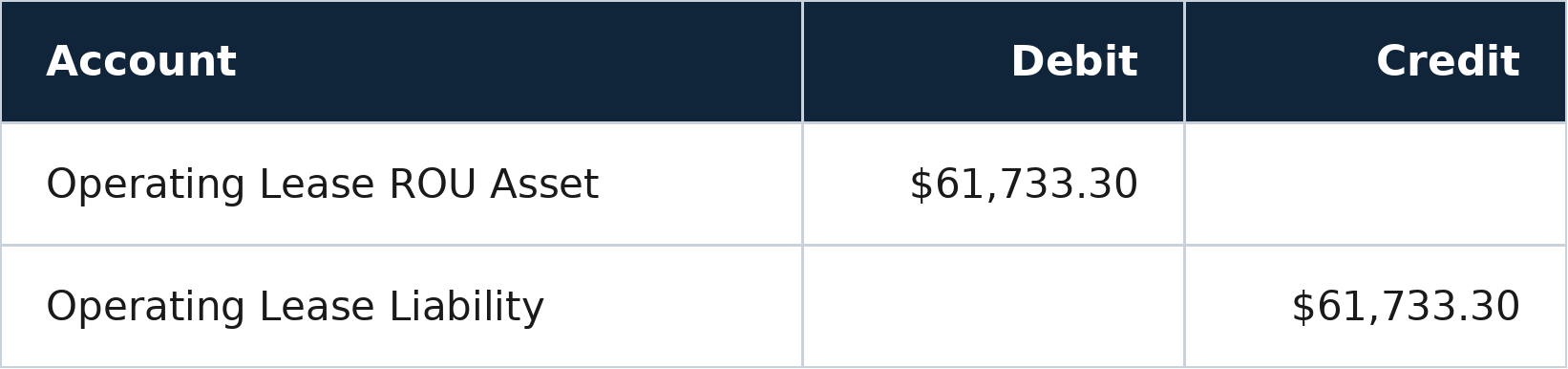
This entry recognizes the initial lease asset and obligation.
Because no rent is paid at commencement, there is no cash payment in the entry.
Journal Entry During the First Rent-Free Month
During the first month, the tenant recognizes $2,750 in operating lease expense.
The lease liability also increases through interest accretion.
At a 0.5% monthly rate:
Interest = $61,733.30 × 0.5% = $308.67
The remaining expense is reflected through the ROU asset:
ROU Asset Reduction = $2,750 − $308.67 = $2,441.33
The journal entry is:
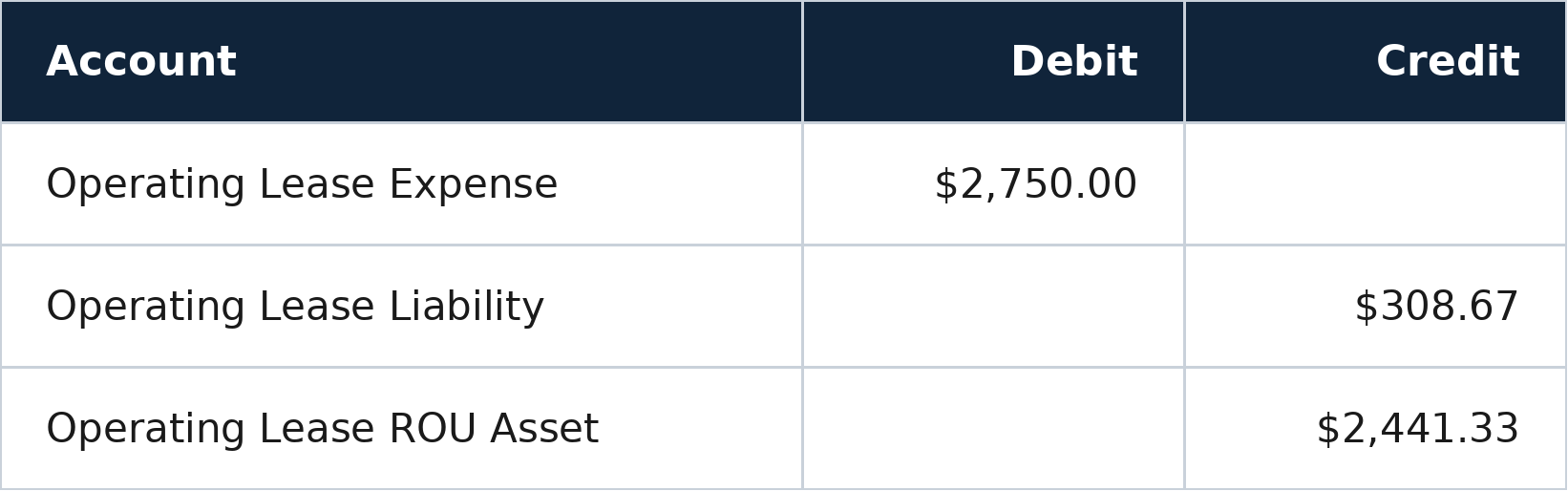
No cash payment is recorded.
The tenant nevertheless recognizes the required operating lease expense.
When regular payments begin, the tenant also records the reduction of the lease liability and the related cash payment.
For a more detailed explanation of the accounting process, see Occupier's lease accounting journal entries guide.
What Is the Difference Between Rent Abatement and Deferred Rent?
Rent abatement and deferred rent are related concepts, but they should not be treated as interchangeable.
Rent abatement generally means the tenant is not required to pay some or all of the specified rent.
Contractual rent deferral means payment is postponed rather than forgiven.
For example, a landlord may allow a tenant to skip two monthly payments but require those amounts to be repaid during the following year.
That is a payment deferral rather than permanent forgiveness.
The distinction affects total contractual payments and potentially the accounting schedule.
The term deferred rent also has a historical accounting meaning.
Under ASC 840, operating leases often generated separate deferred rent balances when straight-line expense differed from actual payments.
Under ASC 842, these timing differences are generally reflected through the ROU asset and lease liability accounting model.
A rent-free period may therefore produce a difference between the liability and ROU asset without creating the same separate deferred rent account used under ASC 840.
Is Rent Abatement Considered a Lease Incentive Under ASC 842?
Free rent is often described commercially as an incentive because landlords use it to attract tenants.
However, ASC 842 distinguishes a rent-free period from a lease incentive paid by the landlord.
Rent abatement included in the original agreement is reflected through reduced contractual lease payments.
A lease incentive generally involves a payment or reimbursement from the landlord to the tenant, or another qualifying payment made on the tenant's behalf.
Examples include cash incentives and certain tenant improvement allowances. Understanding how lease incentives under ASC 842 affect lease measurements helps finance teams distinguish these concessions from rent-free periods and account for them correctly.
The accounting distinction matters because lease incentives can require separate adjustments to the ROU asset and, depending on their timing, the lease liability.
Treating free rent as both a reduction in lease payments and a separate incentive could result in double-counting the same benefit.
What Happens When Rent Abatement Is Granted After Commencement?
The accounting becomes more complicated when a landlord grants rent relief after the lease has already commenced.
For example, a retailer may negotiate three months of reduced rent after experiencing financial difficulties.
The first question is whether the original lease already provided an enforceable right to that reduction.
If the concession was not included in the original terms and changes the contractual consideration, it will generally be evaluated as a lease modification under ASC 842.
For a modification that only changes consideration and does not qualify as a separate contract, the lessee generally must:
- Reassess the lease classification as of the modification date.
- Determine the revised remaining lease payments.
- Remeasure the lease liability using the applicable updated discount rate.
- Adjust the ROU asset for the change in the lease liability.
Understanding the requirements for accounting for lease modifications under ASC 842 helps finance teams determine how revised payments affect the lease liability, ROU asset, and subsequent expense recognition. For an operating lease, the remaining lease cost is then recognized using the applicable expense allocation method.
The accounting is different when the original lease already provides an enforceable right to rent relief and no modification occurs. Such concessions require analysis of the existing contractual terms and relevant variable lease payment guidance.
The important distinction is whether the free rent was included in the original agreement or introduced through a later change.
How Does Rent Abatement Differ for Operating and Finance Leases?
Both operating and finance leases can include rent-free periods.
The initial lease liability is measured using the applicable future payment schedule regardless of classification.
However, subsequent expense recognition differs.
Operating leases generally recognize a single lease cost over the lease term, typically on a straight-line basis.
Finance leases separately recognize interest on the lease liability and amortization of the ROU asset.
As a result, finance lease expense is often higher in earlier periods because interest expense generally declines as the liability is repaid.
Understanding the differences between operating and finance leases under ASC 842 accounting requirements helps finance teams apply the appropriate expense recognition method when rent abatement is included in an agreement. A finance lease does not automatically recognize the same straight-line lease expense used for an operating lease.
The free-rent months still affect cash flow and liability calculations, but the expense pattern follows the applicable classification requirements.
Why Rent Abatement Terms Create Accounting Errors
Rent abatement may appear straightforward in a lease agreement, but several details can affect financial reporting.
The first is the scope of the concession.
A landlord may waive base rent while continuing to charge CAM, taxes, insurance, or other additional rent.
These expenses may be treated differently under ASC 842 depending on whether they represent lease components, non-lease components, or qualifying variable payments.
The second issue is payment timing.
A lease may provide three months of free rent beginning at commencement, while another starts the concession when the tenant opens for business.
These arrangements can create different accounting results.
A third concern is incomplete amendments.
A later amendment may change the rent-free period without the finance team receiving the updated document.
For a company managing multiple commercial locations, these differences can lead to incorrect lease liabilities, expense calculations, and supporting schedules.
The most reliable approach is to confirm the actual lease language, record the applicable dates and payment amounts, and reconcile them against the accounting records.
Keeping Rent Abatement and Lease Accounting Aligned
Rent abatement is a common example of how decisions made during lease negotiations affect financial reporting for years afterward.
Real estate teams negotiate rent concessions, lease commencement dates, and payment schedules.
Finance teams use those details to calculate ROU assets, lease liabilities, and recurring journal entries.
When this information is maintained in separate spreadsheets or documents, errors can occur when a rent concession is overlooked or an amendment is not reflected in the accounting schedule.
Occupier's lease accounting software connects lease records with ASC 842 calculations, payment schedules, modifications, and journal entries.
This helps real estate and finance teams work from consistent information while maintaining documentation for financial reporting and audits.
The objective is not simply to record free rent correctly. It is to ensure that contractual concessions are accurately reflected throughout the lease term, including when agreements change.
Rent Abatement Under ASC 842 FAQs
Is free rent recognized as an expense under ASC 842?
Yes. For an operating lease, the tenant generally recognizes a single lease cost over the lease term, including rent-free periods. The expense is typically allocated on a straight-line basis unless another systematic method better reflects the benefit received.
Does rent abatement reduce the lease liability?
Yes, when the abatement reduces qualifying payments included in the lease liability measurement. Free months established in the original lease reduce the total payments used in the initial calculation.
Is rent abatement a lease incentive?
A rent-free period may be called an incentive commercially, but under ASC 842 it is generally reflected through the lease payment schedule rather than recorded separately as a lease incentive paid by the landlord.
What is the difference between rent abatement and rent deferral?
Rent abatement generally eliminates or reduces rent that would otherwise be owed. Rent deferral postpones payment to a later date. The distinction affects total obligations and may change the accounting treatment.
Does rent abatement affect the ROU asset?
Yes. Rent abatement included in the original lease affects the initial liability calculation and therefore the initial ROU asset. Later concessions may also require changes to these balances, depending on the accounting treatment.
Is rent abatement granted after commencement a lease modification?
Generally, yes, when the concession was not part of the original contractual rights and changes lease consideration. However, concessions already permitted by the original agreement may require different accounting treatment.
Does free rent change the lease commencement date?
Not necessarily. Under ASC 842, commencement generally occurs when the underlying asset is available for use, even if contractual rent payments begin later. The commencement and rent payment dates should be evaluated separately.
How is rent abatement shown on the balance sheet?
For a recognized operating lease, rent abatement affects the measurement and subsequent changes in the lease liability and ROU asset. The timing difference between cash payments and straight-line lease expense is generally reflected through those balances rather than a separate deferred rent liability.



Lease management that works for real estate and finance

15,000 sq ft
90 days notice
March 2026
Action required