Commercial Lease Renewal: Timeline, Negotiation & Notice Tips

What is a commercial lease renewal?
A commercial lease renewal allows a tenant to continue occupying commercial property beyond the existing lease term. It may involve exercising a contractual renewal option or negotiating a new agreement. Rental rates, operating expenses, maintenance responsibilities, and other provisions may change during renewal.
A commercial lease renewal allows a business to continue occupying its existing property after the original lease term ends. Depending on the agreement, tenants may exercise an existing renewal option or negotiate new terms with their landlord. The process can involve changes to rent, lease duration, operating expenses, maintenance responsibilities, and other contractual obligations.
For businesses operating offices, retail stores, restaurants, or industrial facilities, renewing a lease is an important financial and operational decision. Waiting until the final months can limit negotiating options and leave insufficient time to evaluate alternative properties.
A practical approach is to begin planning 12 to 18 months before expiration, review the existing agreement, research comparable properties, and negotiate terms that reflect current business requirements.
This guide explains how commercial lease renewals work, provides a renewal timeline, and covers negotiation strategies and notice deadlines.
What Is a Commercial Lease Renewal?
A commercial lease renewal allows a tenant and landlord to continue their leasing relationship beyond the current term.
Some agreements include a renewal option establishing the period, rental terms, and conditions under which the tenant may extend occupancy. Other arrangements require the parties to negotiate a new agreement.
For example, a retail tenant with a five-year lease may have an option to continue occupying the premises for another five years.
Whether the tenant can exercise that option depends on the existing contract, including its notice requirements and any conditions relating to defaults.
A renewal may preserve many existing provisions while changing rent or other terms. In some transactions, the parties instead execute a new agreement.
The Cornell Legal Information Institute's explanation of renewal distinguishes contractual renewal from extension, although these terms are frequently used interchangeably in commercial leasing.
When Should You Start the Commercial Lease Renewal Process?
Commercial tenants should generally begin evaluating renewal decisions 12 to 18 months before their lease expires.
Larger locations or properties requiring substantial construction may need even longer planning periods.
Starting early provides time to compare market rates, review business requirements, obtain internal approvals, and consider relocation.
However, the appropriate timeline depends on the lease. If a renewal option must be exercised 15 months before expiration, planning must begin earlier.
Commercial Lease Renewal Timeline
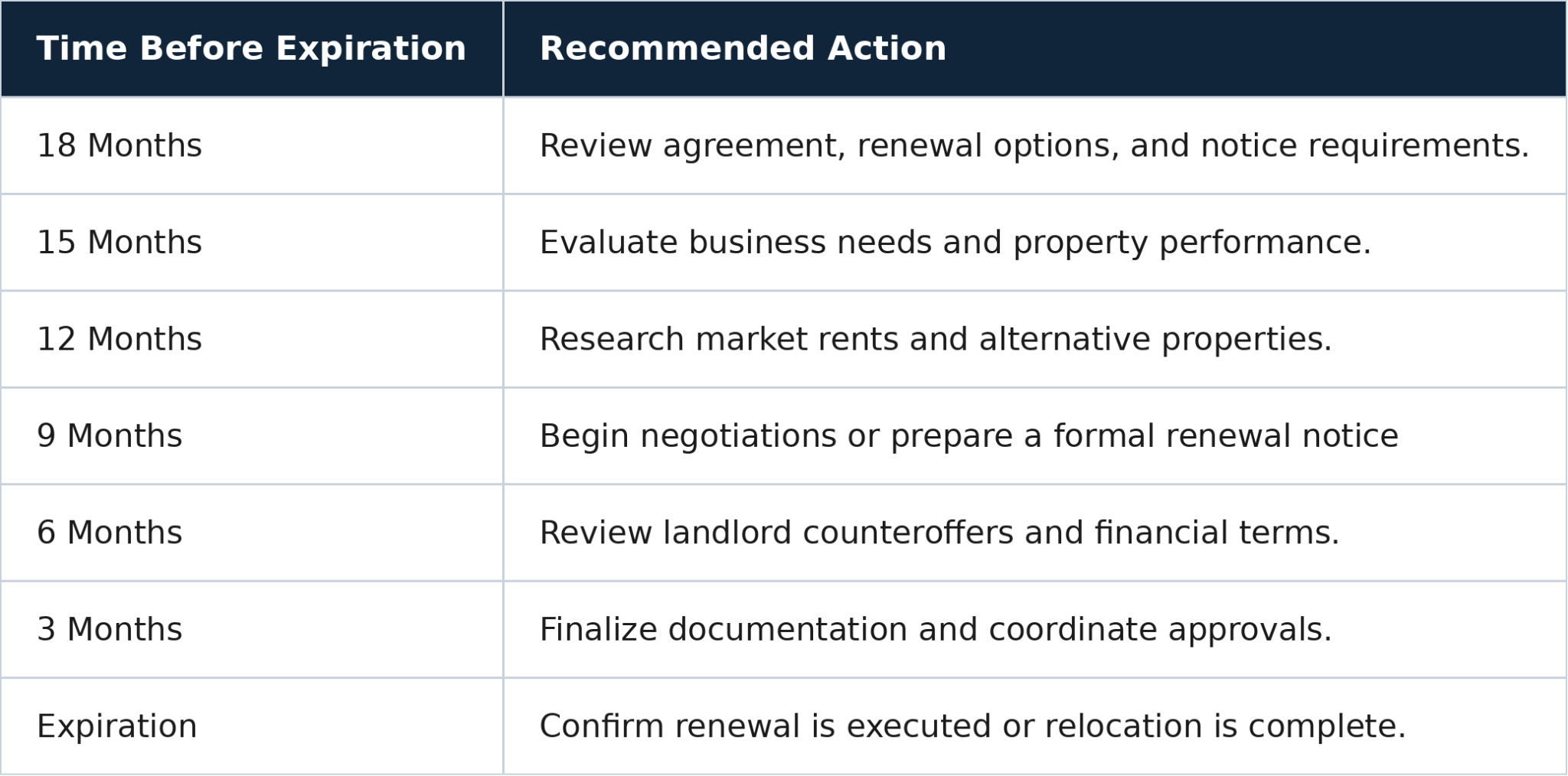
This schedule is a planning example, not a substitute for contractual notice requirements.
If an agreement requires earlier action, the tenant must follow that deadline regardless of the suggested timeline.
How to Prepare for Commercial Lease Renewal Negotiations
Successful negotiations begin with understanding the current agreement, the property's performance, and available market alternatives.
Evaluate Your Business Requirements
Start by determining whether the existing property still supports the business.
Consider location performance, required square footage, accessibility, customer traffic, staffing levels, and anticipated growth.
A restaurant may need additional seating or kitchen improvements, while an office tenant may require fewer workstations or more flexible space.
Renewing an unsuitable property simply to avoid moving can create long-term operational problems.
Research Market Conditions
Review asking rents, vacancy levels, lease incentives, and comparable properties in the surrounding market.
For example, if similar office spaces are leasing for $28 per square foot while the existing tenant pays $34, that difference provides a basis for discussing revised terms.
Landlords may also consider the cost of finding a replacement tenant, potential vacancy periods, and construction expenses.
Market information helps tenants make realistic counteroffers rather than requesting reductions without supporting evidence.
Document the Property's Condition
Review the condition of the premises before negotiations begin.
Identify maintenance problems, outdated building systems, necessary improvements, and repairs that have been deferred.
For example, a tenant may request HVAC replacement or improvements to customer-facing areas as part of the renewal package.
Documenting these issues helps establish which improvements should be addressed and who will pay for them.
Review Existing Lease Terms
Examine the agreement and all amendments for rent increases, renewal rights, maintenance obligations, operating expenses, and security deposit provisions.
Pay particular attention to clauses that may continue automatically into the renewed term.
A renewal should not unintentionally preserve unfavorable provisions simply because they appeared in the original agreement.
What Terms Can You Negotiate During a Lease Renewal?
A commercial lease renewal provides an opportunity to revisit financial and operational terms.
Base Rent and Annual Increases
Compare the proposed renewal rent with current market conditions.
Landlords may propose fixed annual increases or adjustments based on an inflation index.
Tenants should calculate the total expense across the renewal term rather than evaluating only the first year's rate.
For example, a 3% annual escalation can create a meaningful difference over a five-year agreement.
Free Rent and Tenant Improvements
Rent-free periods can reduce short-term occupancy costs, especially when businesses need to remodel or relocate operations within the building.
A tenant improvement allowance may help cover approved construction, fixtures, or interior renovations.
Tenants should clarify which expenses qualify, when reimbursements occur, and whether unused allowances can be applied elsewhere.
Maintenance and Operating Expenses
Lease renewals also provide an opportunity to reconsider property maintenance responsibilities.
A tenant may negotiate clearer repair obligations, exclusions from operating expenses, or caps on controllable charges.
For properties with complicated expense reimbursements, reviewing previous reconciliation statements can reveal costs worth addressing.
Renewal Flexibility
Businesses should consider whether the renewed agreement provides sufficient flexibility.
Important provisions may include additional renewal options, expansion rights, assignment permissions, subleasing arrangements, and early termination conditions.
A tenant expecting operational changes may prefer a shorter renewal term even if a longer commitment offers a lower rental rate.
Commercial Lease Renewal Negotiation Example
Consider a retailer occupying 4,000 square feet with a lease approaching expiration.
The current base rent is $35 per square foot annually, while comparable nearby properties are available at approximately $32 per square foot.
The landlord proposes renewing at $37 per square foot.
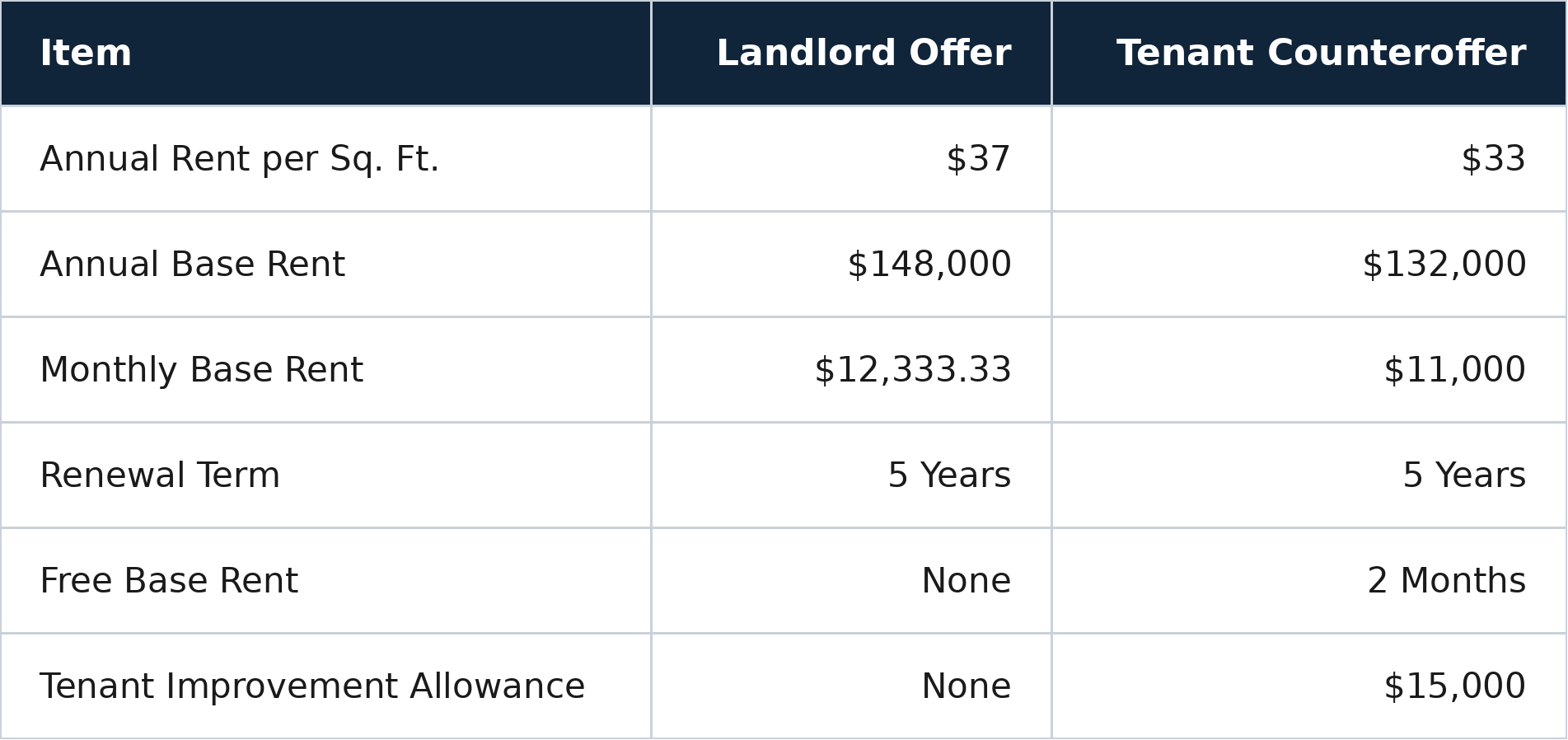
The tenant's proposed reduction would save $16,000 in annual base rent before escalations.
Over five years, that represents $80,000 in potential base rent savings if rates remain unchanged.
The two-month free-rent concession would provide another $22,000 at the proposed monthly rate.
Together, these requests create a starting point for negotiations. The landlord may counter with a higher rate, shorter concession period, or different improvement allowance.
The figures are illustrative and do not represent current market averages.
How Do Commercial Lease Renewal Notice Deadlines Work?
Renewal notice requirements determine when and how a tenant must formally exercise an available renewal option.
Some commercial leases require notice several months before expiration. Others establish a window during which notice must be delivered.
For example, a lease may permit renewal notice no earlier than 12 months and no later than nine months before expiration.
Missing that window may cause the tenant to lose its contractual option, even when it intends to remain in the property.
Renewal Notice Deadline Example
Assume a commercial lease expires on December 31, 2028.
The agreement requires renewal notice at least nine calendar months before expiration.
Under a straightforward calendar-month calculation, the notice deadline would be March 31, 2028, subject to the exact contract language.
The tenant should begin reviewing renewal options well before that date.
A reliable critical date management process records the opening and closing of notice windows, assigns responsibility, and creates reminders before contractual deadlines.
Tips for Avoiding Missed Renewal Deadlines
Tenants should verify the following before submitting notice:
- The correct renewal option and exercise period
- The required notice recipient and address
- Whether notice must be delivered by mail, courier, or another approved method
- Any conditions concerning defaults or other obligations
- Evidence showing the notice was delivered correctly and on time
Do not assume that an email or verbal agreement satisfies the lease.
Legal counsel should review significant notices when the agreement contains complicated requirements.
Should You Renew or Relocate Your Business?
Not every commercial lease should be renewed.
A property may no longer support business operations, or nearby alternatives may offer better financial terms.
When comparing renewal and relocation, tenants should evaluate the full cost of each decision.
Relocating may involve moving expenses, construction, permits, technology installation, downtime, and employee disruption.
Remaining at the existing location may avoid those costs but leave the business with unsuitable space or unfavorable rental terms.
For example, a new property offering $20,000 in annual rent savings may appear attractive. However, if relocation requires $150,000 in upfront expenses, the financial benefit must be evaluated over the expected occupancy period.
The business should also consider customer accessibility, employee travel, operational continuity, and future expansion.
A documented comparison gives management a stronger basis for deciding whether to renew.
What Happens After Lease Renewal Terms Are Agreed?
Once the tenant and landlord reach an agreement, the negotiated terms should be reviewed and documented.
Depending on the transaction, the parties may execute a renewal amendment, extension agreement, or new lease.
Before signing, verify that the document reflects agreed rent schedules, concessions, improvement obligations, renewal rights, and other negotiated conditions.
Real estate, finance, and legal teams should review provisions affecting their responsibilities.
After execution, update payment schedules, critical dates, accounting records, and the property's document history.
For businesses managing multiple locations, accurate lease administration helps keep renewal agreements, revised rent schedules, and contractual obligations organized across the portfolio.
How Can Software Help Manage Commercial Lease Renewals?
Organizations managing numerous commercial leases may struggle to track renewal opportunities when important information is scattered across spreadsheets and documents.
A centralized system helps real estate teams identify upcoming expirations, review renewal provisions, and assign responsibility for important decisions.
Occupier enables commercial tenants to track critical dates, organize lease documents, monitor contractual obligations, and coordinate information across departments.
Automated reminders can also help teams begin renewal planning before notice windows close.
Businesses managing multiple properties can schedule a demo to see how Occupier supports lease renewal tracking and administration.
Commercial Lease Renewal FAQs
1. What is a commercial lease renewal?
A commercial lease renewal allows a tenant to continue occupying commercial property beyond the existing lease term. It may involve exercising a contractual renewal option or negotiating a new agreement. Rental rates, operating expenses, maintenance responsibilities, and other provisions may change during renewal.
2. When should you start negotiating a commercial lease renewal?
Commercial tenants should generally begin planning 12 to 18 months before expiration. Larger or more complicated locations may require additional time. The actual schedule must account for contractual notice deadlines, which may occur earlier than the suggested planning period.
3. Can you negotiate rent during a commercial lease renewal?
Yes. Tenants can often negotiate rental rates, annual increases, rent-free periods, improvement allowances, and other conditions. The landlord's willingness to offer concessions depends on market conditions, vacancy levels, tenant qualifications, and the existing agreement.
4. How much notice is required to renew a commercial lease?
There is no universal notice period for all commercial leases. Requirements depend on the agreement and applicable law. Some contracts establish a specific deadline, while others contain an exercise window. Tenants should review the renewal clause and follow its notice procedures.
5. What happens if you miss a commercial lease renewal deadline?
Missing a contractual renewal deadline may cause the tenant to lose the right to exercise that option. The landlord might still agree to negotiate a renewal, but it may not be obligated to do so. The outcome depends on the agreement and applicable law.
6. Is it better to renew or sign a new commercial lease?
The better choice depends on current rental terms, property suitability, relocation expenses, and future business requirements. Renewing may reduce disruption, while a new location might provide improved facilities or financial terms. Tenants should compare total costs and operational implications before deciding.



Lease management that works for real estate and finance

15,000 sq ft
90 days notice
March 2026
Action required