Sale-Leaseback Accounting Under ASC 842

What is sale leaseback accounting under ASC 842?
Sale leaseback accounting applies when a company transfers an asset to another party and leases it back. If the transfer qualifies as a sale, the seller-lessee removes the asset and accounts for the leaseback. If the transfer does not qualify, the arrangement is generally accounted for as financing.
A sale-leaseback transaction allows a business to sell an asset it owns and lease it back from the buyer, freeing up capital while continuing to use the property. For retailers, restaurant operators, and other businesses with substantial real estate investments, this can provide funding for expansion, debt repayment, or operational improvements without requiring a relocation.
However, sale leaseback accounting under ASC 842 involves more than recording a property sale and signing a lease. Before recognizing a gain or loss, the company must determine whether the transaction qualifies as a sale under US Generally Accepted Accounting Principles (GAAP).
If the transfer qualifies as a sale, the seller removes the underlying asset from its balance sheet and recognizes the resulting leaseback. If the transfer does not qualify, the arrangement is accounted for as financing, even when the legal title has changed.
Understanding this distinction helps real estate and finance teams evaluate proposed transactions, calculate lease obligations, and maintain accurate financial reporting.
What Is a Sale-Leaseback Transaction?
A sale-leaseback transaction occurs when a company sells an asset to another party and simultaneously agrees to lease that same asset back.
The original owner becomes the seller-lessee, while the purchaser becomes the buyer-lessor. Although ownership changes, the seller continues using the asset under a lease agreement.
Consider a restaurant company that owns a commercial building worth $3 million. The business wants to open additional locations but has significant capital tied up in its existing property.
Instead of obtaining a conventional loan, the company sells the building to a real estate investor and signs a long-term lease allowing it to continue operating from the same location.
The company receives immediate cash while maintaining access to the property. In exchange, it gives up ownership and assumes contractual rental obligations.
Sale-leaseback transactions are particularly relevant for companies with substantial investments in commercial real estate, equipment, or other long-lived assets. However, the accounting treatment depends on whether control of the asset actually transfers to the buyer.
How Does Sale Leaseback Accounting Work Under ASC 842?
ASC 842 establishes the accounting framework for sale-leaseback transactions, while ASC 606 provides the transfer-of-control guidance used to determine whether a sale has occurred.
A company must evaluate the sale and leaseback together because the terms of the leaseback can affect whether the initial transfer qualifies as a sale.
Although the general ASC 842 lease accounting requirements govern recognition of the resulting right-of-use (ROU) asset and lease liability, the company must first determine whether the underlying asset can be derecognized.
There are two possible accounting outcomes:
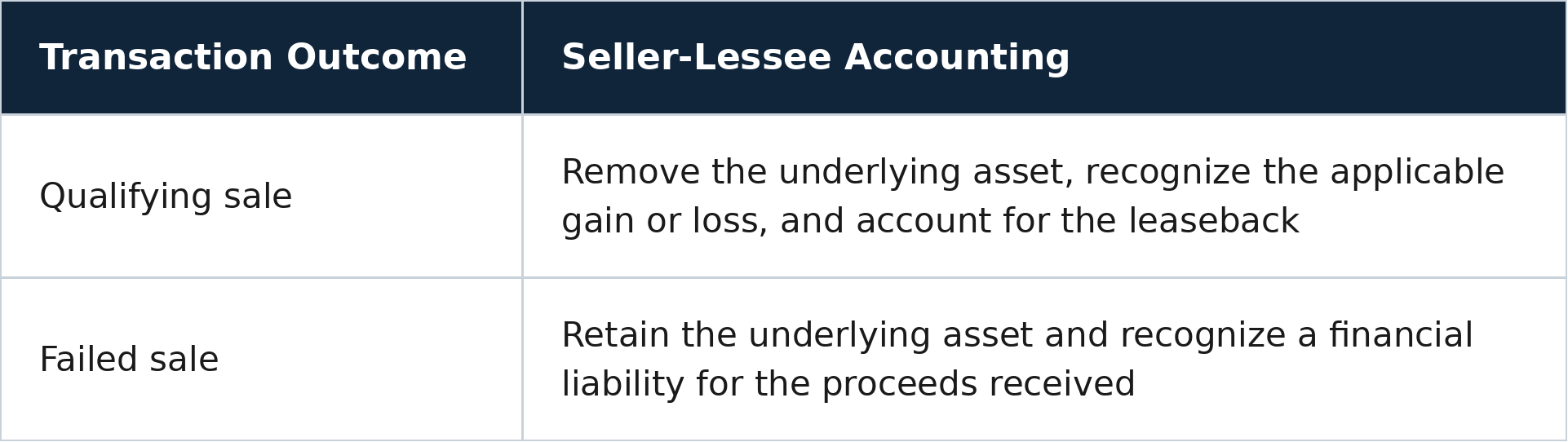
These outcomes can produce very different financial statements, even when the business receives the same amount of cash and continues occupying the same property.
When Does a Sale-Leaseback Qualify as a Sale?
Under ASC 842, both parties evaluate whether the buyer-lessor obtains control of the underlying asset using the relevant ASC 606 requirements.
Indicators of control transfer may include legal title, the buyer's obligation to pay, transfer of significant risks and rewards, and other evidence that control has passed.
However, transferring legal ownership does not automatically establish a sale for accounting purposes.
The transaction generally fails the sale test if the seller-lessee would classify the leaseback as a finance lease or the buyer-lessor would classify it as a sales-type lease.
For example, if a retailer sells its headquarters but leases it back for substantially all its remaining economic life, the leaseback may qualify as a finance lease. In that situation, the company cannot recognize the transfer as a sale under ASC 842.
A proper lease classification test is therefore essential before recording a sale gain or removing the property from the balance sheet.
How Do Repurchase Options Affect the Transaction?
Repurchase options can also prevent sale accounting.
A repurchase option allows the seller-lessee to buy the transferred asset back at a future date. Under ASC 842, such an option generally prevents sale recognition unless both specific conditions are satisfied.
The repurchase price must equal the asset's fair value when the option is exercised, and substantially similar alternative assets must be readily available in the marketplace.
For commercial real estate, the second condition is particularly restrictive because properties at different locations generally cannot be considered substantially the same.
A retailer that sells a specific store while retaining a substantive option to repurchase that property may therefore be unable to recognize a qualifying sale.
These provisions should be evaluated before closing because the accounting result can significantly affect the financial benefits management expects from the transaction.
Sale-Leaseback Accounting Example and Journal Entries
Consider a retail company that owns a commercial building and decides to sell it to a property investor while continuing to occupy the premises.
Assume the transaction satisfies the ASC 606 transfer-of-control requirements. The property has a remaining economic life of 30 years, the leaseback lasts five years, and there is no ownership transfer, purchase option, or other condition requiring finance lease classification.
Also assume the buyer-lessor classifies the leaseback as an operating lease, the property has an alternative use, and the transaction reflects market terms.
The relevant financial details are:
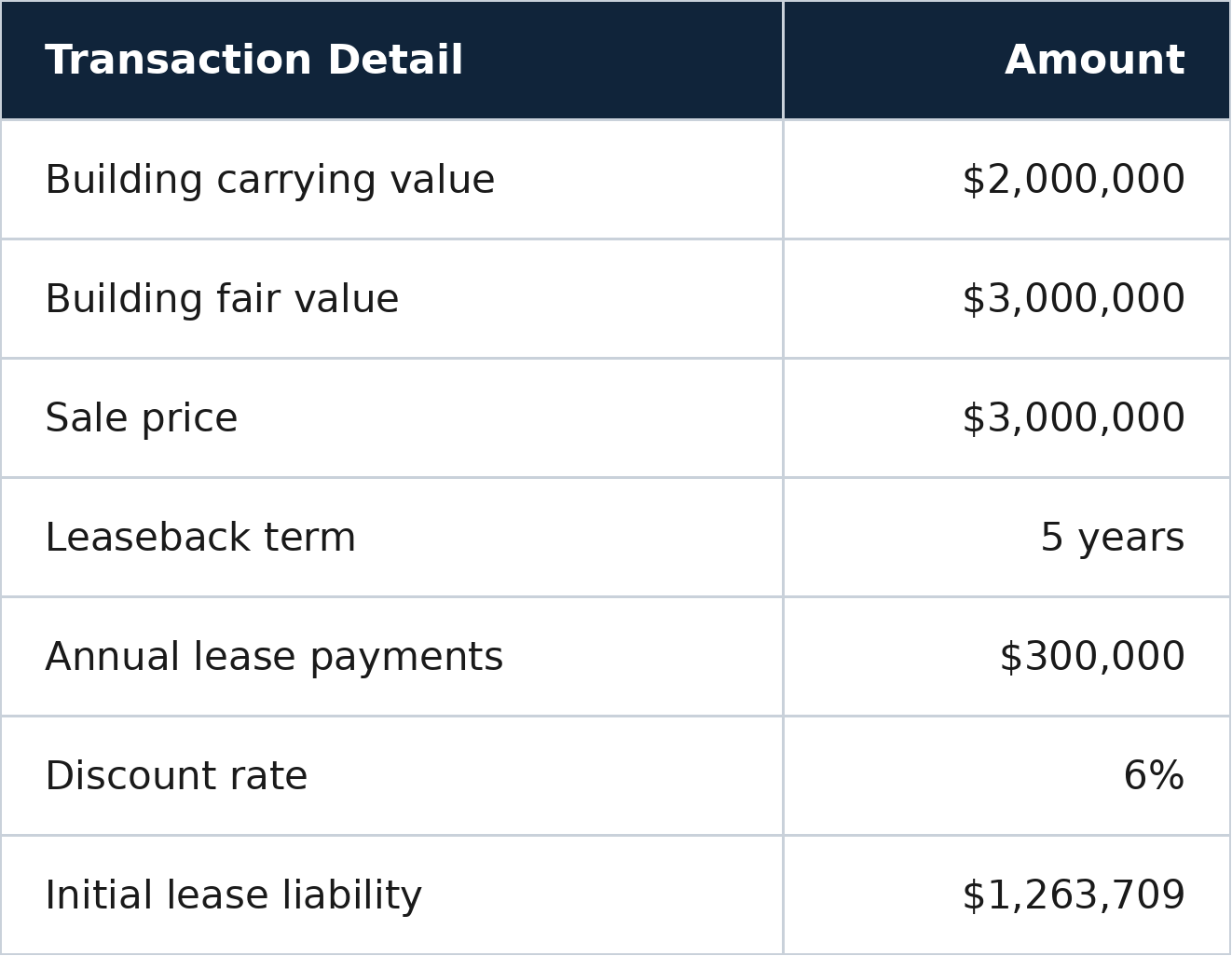
Payments are made at the end of each year. There are no prepaid lease payments, initial direct costs, or lease incentives.
The leaseback's present value is approximately 42% of the property's fair value, and its five-year term represents approximately 17% of the assumed remaining economic life. Together with the other stated assumptions, these facts support operating lease classification for this illustrative example.
Step 1: Calculate the Gain on Sale
Because the transfer qualifies as a sale and the transaction occurs at fair value, the seller-lessee recognizes the difference between the sale proceeds and the property's carrying amount.
Gain on Sale = Sale Price − Carrying Value
$3,000,000 − $2,000,000 = $1,000,000
The company recognizes a gain of $1 million when the buyer obtains control.
Under ASC 842, the seller-lessee generally recognizes the full gain on a qualifying sale, subject to appropriate off-market adjustments.
This differs from IFRS 16, which generally limits gain recognition to the portion associated with rights transferred to the buyer.
Step 2: Calculate the Leaseback Liability
After recognizing the sale, the company records the leaseback under ASC 842.
The initial lease liability equals the present value of the five annual payments:
Lease Liability = $300,000 × [(1 − 1.06⁻⁵) ÷ 0.06]
Initial Lease Liability ≈ $1,263,709
Because the example has no prepaid rent, lease incentives, or qualifying initial direct costs, the ROU asset initially equals the lease liability.
Understanding the right-of-use asset calculation helps finance teams distinguish the amount recognized for continued occupancy from the carrying value of the building that was sold.
Step 3: Record the Journal Entries
The company first records the qualifying sale:
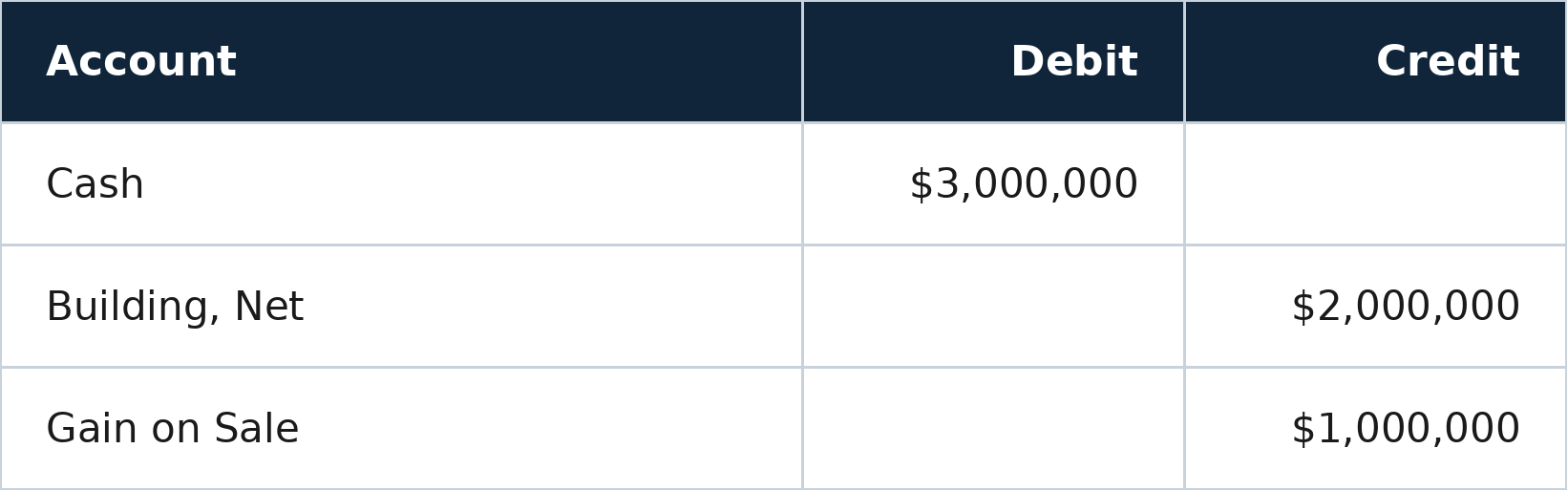
The entry is simplified to show the net carrying amount. In practice, the company would remove the building's gross carrying value and related accumulated depreciation.
The company then recognizes the leaseback:
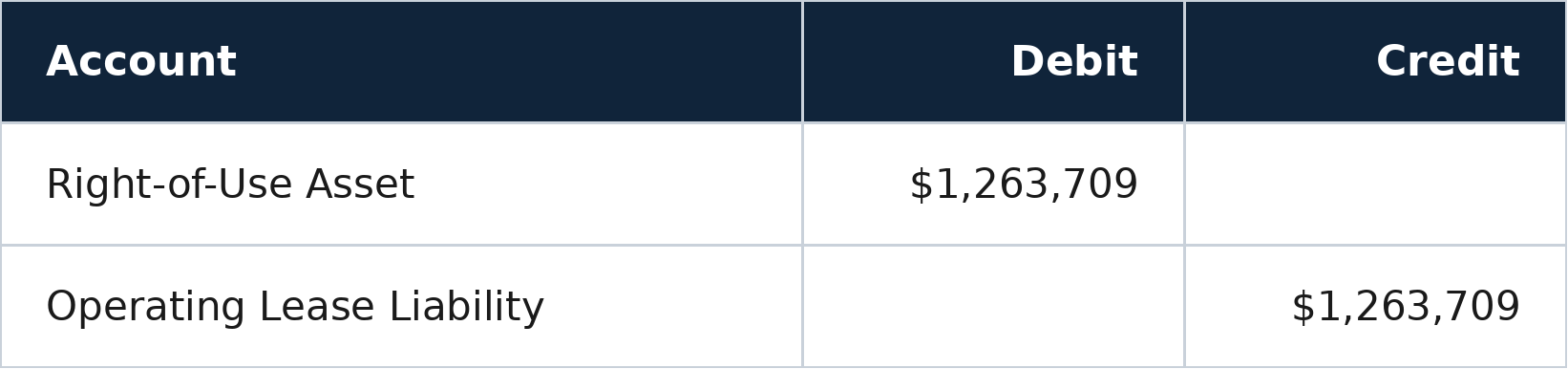
The company subsequently records lease payments, liability interest accretion, and ROU asset reductions according to the operating lease accounting model.
For this simplified example, total rental payments are $1.5 million over five years. Assuming no additional adjustments, the company generally recognizes a single operating lease cost of $300,000 annually.
The underlying lease accounting journal entries must reflect the chosen classification because operating and finance leases have different expense recognition patterns.
What Happens When a Sale-Leaseback Fails the Sale Test?
Not every transaction involving the transfer and subsequent lease of an asset qualifies as a sale.
A failed sale occurs when the seller-lessee does not transfer control of the underlying asset under the applicable accounting requirements.
This may happen when the leaseback would be classified as a finance lease, the buyer-lessor would classify it as a sales-type lease, or a repurchase option prevents sale recognition.
When the sale test is not met, the seller-lessee accounts for the transaction as financing.
The company continues recognizing the underlying asset and records a financial liability for the proceeds received.
Assume the retailer receives $3 million for its building, but a repurchase provision prevents sale recognition.
The initial journal entry is:
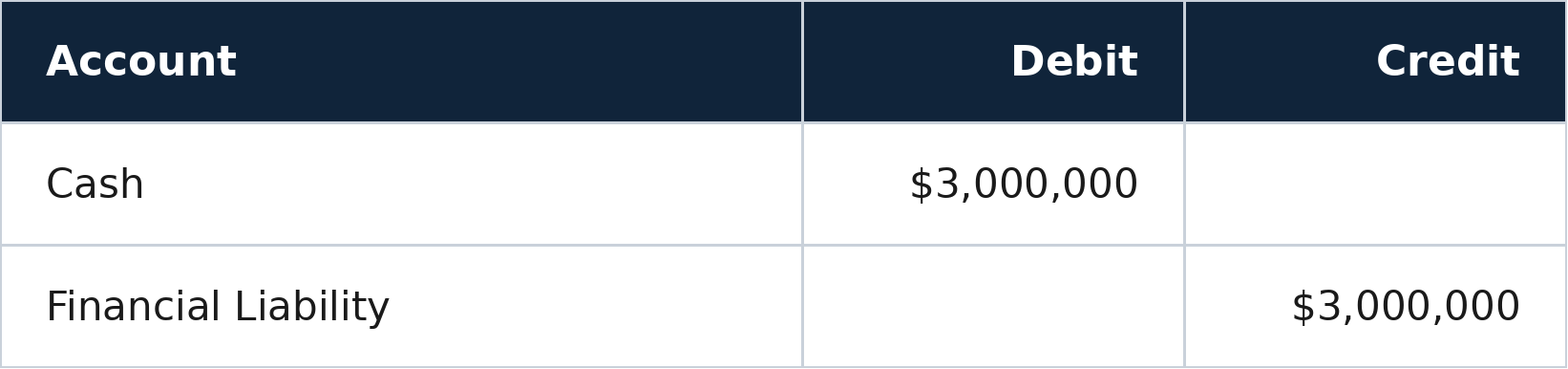
The building remains on the company's balance sheet, and the company continues depreciating it as appropriate.
No gain on sale is recognized. Subsequent payments are accounted for under the financing arrangement, including interest and liability reductions.
The buyer-lessor similarly treats the arrangement as financing rather than immediately recognizing the building as a purchased asset.
A failed sale conclusion can be reassessed when relevant facts or circumstances change. For example, the expiration of a repurchase option that prevented sale accounting may require a new evaluation.
How Do Off-Market Terms Affect Sale-Leaseback Accounting?
Sale-leaseback agreements do not always reflect prevailing market conditions.
A seller might accept less than fair value in exchange for favorable rental terms, while another arrangement may involve a higher sale price supported by above-market payments.
Under ASC 842, qualifying sale-leaseback transactions generally require adjustments when the agreed terms are off market.
The company compares the sale price with the asset's fair value or evaluates the present value of contractual rent against market rental payments, using the more readily determinable measure.
Below-market sale price: The shortfall is generally treated as prepaid rent rather than an additional loss on the sale. This amount is reflected in the ROU asset.
Above-market sale price: The excess generally represents additional financing rather than an increase in the qualifying sale proceeds.
For example, suppose a building with a fair value of $3 million is sold for $3.3 million. If the $300,000 difference represents financing embedded in the arrangement, the seller-lessee recognizes a separate financial liability instead of inflating the gain.
The company must also allocate the related payments appropriately between lease obligations and financing.
These requirements prevent sale-leaseback transactions from generating artificial gains by shifting value between the sale price and future rental payments.
An exception applies to related-party sale-leaseback transactions, for which ASC 842 does not require the same off-market adjustments. Relevant related-party disclosures remain necessary.
How Does a Sale-Leaseback Affect Financial Statements?
A sale-leaseback can materially change the seller-lessee's balance sheet, income statement, and cash flow reporting.
When the transaction qualifies as a sale, the seller removes the underlying asset, recognizes cash proceeds, and records the applicable gain or loss.
The leaseback generally creates an ROU asset and lease liability unless an applicable recognition exemption is elected.
For a retailer selling multiple owned locations, the transaction can release substantial capital for business investment. However, the company also assumes ongoing rental obligations that may affect operating expenses and future cash flows.
A failed sale produces a different result. The original asset remains recognized, the proceeds are recorded as financing, and no immediate sale gain is recognized.
The distinction also affects financial ratios and cash flow statement presentation because proceeds from a qualifying asset sale and proceeds from financing may be classified differently.
Sale-Leaseback Disclosure Requirements
ASC 842 requires seller-lessees to disclose relevant information about qualifying sale-leaseback transactions, including their main terms and conditions.
Gains or losses resulting from these transactions must be disclosed separately from gains or losses associated with other asset disposals.
Companies must also evaluate the disclosures required for the resulting lease, including relevant lease costs, liabilities, and maturity information.
Occupier's ASC 842 disclosure guide provides a broader explanation of the information finance teams need when preparing financial statements under the lease accounting standard.
Supporting records should include the executed sale agreement, leaseback contract, asset valuation, lease classification assessment, and accounting calculations.
What Should Businesses Review Before a Sale-Leaseback?
A sale-leaseback is both a real estate strategy and a financial reporting decision.
Selling a property may provide immediate capital, but the resulting lease introduces long-term contractual commitments that can affect future occupancy costs and flexibility.
Before closing, real estate and finance teams should evaluate the sale price, property fair value, rental payments, renewal options, purchase rights, and remaining economic life of the asset.
For example, a retailer may generate significant cash by selling a flagship location but become subject to rent increases or restrictions that make the property more expensive to occupy over time.
Management should compare the value of the cash proceeds with the long-term financial obligations created by the leaseback.
Finance teams must also assess whether the proposed transaction transfers control under ASC 606 and satisfies ASC 842's additional sale criteria.
This analysis should be completed before closing because a transaction that fails the sale test may not deliver the expected gain recognition or balance sheet presentation.
For qualifying transactions, Occupier's lease accounting software supports ROU asset and liability calculations, recurring lease schedules, and ASC 842 reporting using the finalized contractual terms.
A coordinated review of the transaction structure and accounting treatment allows real estate, finance, and legal teams to make decisions based on both immediate liquidity and continuing occupancy obligations.
Sale-Leaseback Accounting FAQs
What is sale leaseback accounting under ASC 842?
Sale leaseback accounting applies when a company transfers an asset to another party and leases it back. If the transfer qualifies as a sale, the seller-lessee removes the asset and accounts for the leaseback. If the transfer does not qualify, the arrangement is generally accounted for as financing.
How do you determine whether a sale-leaseback qualifies as a sale?
The company evaluates whether control has transferred under ASC 606 and applies ASC 842's additional requirements, including leaseback classification and restrictions involving repurchase rights.
Can a finance lease qualify as a sale-leaseback?
Under ASC 842, the transfer does not qualify as a sale if the seller-lessee would classify the leaseback as a finance lease or the buyer-lessor would classify it as a sales-type lease.
How is the gain on a sale-leaseback calculated?
For a qualifying sale, the gain generally equals the adjusted transaction price minus the carrying amount of the transferred asset. Off-market terms may require adjustments before the gain is measured.
What happens when a sale-leaseback fails?
The seller-lessee retains the asset and recognizes a financial liability for the proceeds received. No immediate gain or loss on the transfer is recognized.
Is a sale-leaseback considered debt?
A qualifying sale-leaseback generally results in a lease liability under ASC 842. A failed sale is treated as financing and results in a financial liability instead.
Does an above-market sale price increase the gain?
Generally, no. For a non-related-party transaction, an above-market portion of the sale price is typically treated as additional financing rather than an increase in the gain.
How does ASC 842 differ from IFRS 16 for sale-leasebacks?
ASC 842 generally recognizes the full gain on a qualifying sale, subject to off-market adjustments. IFRS 16 generally recognizes only the gain associated with the rights transferred to the buyer-lessor.


Lease management that works for real estate and finance
15,000 sq ft
90 days notice
March 2026
Action required