Sublease Accounting Under ASC 842

What is sublease accounting under ASC 842?
Sublease accounting refers to the accounting treatment applied when a tenant leases an underlying asset to another party while remaining obligated under its original lease. The original tenant generally accounts for the head lease and sublease separately.
Sublease accounting under ASC 842 requires a company to account for its original lease and a new sublease separately when it remains responsible for the original lease obligations. The company becomes both a lessee under the original agreement and a lessor under the sublease, creating additional accounting and reporting requirements.
For commercial tenants, subleasing can be an effective way to recover costs from unused office, retail, or industrial space. However, collecting rent from a subtenant does not automatically reduce the liability associated with the original lease.
The accounting treatment depends on whether the tenant remains legally obligated under the original agreement, how the sublease is classified, and whether the arrangement affects the carrying value of the right-of-use (ROU) asset.
Understanding these requirements helps real estate and finance teams accurately report sublease income, maintain lease liabilities, and identify potential impairment risks.
maintain lease liabilities, and identify potential impairment risks.
What Is a Sublease Under ASC 842?
A sublease occurs when a tenant leases all or part of an asset it already leases to another party while the original lease remains in effect.
The original agreement is called the head lease, while the new agreement with the third party is the sublease.
The original tenant becomes an intermediate lessor, also known as the sublessor, because it has two responsibilities.
It remains a lessee under the head lease while acting as a lessor to the subtenant.
For example, a technology company leases 20,000 square feet of office space for ten years. After five years, the company reduces its workforce and no longer needs the entire office.
Instead of terminating its lease, the company subleases 8,000 square feet to another business.
The technology company continues paying rent to the original landlord while collecting income from the subtenant.
Under ASC 842 lease accounting, these agreements are generally treated as separate contracts because they involve different counterparties and contractual obligations.
This distinction is important because entering into a sublease does not automatically eliminate the original tenant's lease liability.
How Does Sublease Accounting Work Under ASC 842?
Sublease accounting begins with determining whether the original tenant remains responsible for the head lease.
When the tenant retains its primary obligations, the head lease generally remains on its balance sheet.
The company also accounts for the sublease under the applicable lessor accounting requirements.
This means a business may continue recognizing lease expense for the original agreement while separately recording income earned from the subtenant.
For example, a company might pay $12,000 monthly under its head lease and receive $9,000 monthly through a sublease.
Although the sublease reduces the company's net occupancy cost, the original $12,000 contractual payment obligation generally remains unchanged.
The company cannot simply reduce its lease liability by the amount expected from the subtenant.
ASC 842 requires the head lease and sublease to be evaluated separately, including their classifications, payment schedules, and financial statement effects.
Who Is Responsible for the Head Lease?
Before determining how to account for a sublease, the company must establish whether it has been legally released from its primary obligations under the original lease.
This determines whether the arrangement qualifies as a sublease or should instead be accounted for as a termination of the head lease.
When the Original Tenant Remains Liable
If the original tenant remains primarily responsible for the lease, the arrangement generally qualifies as a sublease.
The company continues to recognize the head lease liability and applies the appropriate accounting to its ROU asset.
It also recognizes the sublease according to the applicable lessor accounting model.
For example, a retailer may sublease an unused warehouse to another business but remain responsible for all payments owed to the property owner.
Even if the subtenant pays the retailer enough to cover the warehouse rent, the original contractual obligation remains.
When the Tenant Is Released From the Lease
The accounting changes when the original landlord legally releases the tenant from its primary obligations.
In that situation, the arrangement generally represents a termination of the head lease rather than a continuing sublease.
The original tenant typically derecognizes the relevant lease liability and ROU asset and recognizes any resulting gain or loss.
If the company remains secondarily liable under a separate guarantee, additional accounting may be required.
This distinction matters when companies transfer leases through assignments.
A landlord's approval of an assignment does not necessarily mean the original tenant has been released from its obligations.
The actual contractual language determines the accounting conclusion.
How Are Subleases Classified Under ASC 842?
Sublease classification determines how the intermediate lessor accounts for the new agreement.
Under ASC 842, subleases are evaluated using the underlying asset rather than the ROU asset recognized for the head lease.
This is an important distinction because the underlying asset may have a much longer remaining economic life than the original tenant's lease term.
For example, a company may have four years remaining on its office lease, while the building itself has an estimated remaining economic life of 30 years.
A four-year sublease would be evaluated against the relevant underlying asset, not simply against the four years remaining on the head lease.
ASC 842 includes five classification criteria involving ownership transfer, purchase options, lease term, present value, and specialized use.
The outcome determines whether the intermediate lessor classifies the sublease as an operating lease, sales-type lease, or direct financing lease.
Operating Subleases
An operating sublease generally results when the agreement does not meet the criteria for sales-type or direct financing classification.
This is a common outcome for commercial office subleases.
The intermediate lessor generally continues accounting for the head lease and recognizes sublease income over the sublease term.
Sales-Type and Direct Financing Subleases
A sublease may qualify as sales-type or direct financing depending on the classification criteria.
These arrangements require different accounting.
The intermediate lessor generally derecognizes the associated head lease ROU asset and recognizes a net investment in the sublease, subject to applicable recognition and collectibility requirements.
The original head lease liability generally remains because the company continues to owe payments to the head lessor.
Occupier's guide to lease classification provides additional context on how classification affects accounting treatment.
How Do Head Lease and Sublease Classifications Affect Accounting?
The accounting outcome depends on the classification of both agreements.
The head lease may be classified as operating or finance, while the sublease may be operating, sales-type, or direct financing.
These classifications do not have to match.
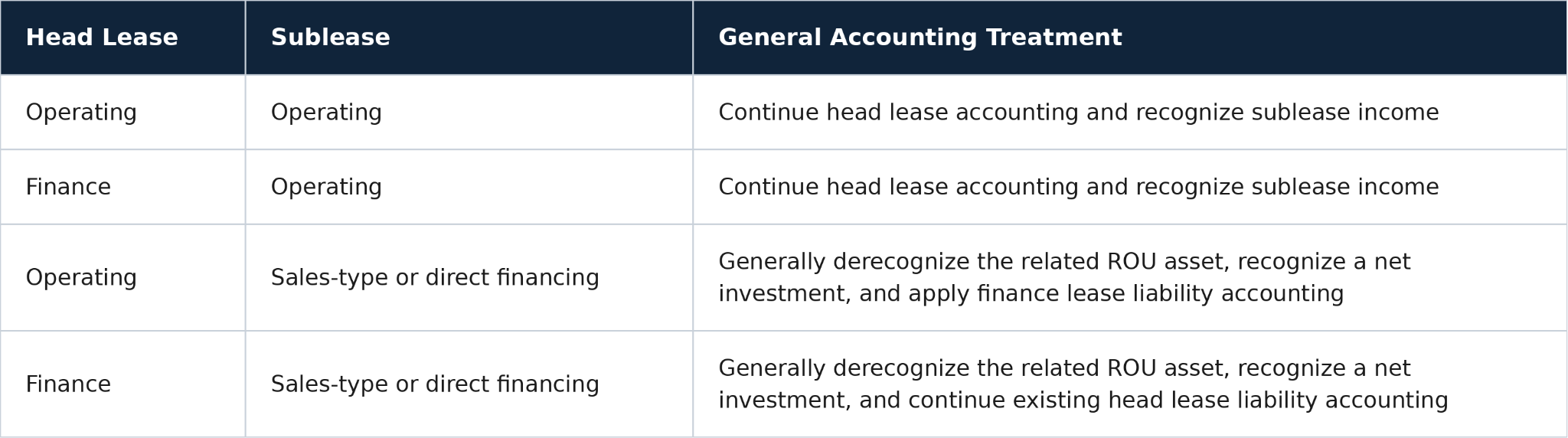
The table summarizes the general model. Additional considerations, including collectibility, asset allocation, and contractual terms, may affect the actual entries.
For an operating sublease, the company typically continues recognizing its original lease expense and separately recognizes sublease income.
For sales-type or direct financing arrangements, the accounting becomes more complex because the intermediate lessor may replace the relevant ROU asset with a net investment in the sublease.
The classification analysis should therefore be completed before preparing sublease accounting schedules.
Sublease Accounting Example: An Office Tenant Subleasing Unused Space
Consider a company that leases an office building but no longer needs the entire premises.
The company has three years remaining on its head lease and decides to sublease the unused space to another business.
Assume both agreements are classified as operating leases.
The financial terms are:
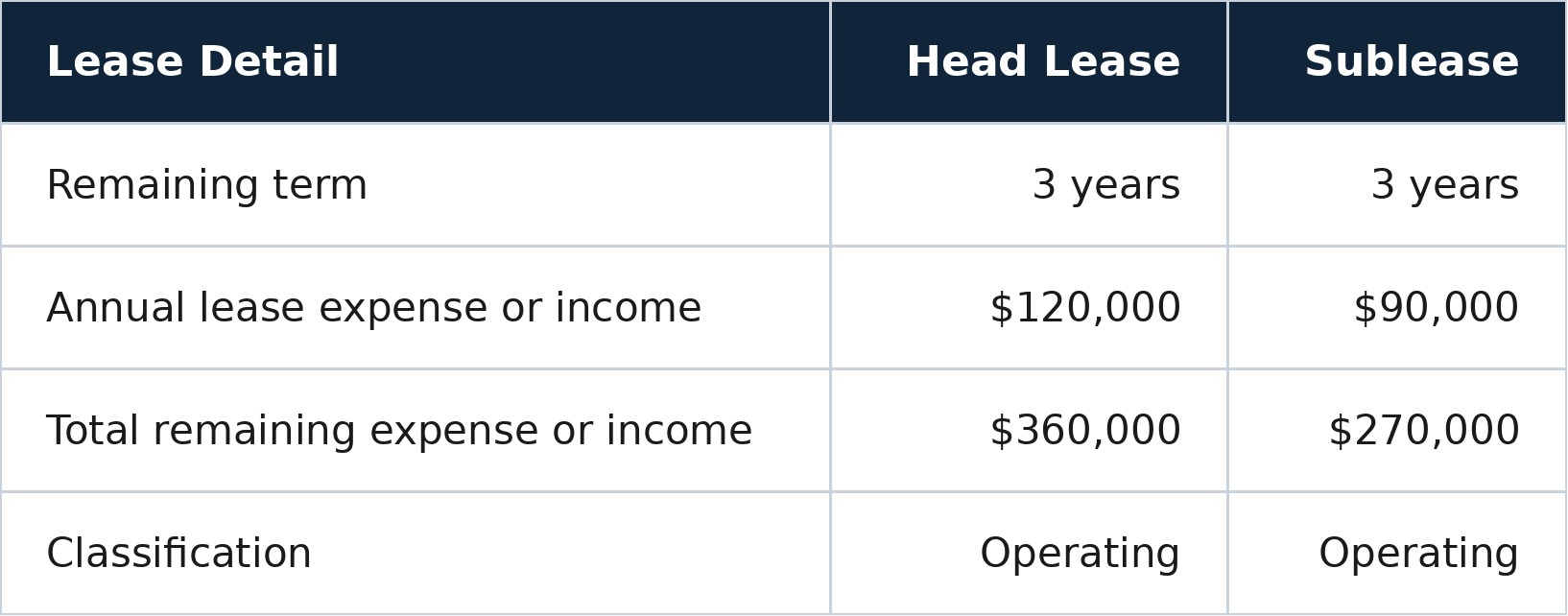
The company continues recognizing $120,000 of annual expense under its head lease.
It also recognizes $90,000 of annual income from the sublease.
The simplified annual income statement effect is:
Head Lease Expense: $120,000
Sublease Income: $90,000
Net Annual Expense: $30,000
Over the three-year period:
Total Head Lease Expense = $360,000
Total Sublease Income = $270,000
Net Expense = $90,000
The company recovers a substantial portion of its occupancy costs through the sublease.
However, the underlying head lease liability is not reduced merely because the subtenant makes payments.
The example also assumes the entire relevant head lease expense relates to the subleased space. If only part of the premises is subleased, the company must appropriately identify the costs and assets associated with that portion.
These calculations illustrate the income statement effect and do not represent a complete ASC 842 amortization schedule.
What Are the Journal Entries for an Operating Sublease?
For a typical operating sublease, the intermediate lessor continues accounting for the original lease and separately recognizes income from the subtenant.
The specific entries depend on the timing of payments, the original head lease schedule, and the terms of the sublease.
Recording Sublease Income
Using the previous example, assume the subtenant pays $7,500 at the end of each month.
The monthly sublease income is:
$90,000 ÷ 12 = $7,500
When the payment is earned and received, the simplified entry is:

If the income is earned before payment is received, the company would generally record a receivable instead.
The head lease accounting continues separately.
For an operating head lease, recurring lease accounting journal entries reflect the single lease cost, changes in the ROU asset, and the reduction of the lease liability through scheduled payments.
The intermediate lessor must maintain both sets of accounting records because the sublease does not eliminate its original payment obligations.
Does Sublease Income Reduce the Original Lease Liability?
No. Sublease income does not automatically reduce the head lease liability under ASC 842.
The head lease liability represents the company's contractual obligation to make future payments to the original landlord.
Sublease income represents consideration received from a different party under a separate agreement.
Even if the subtenant pays the exact amount the company owes under the head lease, the original tenant generally remains responsible for those payments.
This distinction is particularly important when the subtenant defaults.
For example, a company may owe $10,000 monthly under its head lease and expect to collect $8,000 from a subtenant.
If the subtenant stops paying, the company generally remains obligated to pay the original landlord.
The company's economic exposure therefore depends on both its lease obligations and the collectibility of sublease payments.
Under ASC 842, head lease expense and sublease income are generally presented separately rather than automatically offsetting each other.
This provides clearer information about the company's obligations and income sources.
Can Subleasing Trigger an ROU Asset Impairment?
Yes. Entering into a sublease may indicate that the carrying amount of the head lease ROU asset is no longer recoverable.
This is particularly relevant when the company expects to collect less from the sublease than the costs associated with the underlying space.
Under ASC 842, if lease cost during the sublease term exceeds anticipated sublease income for that period, this is an impairment indicator for the associated ROU asset.
However, an impairment indicator does not automatically mean that an impairment loss must be recorded.
The company must evaluate recoverability under ASC 360 using the relevant asset grouping and cash flow assumptions.
For example, a company may recognize $120,000 in annual head lease expense while expecting $90,000 in annual sublease income.
The $30,000 difference suggests the space may no longer provide the expected economic benefit.
Management must determine whether this indicates impairment and perform the appropriate recoverability analysis.
If the asset group's carrying amount exceeds its expected undiscounted cash flows, the company generally measures the impairment loss based on the difference between carrying amount and fair value.
The original lease liability is not automatically reduced when an ROU asset impairment is recognized.
Occupier's article on lease impairments of ROU assets explains the impairment process and its effect on financial reporting.
What Happens When a Sublease Changes the Head Lease Term?
A sublease may affect the assumptions used to account for the original lease.
This becomes important when the sublease extends beyond the currently recognized head lease term.
For example, a business may have three years remaining under its accounting lease term, excluding an optional extension.
If it signs a four-year sublease, the arrangement may provide new evidence that the company is reasonably certain to exercise its head lease renewal option.
That change can require reassessment of the head lease term and potentially its classification and measurement.
However, entering into a sublease does not automatically require remeasurement in every situation.
The company must evaluate the contractual terms and whether the relevant reassessment criteria have been satisfied.
Changes to rent, leased area, or other contractual provisions can also require analysis.
When an amendment changes the scope or consideration of an agreement, the resulting lease modification under ASC 842 may require the company to reassess classification and remeasure the relevant lease balances.
Both agreements should be reviewed whenever either the head lease or sublease is amended.
How Does Sublease Accounting Affect Financial Statements?
Sublease accounting can affect the balance sheet, income statement, and financial statement disclosures.
The specific impact depends on whether the sublease is classified as operating, sales-type, or direct financing.
For an operating sublease, the company generally retains the head lease accounting and separately recognizes income from the subtenant.
The income statement reflects both the lease cost associated with the head lease and the income earned from the sublease.
The balance sheet continues reflecting the relevant head lease ROU asset and liability, subject to impairment or other applicable adjustments.
For sales-type or direct financing subleases, the company may recognize a net investment in the sublease instead of the related ROU asset.
Disclosures may also need to reflect sublease income, lease commitments, and other information required under ASC 842.
Companies should maintain documentation supporting the classification, accounting treatment, and relationship between the agreements.
Sublease Accounting Under ASC 842 vs. IFRS 16
Although ASC 842 and IFRS 16 both address subleases, an important difference exists in how the intermediate lessor determines classification.
Under ASC 842, sublease classification is based on the underlying asset.
Under IFRS 16, the intermediate lessor generally classifies the sublease by reference to the ROU asset arising from the head lease, subject to applicable exceptions.
This distinction can produce different classification outcomes for otherwise similar arrangements.
For example, a sublease covering most of the remaining head lease term might be classified as a finance lease under IFRS 16 but remain an operating sublease under ASC 842 when evaluated against the underlying building's remaining economic life and fair value.
Companies reporting under both standards should not assume that the same sublease classification applies to each reporting framework.
The accounting policies and supporting calculations must reflect the applicable standard.
Managing Sublease Accounting Across Multiple Locations
For commercial tenants managing multiple offices, retail locations, or industrial facilities, subleases add another layer of complexity to lease accounting.
A company may have dozens of head leases, several subleases, and different payment schedules for each arrangement.
One location may generate sublease income that covers most of its rental expense. Another may have a subtenant paying below-market rent, creating potential impairment considerations.
Real estate teams manage landlord consent, subtenant negotiations, and occupancy decisions.
Finance teams must determine classification, maintain payment schedules, recognize income, and evaluate changes to the original lease.
When the agreements are maintained in separate spreadsheets, it becomes difficult to reconcile sublease income with the corresponding head lease obligations.
Each sublease should remain connected to its original lease record while retaining its own contractual terms and accounting documentation.
Occupier's lease accounting software helps real estate and finance teams maintain lease records, accounting calculations, journal entries, and reporting information within a connected system.
Accurate lease information supports a more consistent accounting process when businesses reduce space, enter into subleases, or modify existing agreements.
Sublease Accounting FAQs
What is sublease accounting under ASC 842?
Sublease accounting refers to the accounting treatment applied when a tenant leases an underlying asset to another party while remaining obligated under its original lease. The original tenant generally accounts for the head lease and sublease separately.
Does a sublease reduce the original lease liability?
No. When the original tenant remains primarily obligated under the head lease, the liability generally remains in place. Sublease income is recognized separately and does not automatically offset the obligation owed to the original landlord.
How is sublease income recorded under ASC 842?
For an operating sublease, the intermediate lessor generally recognizes sublease income over the sublease term in accordance with the applicable lessor accounting requirements. The original lease expense continues to be accounted for separately.
Is a sublease classified as operating or finance?
Under ASC 842, the intermediate lessor evaluates the sublease using the applicable lessor classification criteria. The resulting classification may be operating, sales-type, or direct financing.
Can a head lease and sublease have different classifications?
Yes. The head lease and sublease are evaluated separately. An operating head lease can be associated with an operating, sales-type, or direct financing sublease, depending on the relevant classification criteria.
Does a sublease trigger impairment under ASC 842?
A sublease may create an impairment indicator, particularly when expected sublease income is lower than the associated head lease cost. The company must perform the appropriate recoverability analysis before determining whether a loss should be recognized.
What happens if the landlord releases the original tenant?
If the original tenant is legally released from its primary obligations, the arrangement generally represents a termination of the head lease rather than a continuing sublease. Any surviving secondary guarantee must be evaluated separately.
Can sublease income be netted against lease expense?
Head lease expense and sublease income are generally presented separately under ASC 842. Limited circumstances may require different presentation depending on the applicable guidance, but netting should not be assumed merely because the agreements relate to the same property.
What is the difference between sublease accounting under ASC 842 and IFRS 16?
Under ASC 842, sublease classification is based on the underlying asset. Under IFRS 16, the intermediate lessor generally evaluates the sublease with reference to the ROU asset from the head lease. This can lead to different classifications.



Lease management that works for real estate and finance
15,000 sq ft
90 days notice
March 2026
Action required