What is ASC 842 and how does it affect the balance sheet for commercial tenants?
ASC 842 is the FASB lease accounting standard that requires any organization following GAAP to record leases longer than one year as both a right-of-use asset and a lease liability on the balance sheet. It replaced ASC 840 in 2019 and applies to all lease types, including real estate, equipment, and vehicles. For real estate and finance teams managing multiple leases, ASC 842 significantly increases the volume and complexity of entries required each reporting period. The standard is designed to give investors a more accurate view of a company's financial obligations.
Generally accepted accounting practices (GAAP) for lease accounting instituted ASC 842 (replacing ASC 840) in 2019, requiring organizations to record any lease with a lifetime of greater than one year as an asset and a liability on the company balance sheet. The new leasing standard was put forth by the Financial Accounting Standards Board (FASB) to bolster transparency between a company and its investors.
ASC 840 didn't require operating leases or embedded leases to be recorded as assets reflected on a company balance sheet. The resulting calculations, however, didn't always portray an accurate financial picture and often portrayed just the opposite, falsely inflating a company's financial performance.
ASC 842 rectified this error and now all companies that follow GAAP must categorize every lease as both a liability and an ROU, or right-of-use, asset.
What is ASC 842?
ASC 842 is a GAAP lease accounting standard that requires companies to record all leases longer than one year as both an asset and a liability, making lease obligations visible on the balance sheet for the first time.
Most companies also lease phone systems, cars, heavy machinery, office equipment, and warehouse space. Then there are more intangible leases, such as services and usage contracts, hidden amongst expenses.
Uncovering every lease a company has and identifying each lease and non-lease components under ASC 842 is rather tedious for businesses, especially if operations aren't centralized. All in all, accounting for leases under ASC 842 is much more complex than under ASC 840. Financial statement users have a heavy lift to not only make the accounting standards compliance transition but to also build sustainable lease accounting policies and processes for their organization.
How are leases calculated under ASC 842?
Under ASC 842, operating leases require you to record the net present value of future lease payments as a liability, offset by a corresponding right-of-use asset entry — a calculation that must be updated any time the lease is modified, remeasured, or impaired.
What if your lease somehow changes? All lease modification change must be accounted for properly, too, with the correct liability and ROU asset entries. For instance, say:
- You're renting a portion of office space to a tenant and the tenant decides they need more (or less) space than originally leased.
- A vehicle you're leasing is involved in an accident and sustains damages.
- You're leasing office equipment and the renter returns it before the lease has ended.
Each of these circumstances requires a revision of your lease entries and, under ASC 842, those revisions might be considered:
- Lease Modifications
- Lease Remeasurements
- Lease Impairments
Each revision classification requires a different calculation for the entries, which can be confusing. If you haven't yet, it's time to schedule meetings with your clients to let them know how these changes will affect their accounting going forward.
Who Needs to Comply with ASC 842?
Any organization that follows GAAP and has leases that are longer than one year must comply with all rules recorded in ASC 842. To properly implement ASC 842, companies must change their approach to lease accounting and its financial reporting requirements — on their balance sheet, income statement, and cash flow statements. They also must update the processes involved in accounting for leases. Companies should decide disclosure requirements early in their implementation journey and inspect for organizational accounting relief to ease the transition. Any organization that did not plan for the data updates, financial management changes and system impacts required by ASC 842 might find the changes rather significant and overwhelming — it's not an overnight implementation.
To make the transition as seamless as possible, it should happen in stages:
- Stage 1: Prep your corporate real estate strategy and readiness assessment followed by planning for the change.
- Stage 2: Policy development and selection of storage tools and solutions.
- Stage 3: Abstracting leases and setting up data storage.
- Stage 4: Setting up tools and solutions.
- Stage 5: Deploying plan and monitoring.
While the steps are the same, this may look different for different organizations.
Lease accounting is no longer a back-office task.
When Did ASC 842 Become Effective?
ASC 842 became effective for all private organizations and nonprofits on December 15, 2021. For the first and all subsequent reporting periods after that date, all private companies and nonprofits must switch to GAAP ASC 842. The original implementation date was earlier than this, but the FASB delayed its rollout due to the global pandemic, offering businesses time to navigate the effects of COVID and properly implement the required changes.For calendar year end, public companies, the transition date was January 1, 2019.
Originally, ASC 842 required all businesses to choose one method of discounting for all lease types. In September 2021, the FASB announced an update to alleviate the undue stress this would cause some organizations. Discount rates are applied to all future payments on a lease and determines the net present value of the lease liability. The update allows organizations to choose one discount rate per asset class. This helps organizations by allowing for an incremental rate for larger leases, such as fleets and office or retail space, which reduces the overall lease liability. The risk-free rate can still be applied to leases that aren't as material to reports.
What should lease accounting software do for ASC 842 compliance?
Lease accounting software should automate the core calculations ASC 842 requires — present value, journal entries, and modifications — while giving real estate and finance teams a shared workspace so compliance doesn't fall entirely on accounting.
When evaluating accounting software, look out for the following:
- Provide efficient calculations. Manually calculating accounting entries is time-consuming, and not all accounting software is made for lease accounting. Lease accounting software ensures your numbers are right, saving you money, time, and headaches down the road.
- Intuitive user experience. Lease accounting software should take the hassle out of implementing ASC 842, not compound your confusion. Search for software with an easy-to-use dashboard and interface to make integration a breeze.
- Offer complete customization. The right lease accounting software for your organization can scale with you, has the features you need and nothing you don't, and can be modified per your needs.
- Provide absolute security. Speed and accuracy are important in accounting, but secure technology is paramount. Choose a lease accounting software with FASB-level security built in.
- Power the entire lease lifecycle: The Lease accounting changes impact numerous teams from real estate, construction, facilities, and of course, finance and accounting. Choose a software solution that enables collaboration by all stakeholders within the lease lifecycle..
Occupier is the leader in lease accounting software that works and solves the ASC 842 implementation burden on your organization while removing the silos between accounting and real estate teams enabling better collaboration.
How does Occupier support ASC 842 compliance?
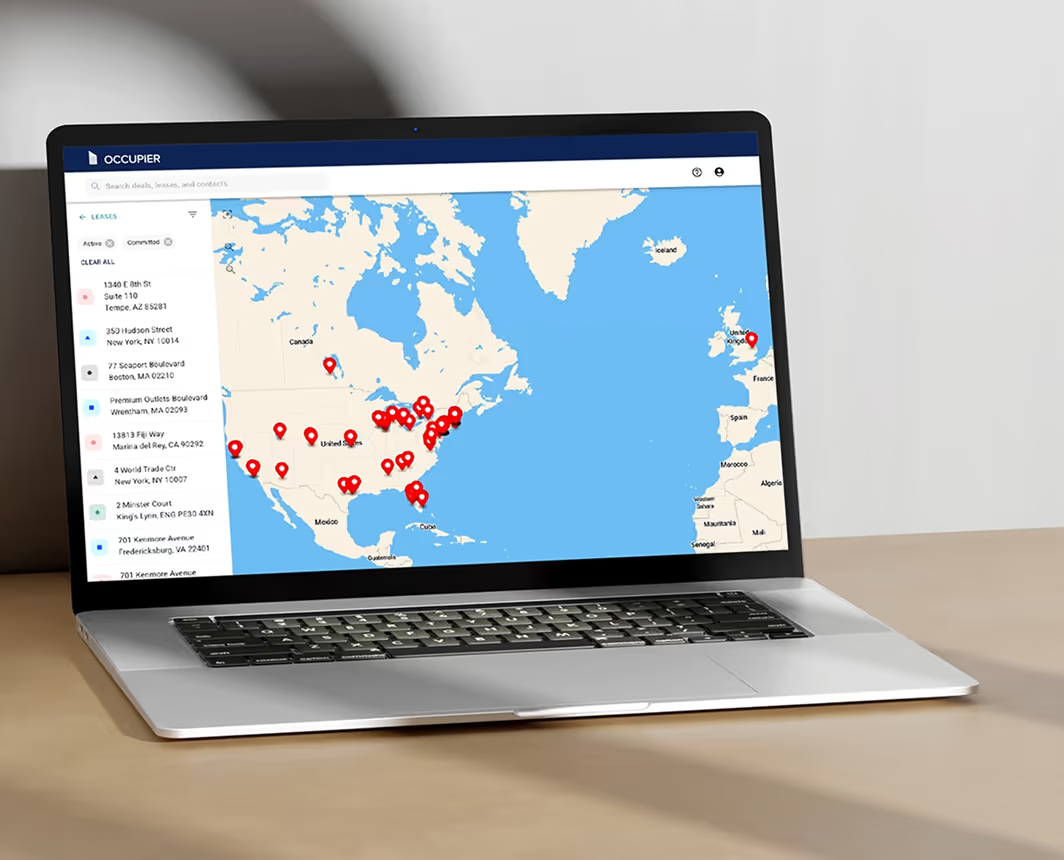
Managing ASC 842 compliance across a full lease portfolio is a cross-functional challenge — real estate teams track lease terms, finance teams handle the journal entries, and the two often work from different sources of truth. Occupier gives both teams a single lease management platform so the data that drives compliance never has to be reconciled manually. Accounting for the changes posed by ASC 842 is easier, more efficient, and more reliable with lease accounting software. We also help manage the international equivalent of ASC 842, call IFRS 16 and instituted by the International Financial Reporting Standards or IFRS group. Both new guidance substantially change the scope of work that the accounting team needs to manage. Reach out to our team to learn more or schedule a demo.
Frequently Asked Questions
How many accounting standards are in ASC?
GAAP provides about 90 accounting principles recognized by the FASB.
What do ASC and US GAAP stand for?
ASC is "accounting standards codification." GAAP is "generally accepted accounting principles." The Financial Accounting Standards Board, or FASB, releases, recognizes, and maintains the GAAP standards for the United States.
Are ASC standards mandatory? Do all companies have to implement ASC 842?
Yes. ASC 842 must be implemented by all companies with leases lasting longer than one year. All leases lasting exactly one year, aka short-term leases are not affected by the new standards.
I've already transitioned to ASC 842? What can I do to update my internal controls and processes?
Post-audit presents the perfect time to add policies and controls to your lease accounting process. After all, your finance team is undergoing major changes in tracking and managing leased assets.
What is the difference between ASC 840 and ASC 842?
Under ASC 840, operating leases were kept off the balance sheet and expensed using a straight-line calculation. ASC 842 changed that by requiring all leases longer than one year to appear as both a right-of-use asset and a lease liability, giving investors a complete view of a company's financial obligations for the first time.
What is a right-of-use asset under ASC 842?
A right-of-use asset represents a lessee's right to use a leased asset over the term of the lease. Under ASC 842, it is recorded on the balance sheet at the present value of future lease payments and is reduced over time as payments are made.
Does ASC 842 apply to short-term leases?
No. Leases with a term of 12 months or less qualify as short-term leases under ASC 842 and are exempt from balance sheet recognition. Organizations can elect a short-term lease exemption by asset class, which simplifies accounting for high-volume, low-value lease portfolios.
What happens when a lease is modified under ASC 842?
A lease modification under ASC 842 requires the lease liability and right-of-use asset to be remeasured and updated. Depending on the nature of the change, it may be treated as a new lease or a continuation of the existing one, each requiring different journal entry treatment.
How do discount rates work under ASC 842?
Discount rates are applied to future lease payments to determine the net present value of the lease liability. Organizations can use their incremental borrowing rate or, for qualifying entities, a risk-free rate. A 2021 FASB update allows companies to choose one discount rate per asset class rather than applying a single rate across all leases.


Lease management that works for real estate and finance
15,000 sq ft
90 days notice
March 2026
Action required