FRS 102 Explained: 2026 Rules & Lease Accounting Guide
What Is FRS 102?
FRS 102, formally titled The Financial Reporting Standard applicable in the UK and Republic of Ireland, is issued by the Financial Reporting Council (FRC).
FRS 102 is the financial reporting standard used by many businesses in the UK and Republic of Ireland to prepare their financial statements. It covers the recognition, measurement, presentation, and disclosure of financial transactions, including commercial leases, revenue, financial instruments, and property-related obligations.
Significant amendments to FRS 102 took effect for accounting periods beginning on or after January 1, 2026. Among the most important changes is a revised approach to lease accounting. Businesses must now recognize most leases on their balance sheets as right-of-use (ROU) assets and corresponding lease liabilities, replacing the previous distinction between operating and finance leases for lessees.
For commercial tenants managing offices, retail stores, restaurants, or equipment leases, these requirements affect financial reporting and the information finance teams need from their real estate departments.
This guide explains the key sections of FRS 102, what changed in 2026, and how organizations can manage the revised requirements.
What Is FRS 102?
FRS 102, formally titled The Financial Reporting Standard applicable in the UK and Republic of Ireland, is issued by the Financial Reporting Council (FRC).
It provides a comprehensive accounting framework for entities preparing financial statements under applicable UK and Irish reporting requirements.
The standard covers topics such as financial statement presentation, revenue recognition, financial instruments, property, plant and equipment, leases, provisions, and income taxes.
Unlike full IFRS Accounting Standards, FRS 102 includes simplifications intended to make financial reporting proportionate for the entities within its scope.
For example, a UK retail business operating several leased locations may use FRS 102 to account for its property commitments, leasehold improvements, and other financial transactions.
The standard determines how these items are recognized and presented, helping businesses produce financial statements that reflect their financial position and performance.
Who Does FRS 102 Apply To?
FRS 102 is used by many private companies and other qualifying entities in the UK and Republic of Ireland.
Its application depends on the organization's legal structure, financial reporting obligations, and eligibility for other accounting frameworks.
Some organizations prepare financial statements under full IFRS Accounting Standards. Eligible micro-entities may instead use FRS 105, which establishes a simplified reporting framework.
Qualifying small entities applying FRS 102 may also be eligible for certain reduced presentation and disclosure requirements under Section 1A.
For commercial tenants, the standard affects more than the accounting department. Real estate managers may need to provide accurate information about lease commencement dates, payment schedules, renewal options, and amendments.
When a business operates multiple locations, these details become important inputs into financial reporting.
What Changed in FRS 102 for 2026?
The FRC completed its Periodic Review 2024 in March 2024, introducing amendments designed to improve financial reporting and align selected requirements more closely with international accounting principles.
Most amendments are effective for accounting periods beginning on or after January 1, 2026.
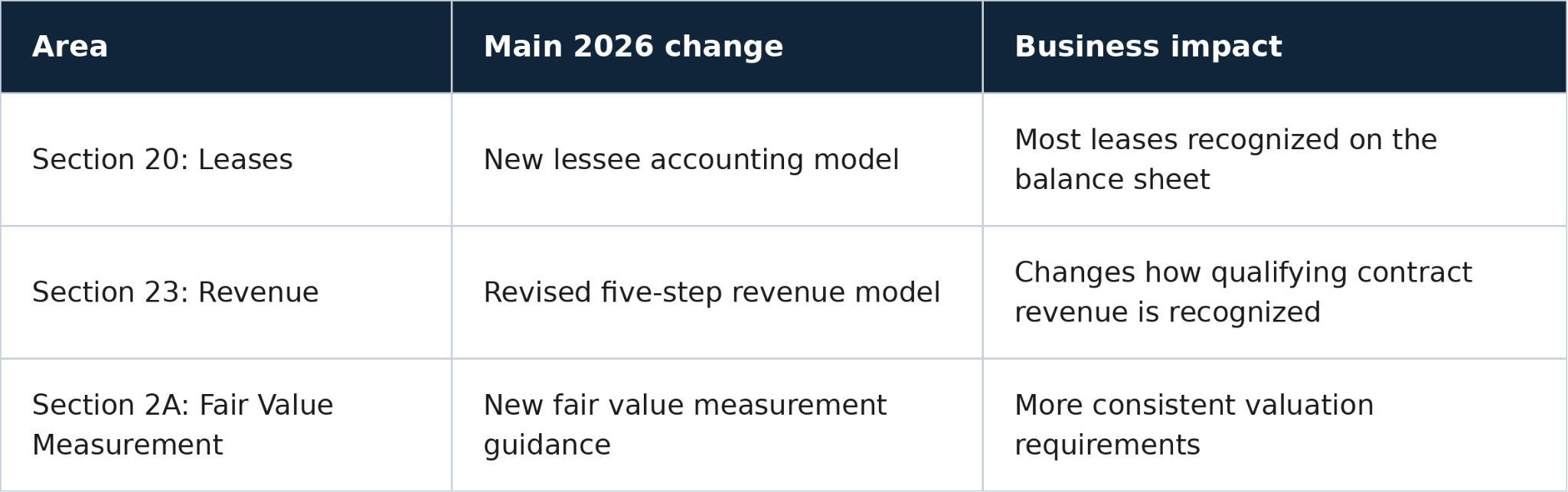
Three of the most significant changes relate to lease accounting, revenue recognition, and fair value measurement.
Revised Lease Accounting Under Section 20
Previously, FRS 102 distinguished between operating and finance leases for lessees.
Finance leases generally resulted in recognized assets and liabilities, while operating leases were typically accounted for through rental expenses and related disclosures.
The revised Section 20 removes that distinction for lessees and introduces a model under which most leases are recognized as ROU assets and lease liabilities.
This brings the standard closer to IFRS 16, although FRS 102 retains some differences and simplified requirements.
For example, a company leasing several retail stores may now recognize substantial lease liabilities that were not previously presented on its balance sheet.
Updated Revenue Recognition Under Section 23
The revised Section 23 introduces a five-step revenue recognition model aligned more closely with IFRS 15.
Organizations must identify contracts with customers, determine their performance obligations, establish transaction prices, allocate those prices where appropriate, and recognize revenue when or as obligations are satisfied.
The financial effect depends on the organization's contracts and business model.
For commercial tenants, this change may be relevant to their operating activities, but it should be evaluated separately from lease accounting.
New Fair Value Measurement Guidance
The introduction of Section 2A provides a more consistent framework for determining fair value.
This guidance affects transactions and balances for which other sections of FRS 102 require or permit fair value measurement.
It does not mean every leased asset or financial liability must automatically be measured at fair value.
Organizations should identify the financial statement items affected by the revised guidance and apply the relevant requirements.
Which FRS 102 Sections Matter Most to Commercial Tenants?
Although FRS 102 addresses many areas of accounting, several sections are particularly relevant to commercial lease portfolios.
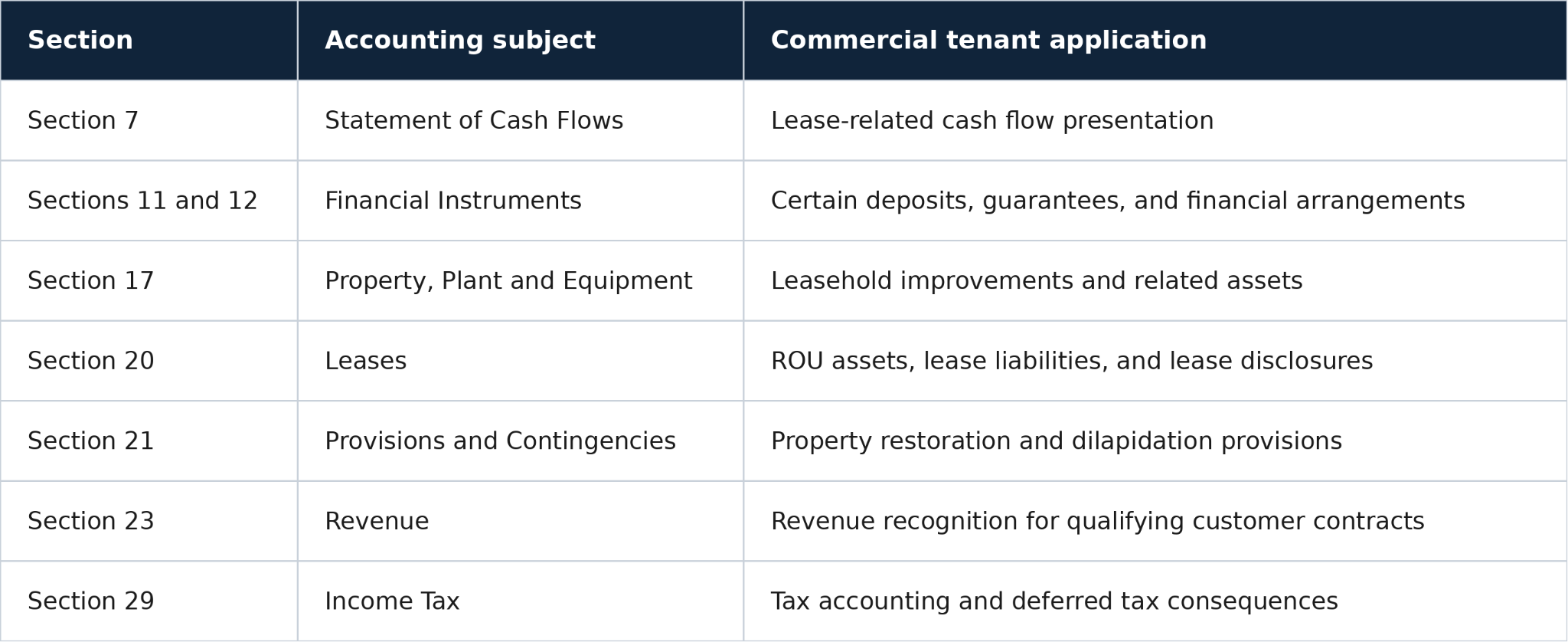
These sections can interact within a single commercial property arrangement.
Consider a company leasing a retail location and installing customized fixtures. The lease may fall under Section 20, while certain leasehold improvements are accounted for under Section 17.
If the company must restore the premises when the agreement ends, Section 21 may also become relevant.
Understanding how the requirements interact helps finance teams avoid treating each aspect of the agreement in isolation.
How the New Section 20 Changes Commercial Lease Accounting
The revised Section 20 has a significant impact on businesses that previously accounted for property leases as operating leases.
Under the new requirements, qualifying leases generally create recognized assets and liabilities even when the tenant has no intention of purchasing the property.
Recognizing the Right to Use Commercial Property
A right-of-use asset represents a business's contractual right to use a leased property or other underlying asset during the lease term.
For example, a restaurant leasing commercial premises for seven years generally recognizes an ROU asset representing its right to occupy the location.
The initial measurement is based on the lease liability and relevant adjustments, including qualifying initial direct costs, prepayments, and incentives.
The ROU asset is then accounted for under the applicable subsequent measurement requirements.
Measuring Future Lease Obligations
The lease liability generally represents the present value of qualifying future lease payments remaining unpaid at commencement.
Its measurement depends on factors such as the lease term, payment schedule, applicable discount rate, and certain contractual options.
The liability changes over time as interest accrues and payments are made.
Lease extensions, payment adjustments, and other specified events may require remeasurement.
Rather than duplicating a full calculation and journal-entry example here, finance teams can refer to Occupier's lease accounting overview for the broader recognition and reporting process.
Evaluating Renewal and Termination Options
Commercial leases often contain renewal options or rights to terminate early.
These provisions can affect the accounting lease term when the relevant recognition and measurement criteria are met.
For example, a retailer with a five-year lease and a further five-year renewal option must assess whether exercising the option is reasonably certain under the applicable requirements.
Financial incentives, relocation costs, significant improvements, and operational dependencies may influence that judgment.
Accurate lease term assessments are particularly important for multi-location businesses because they can materially affect reported liabilities.
What Lease Recognition Exemptions Are Available?
The revised FRS 102 includes exemptions intended to reduce unnecessary accounting complexity for certain lease arrangements.
Two important exemptions relate to short-term leases and low-value underlying assets.
Short-Term Lease Exemption
The revised FRS 102 provides a recognition exemption for qualifying short-term leases.
The FRC describes these as leases with a term of less than 12 months, subject to the applicable requirements.
For example, a business renting temporary commercial space for six months may qualify for the exemption.
However, the accounting lease term must still be determined properly, including consideration of relevant contractual options.
Organizations should document the accounting policy election and ensure that qualifying arrangements are treated consistently.
Low-Value Asset Exemption
FRS 102 also permits an exemption for leases of qualifying low-value underlying assets.
Examples may include smaller office equipment and other assets meeting the relevant conditions.
Importantly, FRS 102's exemption differs from IFRS 16 because the FRC has provided greater flexibility to qualifying preparers, subject to recognition of the most economically significant leases.
A company should therefore not assume that IFRS 16's low-value considerations can be applied unchanged under FRS 102.
The assessment should be based on the relevant requirements, the underlying asset, and the organization's documented accounting policies.
For a closer look at the international standard's approach, see Occupier's IFRS 16 accounting guide.
How Should Businesses Handle the 2026 Transition?
The transition to the revised lease accounting requirements is particularly important for organizations that previously reported significant operating lease commitments outside the balance sheet.
The FRC requires a modified retrospective approach for the revised Section 20.
This means the cumulative effect of applying the new requirements is recognized at the date of initial application, rather than restating comparative information.
For a business with a calendar financial year, the initial application date would generally be January 1, 2026.
Review Existing Lease Commitments
Organizations should begin with the lease agreements in effect at the transition date.
This requires identifying the relevant contracts, payment obligations, remaining terms, and other information needed to calculate opening balances.
A company operating 40 commercial locations may need to review each agreement to determine which leases fall within the revised recognition model.
The process should also capture amendments and side agreements that affect the enforceable lease terms.
Establish Opening Asset and Liability Balances
Businesses must determine the opening lease liabilities and corresponding ROU assets using the relevant transition requirements.
The calculation can involve discount rates, remaining payment obligations, and adjustments associated with the previous accounting treatment.
Existing finance leases and previously unrecognized operating leases may require different transition considerations.
Organizations should also evaluate available practical expedients and document which provisions they have applied.
Document the Transition Adjustments
The cumulative effect of initial application is recorded in the appropriate opening equity balance when required.
Comparative financial information is not restated under the revised Section 20 transition approach.
Finance teams should retain calculations, accounting judgments, reconciliations, and supporting documentation so reviewers can trace how the opening balances were established.
The Financial Reporting Council's FRS 102 guidance provides the authoritative standard and related amendments.
How Do the Changes Affect Financial Statements and Business Decisions?
Recognizing more leases on the balance sheet can affect an organization's reported financial position and performance measures.
The most noticeable impact for some businesses will be an increase in reported assets and liabilities.
However, the consequences extend beyond balance sheet presentation.
For example, lease expenses that were previously recognized as operating rent may now appear as depreciation and interest for arrangements within the revised model.
This can affect EBITDA and the timing of reported expenses.
The changes may also influence gearing ratios and other measures used by lenders or management.
A company with borrowing arrangements should evaluate how its financial covenants define relevant accounting measures.
Not every covenant automatically changes because of an accounting standard update. The outcome depends on the contractual terms and any agreed accounting adjustments.
Finance teams should communicate material reporting effects to relevant stakeholders and ensure that management understands the difference between accounting presentation and actual lease cash payments.
Lease Incentives, Rent-Free Periods, and Property Changes
Commercial property agreements often contain financial arrangements that require additional consideration under FRS 102.
Rent-free periods, landlord contributions, and contractual amendments can influence the recognized lease balances.
Treatment of Rent-Free Periods
Landlords sometimes provide rent-free periods during construction or at the beginning of a lease.
Under the revised accounting model, these periods affect the payment schedule used in measuring the lease liability.
For example, a five-year property agreement with six months of rent-free occupancy will have a different payment profile from an agreement requiring equal payments throughout the term.
The accounting should reflect the qualifying contractual payments rather than automatically applying the previous straight-line operating rent approach.
Landlord Contributions and Fit-Out Incentives
A landlord may contribute toward improvements or provide other incentives as part of lease negotiations.
The accounting treatment depends on the nature of the contribution and the relevant agreement.
Some amounts may represent lease incentives affecting the ROU asset, while certain improvements may require separate accounting.
For this reason, finance teams should review the signed lease and supporting construction agreements rather than treating every landlord contribution identically.
Lease Extensions and Changes in Space
A tenant may negotiate an extension, reduce its occupied area, or add space during an existing lease.
These changes can affect the recognized asset and liability.
The accounting outcome depends on whether the change is a lease modification, a reassessment under an existing contractual provision, or another event addressed by the standard.
Keeping a record of executed amendments and the dates of relevant decisions helps finance teams apply the correct treatment.
What Information Is Needed for FRS 102 Reporting?
The revised accounting requirements make complete lease information more important.
When businesses operate several locations, lease information may be distributed between property managers, legal teams, and finance departments.
A reliable process should make the following information readily available:
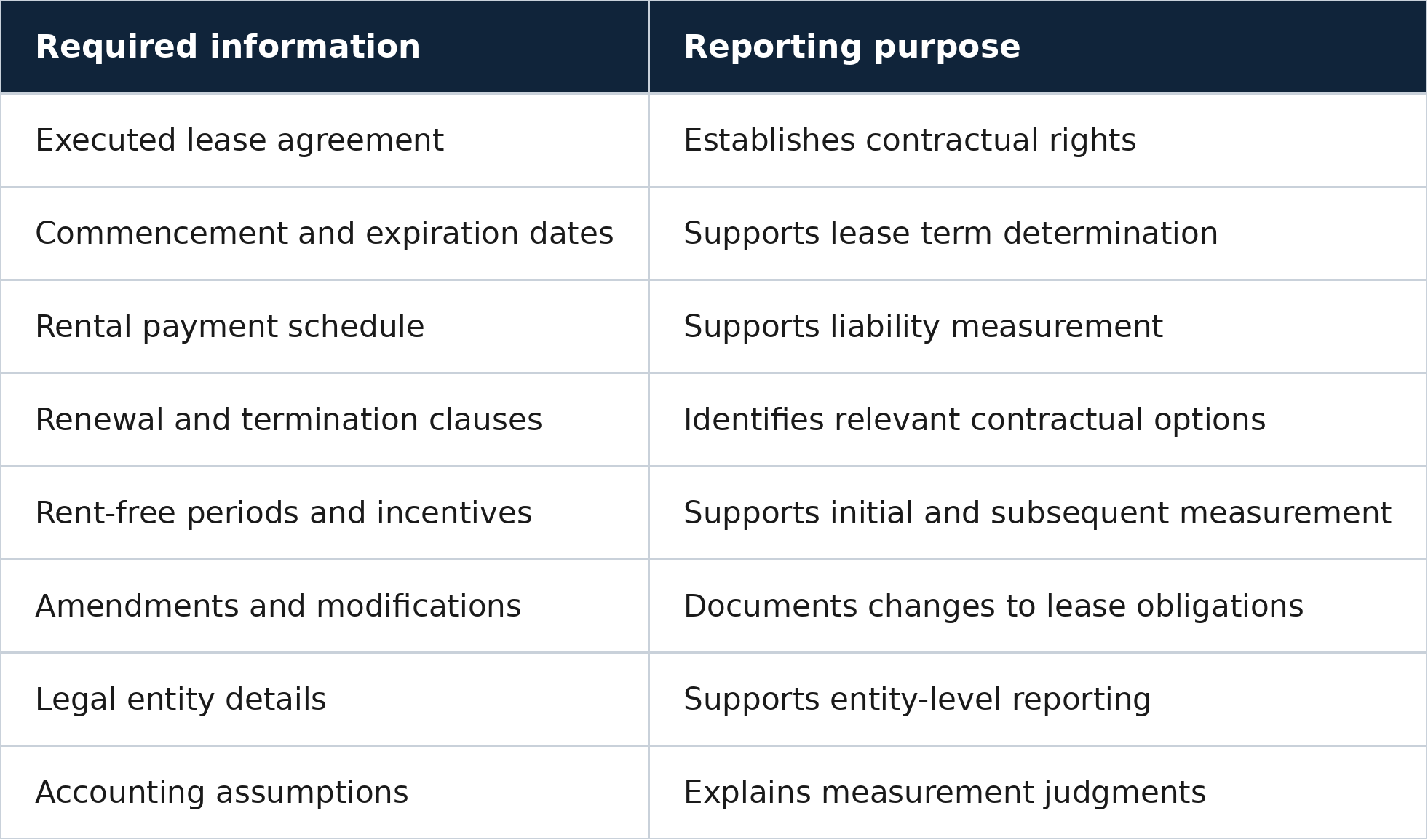
Maintaining this information consistently can reduce the risk of missed amendments and outdated accounting schedules.
Businesses should also establish internal controls for reviewing financial assumptions, approving accounting changes, and reconciling balances.
Occupier's guide to lease accounting controls discusses how finance teams can structure these responsibilities.
Managing FRS 102 Requirements Across Multiple Properties
A commercial tenant with a single straightforward lease may be able to maintain its accounting calculations using a controlled spreadsheet.
For organizations managing dozens or hundreds of agreements, the challenges are different.
Each location may have different commencement dates, renewal options, incentives, payment changes, and reporting requirements.
Finance teams must also rely on real estate departments to communicate when agreements are signed or modified.
A centralized lease information process can help businesses maintain consistent records and identify changes that require accounting review.
Software may assist with lease data collection, payment schedules, liability calculations, reconciliation, and supporting documentation.
Occupier's lease accounting software brings lease information and financial workflows together for commercial real estate and finance teams.
Businesses evaluating a system for FRS 102 should specifically confirm support for the revised 2026 Section 20 requirements, available transition methods, reporting formats, and applicable exemptions before implementation.
Frequently Asked Questions About FRS 102
What is FRS 102 in accounting?
FRS 102 is the financial reporting standard applicable in the UK and Republic of Ireland. It establishes accounting rules for entities preparing financial statements under that framework, covering leases, revenue, assets, liabilities, and other transactions.
What changed under FRS 102 in 2026?
The major changes include a revised Section 20 lease accounting model, updated Section 23 revenue recognition requirements, and new Section 2A fair value measurement guidance. Most amendments apply to accounting periods beginning on or after January 1, 2026.
Does FRS 102 require operating leases on the balance sheet?
Under the revised Section 20, lessees generally recognize most qualifying leases as ROU assets and lease liabilities, including arrangements previously classified as operating leases. Certain recognition exemptions are available.
Is FRS 102 the same as IFRS 16?
No. FRS 102 is a broader UK and Irish financial reporting standard, while IFRS 16 specifically addresses leases under international accounting requirements. Revised Section 20 is more closely aligned with IFRS 16 but includes differences and simplifications.
Does FRS 102 apply to small businesses?
Many small businesses use FRS 102, potentially applying reduced presentation and disclosure requirements under Section 1A. Eligible micro-entities may use FRS 105 instead. The appropriate reporting framework depends on the entity's circumstances.
Do businesses need to restate previous financial statements?
The revised Section 20 requires a modified retrospective approach at initial application, with no restatement of comparative information. Other FRS 102 amendments may have different transition requirements.
For businesses managing multiple properties, coordination between real estate and finance teams is particularly important. When agreements, amendments, and payment information are maintained consistently, organizations are better equipped to meet FRS 102 requirements and understand the financial effects of their lease portfolios.



Lease management that works for real estate and finance

15,000 sq ft
90 days notice
March 2026
Action required