SNDA Agreements: What Commercial Tenants Should Know
Is an SNDA required in every commercial lease?
No. An SNDA is not universally required by law. However, commercial lenders frequently request these agreements, and some leases require tenants to execute an SNDA under specified conditions.
An SNDA agreement, short for Subordination, Non-Disturbance, and Attornment Agreement, establishes how a commercial tenant's lease interacts with the landlord's mortgage. It defines the lender's priority, helps protect the tenant's occupancy following foreclosure, and determines how the lease continues when a successor takes ownership.
For commercial tenants, the most important consideration is whether their right to occupy the property will survive a landlord's mortgage default. A business may have invested heavily in its location, negotiated favorable lease terms, and consistently paid rent. Yet financial problems involving the property owner could still threaten its occupancy.
An SNDA can help protect against that risk, but the agreement's wording matters. Understanding what each provision does and which rights a successor landlord must recognize helps tenants make informed decisions before signing.
What Is an SNDA Agreement in Commercial Real Estate?
An SNDA is a legal agreement that establishes certain rights and obligations between a commercial tenant and the landlord's mortgage lender. The landlord may also be a party.
It primarily addresses what happens when the landlord defaults on its mortgage and the lender forecloses on the property.
Commercial tenants ordinarily negotiate their leases directly with property owners. However, many commercial buildings are financed through mortgages or deeds of trust that give lenders enforceable rights against the property.
Those rights may affect existing leases during foreclosure.
An SNDA clarifies the relationship between the tenant's leasehold interest and the lender's mortgage before a dispute occurs.
The document does not replace the original commercial lease agreement. Instead, it establishes how certain contractual rights operate if the lender or another covered successor takes ownership.
What Does SNDA Stand For?
SNDA represents three provisions: subordination, non-disturbance, and attornment. Each addresses a different part of the relationship between tenants and lenders.
Subordination
Subordination establishes that the tenant's leasehold interest has a lower priority than the lender's mortgage or deed of trust.
Priority matters because it can influence whether an existing lease survives foreclosure.
For example, a lender financing an office building may require tenants to subordinate their leases so its mortgage receives the agreed priority.
Subordination alone does not automatically require tenants to leave. However, a subordinate lease may face termination during foreclosure depending on applicable law and contractual protections.
Non-Disturbance
Non-disturbance is generally the most valuable SNDA provision for commercial tenants.
It means the lender agrees not to terminate the tenant's right to occupy the premises solely because of a covered foreclosure, provided the tenant meets the agreement's conditions.
Consider a retailer with six years remaining on its lease. The landlord defaults on its mortgage, and the lender forecloses.
With enforceable non-disturbance protection, the retailer can generally continue occupying the space under the recognized lease terms.
However, protection commonly depends on the tenant not being in default beyond applicable notice and cure periods.
Attornment
Attornment requires the tenant to recognize the lender or another qualifying successor owner as its new landlord after foreclosure.
The tenant continues fulfilling its lease obligations, including making rent payments to the appropriate party.
For example, if a lender acquires a shopping center through foreclosure, tenants covered by their SNDAs generally recognize the lender or subsequent purchaser as their landlord.
Together, these three provisions balance the lender's interest in protecting its mortgage with the tenant's need for continued occupancy.
Why Are SNDA Agreements Important for Commercial Tenants?
An SNDA helps protect a tenant's investment in a commercial location when the property's financing situation changes.
Businesses often make commitments extending beyond monthly rental payments. Restaurants install kitchens and equipment. Retailers invest in fixtures and storefront improvements. Healthcare providers may require specialized infrastructure that would be expensive to recreate elsewhere.
If the landlord defaults on its mortgage, these investments can become vulnerable even when the tenant has fulfilled its obligations.
An SNDA addresses that risk by establishing conditions under which the tenancy can continue.
For a business that has spent $500,000 improving its premises, the loss of a location could create significant financial and operational disruption.
This is particularly important when evaluating leasehold improvements, which may represent substantial investments tied to a specific property.
However, preserving occupancy does not necessarily mean every financial benefit negotiated in the original lease will survive foreclosure.
That distinction becomes important when reviewing the agreement's additional provisions.
What Happens to a Commercial Lease During Foreclosure?
When a property owner defaults on its mortgage, the lender may pursue foreclosure under the financing documents and applicable law.
Whether existing leases survive depends on factors including mortgage priority, lease provisions, foreclosure procedures, and state law.
A lease with priority over the mortgage may receive different treatment from one that is subordinate.
An SNDA can provide contractual protection when the tenant's continued occupancy would otherwise be uncertain.
Consider a company leasing 15,000 square feet of office space under a ten-year agreement.
Four years into the lease, the landlord defaults on its mortgage. The tenant has continued paying rent and complying with its lease, but the lender begins foreclosure proceedings.
If an enforceable SNDA provides appropriate non-disturbance protection, the tenant may continue occupying the premises after foreclosure.
However, a successor landlord may not assume every obligation owed by the previous property owner.
For example, the original landlord might owe an unpaid improvement allowance or reimbursement. The successor could argue that the SNDA excludes responsibility for that obligation.
The tenant may retain possession while facing uncertainty about recovering the outstanding amount.
This is why an SNDA should be evaluated based on both occupancy protection and the treatment of existing contractual rights.
Which SNDA Provisions Should Commercial Tenants Review?
Although the three main components explain the purpose of an SNDA, additional clauses determine how it operates in practice.
Some provisions are designed to limit the lender's exposure to liabilities created by the previous landlord.
Successor Landlord Liability
Many SNDAs limit a successor landlord's responsibility for actions or omissions of the former property owner.
For example, the original landlord may have failed to complete required repairs or reimburse the tenant for approved improvements.
A successor might argue that those obligations arose before ownership changed and are excluded under the agreement.
Tenants should determine which commitments remain enforceable, especially when substantial amounts are outstanding.
Security Deposits and Prepaid Rent
Some SNDAs state that a successor landlord is not responsible for security deposits unless the funds were actually transferred to it.
This can create problems when tenants have provided significant deposits or prepaid rent.
For example, a company may have paid a $40,000 security deposit. If the original landlord fails to transfer it after foreclosure, the tenant could face difficulties recovering the amount.
Tenant Improvement Allowances
An SNDA may also limit the successor owner's responsibility for unpaid improvement allowances.
Suppose a retailer negotiated a $250,000 improvement allowance, with $75,000 remaining unpaid when foreclosure occurs.
If the SNDA excludes prior landlord obligations, the retailer may remain in the premises without being able to recover that reimbursement from the successor.
This deserves particular attention when a lease is signed before construction is complete.
Rent Offsets and Existing Claims
Commercial leases sometimes allow tenants to offset certain amounts against rent when landlords fail to fulfill contractual obligations.
An SNDA may restrict these rights after foreclosure, particularly when they relate to a previous landlord's default.
Tenants should understand whether negotiated remedies remain available and whether additional notice requirements apply.
When Should Tenants Negotiate an SNDA Agreement?
The best time to address SNDA requirements is generally during the original lease negotiation.
Before execution, tenants may have greater leverage because the landlord is seeking to secure their commitment.
The lease can establish whether the landlord must obtain non-disturbance protection from an existing lender and what minimum protections are acceptable.
Once the lease has been signed, negotiations can become more difficult.
For example, a tenant may already have committed to the location, paid deposits, or started planning construction. Refusing a lender's proposed agreement may no longer be practical.
Occupier's guide to commercial lease negotiations explains why identifying important contractual requirements before execution helps businesses protect their interests.
Negotiating leverage varies based on tenant creditworthiness, lease size, property type, and lender requirements.
The practical objective is to address SNDA terms before the tenant has made substantial commitments that limit its flexibility.
Can an SNDA Affect Lease Amendments and Renewal Rights?
Yes. Some SNDAs require lender approval before certain lease amendments become binding on a successor landlord.
These provisions are intended to prevent changes that could materially affect rental income, property value, or the lender's security.
However, they can create complications for tenants.
For example, a restaurant operator may negotiate a five-year lease extension directly with the landlord. If the SNDA requires lender consent and that approval is not obtained, the tenant may face uncertainty about whether the extension binds a foreclosure purchaser.
Similar issues can arise with rent reductions, expansion rights, and early termination agreements.
Tenants should review these restrictions alongside the procedures for commercial lease amendments to ensure changes receive any required approvals.
Renewal rights also deserve particular attention.
If the lease requires written renewal notice and the SNDA establishes additional requirements involving the lender, tenants need to understand which procedures apply.
Missing a contractual deadline or approval requirement can create problems even when the landlord agrees to the change.
SNDA Agreement vs. Tenant Estoppel Certificate
An SNDA and a tenant estoppel certificate are different documents frequently requested during commercial property financing transactions.
An SNDA addresses the relationship between the tenant's lease and the lender's rights. An estoppel certificate confirms existing facts about the lease.
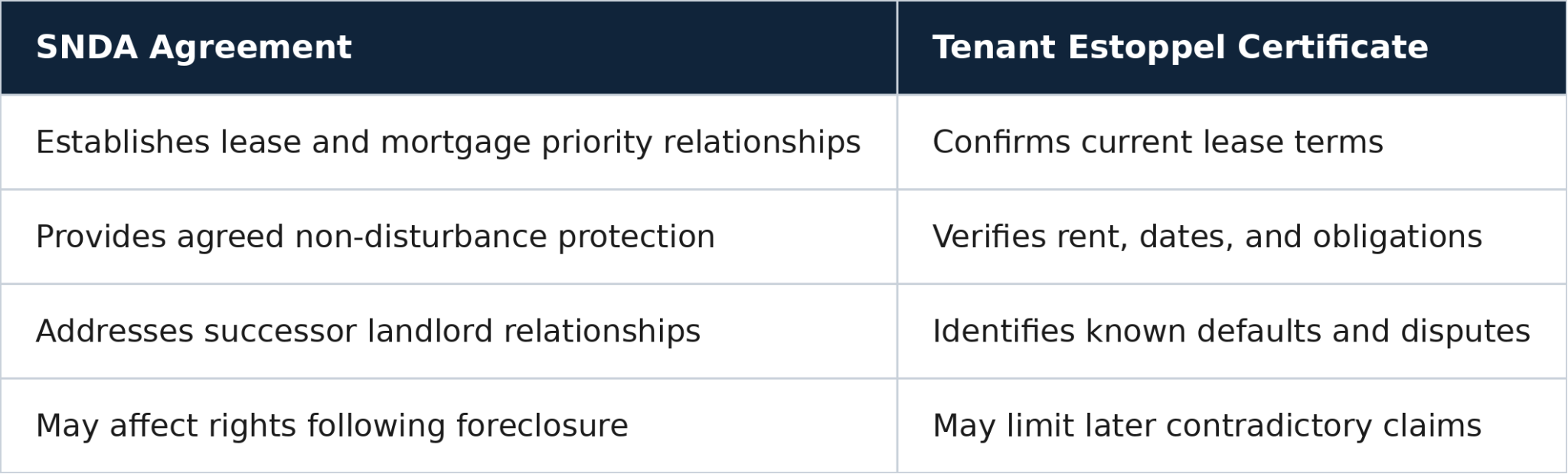
Some SNDAs also include representations resembling an estoppel certificate.
A tenant might be asked to confirm that rent is current, no landlord defaults exist, or the lease has not been modified.
These statements should be checked against the actual records before signing.
An SNDA should not become an opportunity to unintentionally waive claims or confirm inaccurate information.
SNDA Agreement Example: A Retail Tenant Facing Foreclosure
Consider a retailer operating a 5,000-square-foot store in a shopping center.
The company signs a ten-year lease, pays a $30,000 security deposit, and invests $300,000 in improvements.
Five years later, the landlord defaults on its mortgage, and the lender begins foreclosure proceedings.
The retailer has an executed SNDA containing non-disturbance protection.
Under the agreement, the lender agrees not to disturb the tenant's possession solely because of foreclosure, provided the tenant satisfies the applicable conditions.
After foreclosure, the retailer recognizes the successor owner as its landlord and continues paying rent.
However, the agreement also limits the successor's responsibility for security deposits that were not transferred.
If the original landlord fails to transfer the $30,000 deposit, the tenant may face a dispute over its recovery.
This example illustrates the difference between protecting the right to remain in a location and preserving every financial obligation under the original lease.
The appropriate protections depend on the tenant's investment, lease terms, and negotiating priorities.
Does an SNDA Protect Every Lease Right After Foreclosure?
No. Non-disturbance does not automatically preserve every right contained in the original lease.
A lender may agree to recognize the tenancy while limiting responsibility for obligations associated with the previous landlord.
These limitations may affect security deposits, prepaid rent, improvement allowances, or existing claims.
Tenants should also review how the agreement treats renewal options, expansion rights, casualty provisions, and termination rights.
For example, a retailer may have negotiated an option to expand into an adjacent unit when it becomes available.
Whether that right remains enforceable against a successor landlord can depend on the SNDA's terms and applicable law.
The important question is not simply whether non-disturbance protection exists.
It is whether the protection covers the contractual rights that matter most to the tenant's business.
Managing SNDA Agreements Across Multiple Locations
An SNDA may receive attention when a lease is signed but become relevant only years later.
By then, the employees who negotiated the agreement may have left the company. The landlord may have changed, and several amendments may have altered the original terms.
For businesses managing multiple locations, locating the correct agreement and identifying its obligations can become challenging.
Some SNDAs require notices to be delivered to lenders before tenants exercise remedies against landlords.
Other provisions establish approval requirements or additional cure periods.
These obligations should remain accessible throughout the lease term.
Accurate critical date management can help teams monitor relevant notice periods and deadlines established in leases and related agreements.
Keeping SNDAs with the corresponding lease documents also makes it easier to identify which protections apply when ownership or financing circumstances change.
Keeping Real Estate and Finance Teams Aligned on SNDA Obligations
SNDA agreements sit at the intersection of real estate operations, legal obligations, and financial exposure.
Real estate teams manage lease negotiations and occupancy rights. Legal teams review lender requirements and successor liability provisions. Finance teams may need to monitor deposits, improvement allowances, and other financial commitments.
When these records are spread across different systems, identifying the current contractual terms becomes unnecessarily complicated.
Occupier's lease administration software helps commercial tenants organize lease documents, important dates, contractual provisions, and related obligations in one platform.
Keeping SNDA agreements alongside their corresponding leases allows teams to locate relevant information when ownership changes or lenders request documentation.
The objective is not to eliminate legal review. It is to ensure real estate and finance teams have consistent records and understand the obligations affecting their properties.
SNDA Agreement FAQs
Is an SNDA required in every commercial lease?
No. An SNDA is not universally required by law. However, commercial lenders frequently request these agreements, and some leases require tenants to execute an SNDA under specified conditions.
Can a tenant refuse to sign an SNDA?
The tenant's obligation depends on the lease. If the agreement requires execution, refusal may have contractual consequences. Tenants should review the requested terms and obtain legal advice before signing or refusing.
Does an SNDA guarantee that a tenant can stay after foreclosure?
Not unconditionally. A properly structured non-disturbance provision can protect occupancy during a covered foreclosure, but the tenant must satisfy the agreement's applicable conditions.
What happens if a tenant does not have an SNDA?
The outcome depends on mortgage priority, lease provisions, applicable law, and the foreclosure process. Some subordinate leases may be terminated, while others may survive.
Can SNDA terms be negotiated?
Yes. Tenants may negotiate non-disturbance protections, successor landlord obligations, security deposit treatment, and notice requirements. The available flexibility depends on the transaction.
Does an SNDA protect a tenant if the landlord files for bankruptcy?
An SNDA primarily addresses mortgage priority and foreclosure. Landlord bankruptcy involves separate legal rules, including provisions of the US Bankruptcy Code, so an SNDA should not be assumed to provide complete bankruptcy protection.
Who typically prepares an SNDA?
The landlord's lender or its legal representatives commonly prepare the initial agreement. The tenant and its counsel then review the terms and may request revisions.
Is an SNDA the same as a subordination agreement?
No. Subordination is only one component of an SNDA. A subordination agreement establishes priority but may not include the non-disturbance protection that helps preserve occupancy after foreclosure.



Lease management that works for real estate and finance

15,000 sq ft
90 days notice
March 2026
Action required