What Is a Right-of-Use (ROU) Asset? Calculation, Amortization, and Journal Entries
A right-of-use (ROU) asset represents a lessee’s right to use a leased asset, like an office, warehouse, or fleet vehicle, for the lease term. Under ASC 842 and IFRS 16, nearly every lessee has to record one on the balance sheet, calculated as the initial lease liability plus initial direct costs and prepayments, minus any lease incentives received. It’s an intangible asset even when the underlying thing you’re leasing, like a building, obviously isn’t.
If you’re on a real estate team, the ROU asset is the accounting reflection of every lease you negotiate, so a missed renewal option or an unreported amendment throws the number off. If you’re on a finance team, it’s a recurring amortization calculation that has to tie to the lease liability exactly, for every lease, every close. Here’s how it works, including where ASC 842 and IFRS 16 genuinely diverge, with a full worked example.
What Is an ROU Asset?
An ROU asset, short for right-of-use asset, is the balance sheet representation of a lessee’s right to control a leased asset for the lease term. It was introduced by ASC 842 and IFRS 16 to replace the old approach, where operating leases stayed off the balance sheet entirely. Instead of recording the truck, the office, or the equipment itself, the lessee records the right to use it, which is why the ROU asset is classified as an intangible asset even when the underlying leased item is a physical, tangible one.
Every lease with a term over 12 months creates an ROU asset for the lessee, whether the lease is classified as operating or finance under ASC 842, or treated under IFRS 16’s single lease model.
Is an ROU Asset Tangible or Intangible? Fixed or Current?
This trips up more people than any other ROU question, so it’s worth answering directly: an ROU asset is an intangible asset, regardless of what’s being leased. Leasing a building doesn’t make the ROU asset real property. You’re not recording the building; you’re recording your contractual right to use it, and that right is intangible by definition.
It’s also a noncurrent asset for financial statement presentation purposes, though it gets reduced over time as it amortizes, similar to how a fixed asset gets depreciated. Companies typically present the current portion of the related lease liability separately from the noncurrent portion, but the ROU asset itself isn’t split into current and noncurrent pieces the way the liability is.
ROU Asset vs. Lease Liability: What’s the Difference?
The lease liability is the present value of the future payments you’re obligated to make. The ROU asset is what you get in exchange: the right to use the underlying asset. They start out closely related, but they’re not always identical, and understanding why is the key to getting the calculation right.
For a simple lease with no initial direct costs, prepayments, or incentives, the ROU asset and the lease liability are equal at commencement. The moment any of those three items enter the picture, they diverge, which is the most common source of “why don’t my numbers match” questions in ASC 842 compliance.
What’s Included in an ROU Asset?
The ROU asset is built from four components under ASC 842:
The formula:
ROU Asset = Initial Lease Liability + Initial Direct Costs + Prepayments − Lease Incentives
IFRS 16 uses the same starting formula but adds one more component, covered in the ASC 842 vs. IFRS 16 section below.
How to Calculate an ROU Asset
- Determine the lease term and payments, including any renewal options the lessee is reasonably certain to exercise.
- Select a discount rate: the rate implicit in the lease if readily determinable, otherwise your incremental borrowing rate (or a risk-free rate, for private companies electing that practical expedient).
- Calculate the present value of the lease payments using that discount rate. This becomes your initial lease liability. Use our present value of lease payments walkthrough if you’re doing this in Excel.
- Add initial direct costs and any prepaid rent.
- Subtract any lease incentives received from the lessor.
- The result is your initial ROU asset.
ROU Asset Calculation Example
Scenario:(Financial Lease) A company signs a 4-year equipment lease with $60,000 due annually, paid at the start of each year. The incremental borrowing rate is 6%. Initial direct costs total $3,000, and there are no prepayments or incentives.
Step 1: Calculate the lease liability. Discounting four annual payments of $60,000, paid in advance, at 6%, gives a present value of $220,381.
Step 2: Calculate the ROU asset.
ROU Asset = $220,381 (lease liability) + $3,000 (initial direct costs) + $0 (prepayments) − $0 (incentives) = $223,381
Step 3: Amortization schedule (lease liability).
Step 4: Journal entries.
At commencement:
- Debit ROU Asset: $223,381
- Credit Lease Liability: $220,381
- Credit Broker Commissions (initial direct costs): $3,000
First payment (made at commencement, since payments are due at the start of each year):
- Debit Lease Liability: $60,000
- Credit Cash: $60,000
During Year 1 (interest accrual on the outstanding balance):
- Debit Interest Expense: $9,623
- Credit Lease Liability: $9,623
Because payments are made in advance, each payment reduces the liability in full when it’s paid, and interest then accrues on the remaining balance through the year. That’s exactly what the amortization schedule above shows: $220,381 minus the $60,000 payment leaves $160,381, which accrues $9,623 of interest to end the year at $170,004.
Year 1 ROU amortization (finance lease, straight-line over 4 years):
- Debit Amortization Expense: $55,845
- Credit Accumulated Amortization – ROU Asset: $55,845
For the full set of entries, including operating-lease treatment and subsequent months, see our ROU asset journal entries guide.
How Is an ROU Asset Amortized?
Amortization runs from lease commencement to the earlier of the end of the lease term or the end of the underlying asset’s useful life. If the lessee is reasonably certain to exercise a purchase option, the amortization period extends to the end of the asset’s useful life instead of stopping at the lease term.
Finance leases are the simple case: amortize the ROU asset on a straight-line basis (unless another systematic method better reflects the asset’s usage pattern), and record that amortization separately from interest expense on the income statement, as shown in the example above.
Operating leases are where it gets less intuitive, because the ROU asset isn’t amortized independently. ASC 842 allows two approaches:
- Direct method: recalculate the ROU asset each period as the lease liability’s carrying amount, plus unamortized initial direct costs, plus or minus any prepaid or accrued lease payments, minus the unamortized balance of lease incentives. This is manageable for a small, simple lease portfolio, but gets complicated fast once modifications, remeasurements, impairments, or foreign currency translation enter the picture.
- Roll-forward method: start with the beginning ROU asset balance and subtract accumulated amortization, where that amortization figure is the difference between the period’s straight-line lease cost and the lease liability’s accretion for the period under the effective interest method. This is the more common approach for larger portfolios, since it doesn’t require rebuilding the full calculation from scratch every period.
Either method should land on the same answer for a given lease; the second is just more practical to maintain at scale.
If you build schedules manually, start from our lease amortization schedule Excel template, or browse the templates and calculators library.
ROU Asset: Finance Lease vs. Operating Lease
That middle row on operating leases is where most spreadsheet-based calculations break down. It isn’t a clean straight-line number the way a finance lease is; it’s a residual that keeps the balance sheet consistent with a single, level lease expense, and it has to be recalculated every period as the liability itself changes.
Where Does the ROU Asset Go on the Balance Sheet and Cash Flow Statement?
Balance sheet: the ROU asset is presented as a noncurrent asset, either as its own line item or grouped with other noncurrent assets, but finance lease ROU assets and operating lease ROU assets can’t be combined on the face of the balance sheet without separate disclosure.
Cash flow statement: placement depends on lease classification, not on the ROU asset itself. For operating leases, the full lease payment is classified within operating activities. For finance leases, the principal portion of each payment goes to financing activities, while the interest portion stays in operating activities, the same split used for any other debt instrument.
How Is an ROU Asset Impaired?
ROU assets get tested for impairment under the same long-lived asset impairment guidance in ASC 360 that applies to other noncurrent assets. Common triggers include:
- A significant change in how the leased space or asset is being used, or a decision to stop using it
- A downward revision to the assumptions driving the lease term (for example, no longer being reasonably certain about a renewal you’d previously counted on)
- A significant decline in the market value of the underlying asset or the business it supports
If an ROU asset is impaired, the carrying value is written down to fair value in a one-time charge, and all subsequent measurement starts from that new, reduced carrying amount minus ongoing amortization. This is a step that gets missed most often when a lease amendment, closure, or sublease decision happens on the real estate side and doesn’t make it to finance in time to trigger the review. For the full testing process, a worked example, and the write-down entries, see our lease impairment guide.
What Happens to the ROU Asset When a Lease Is Terminated?
At termination, both the ROU asset and its associated lease liability come off the balance sheet entirely. Any difference between the two carrying amounts at that point is recognized as a gain or loss. For a partial termination, only the corresponding portion of the asset and liability is derecognized, with the same gain-or-loss treatment applied to that portion.
ROU Assets Under ASC 842 vs. IFRS 16
The ROU asset concept exists under both standards, and the starting formula looks the same, but there’s a real calculation difference, not just a presentation one, that matters if your company reports under both frameworks.
That restoration-cost line is the one worth flagging loudest: if your lease requires you to return a space or asset to its original condition, IFRS 16 requires that estimated cost to be built into the ROU asset from day one. ASC 842 doesn’t include it in the base calculation the same way, which means a company running both standards in parallel can end up with two genuinely different ROU asset balances for the exact same lease, not just two different presentations of the same number.
For the full breakdown of how the two standards diverge more broadly, see our ASC 842 vs. IFRS 16 comparison.
Why ROU Asset Calculations Go Wrong in Practice
Everything above is mechanical. Feed it the right lease term, discount rate, and cost inputs, and the math resolves cleanly. The place ROU asset calculations actually go wrong is the two-team compliance gap: the real estate team negotiating an amendment, renewal, or early termination without a same-day handoff to finance, and finance recalculating a liability and ROU asset off terms that are already out of date by the time they hear about them.
A missed renewal option changes the “reasonably certain” assumption behind the whole calculation. An amendment that reaches finance a month late means an entire quarter’s amortization schedule gets built on stale numbers, then has to be corrected. None of that is a judgment call about the accounting. It’s a data-handoff problem.
How Occupier Keeps ROU Asset Calculations Accurate
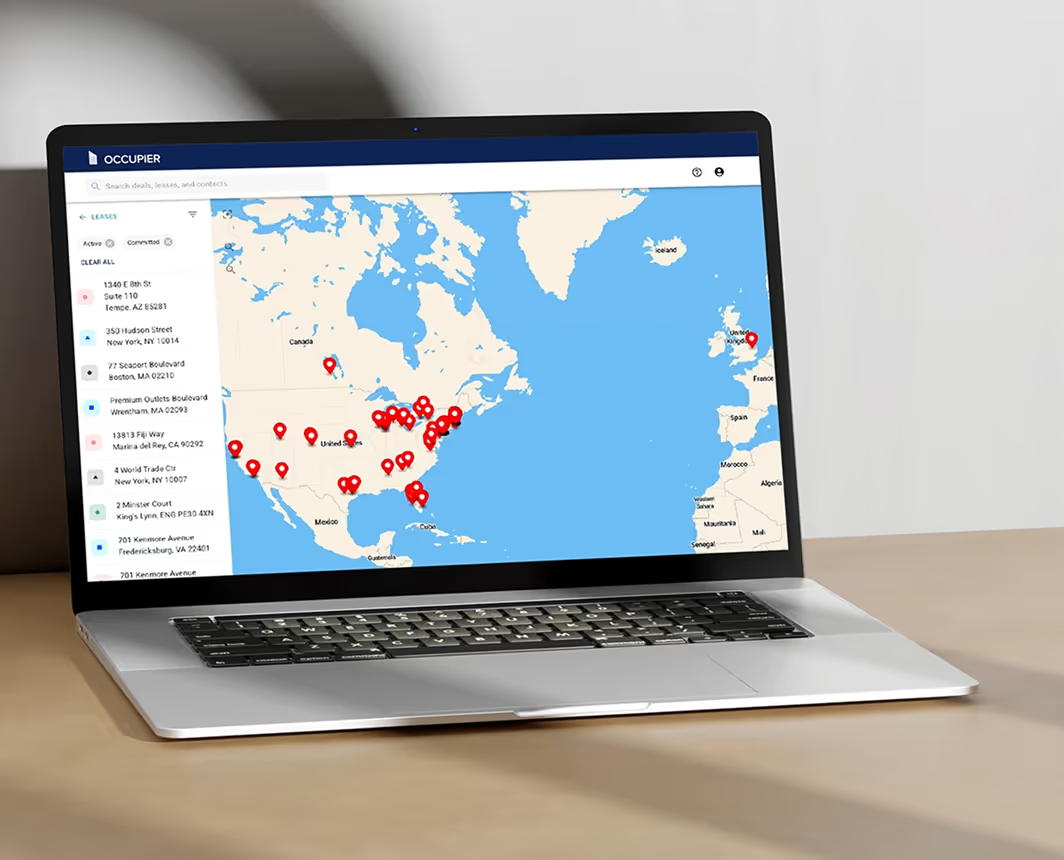
Occupier closes that gap by giving real estate and finance teams one shared source of lease data instead of two versions of the same lease. When a lease is signed, renewed, or modified, the terms feeding your ROU asset and lease liability calculations update from the same record your real estate team is actively working from, not a static file finance is waiting on.
Our team supports the lease abstraction process, pulling key terms directly out of lease documents so the inputs to your initial ROU asset calculation are accurate from day one. Automated amortization schedules and journal entries stay current as leases change, so an amendment, termination, or impairment trigger doesn’t sit unrecorded until close.
One platform. Two teams. Zero compromise.
See how Occupier handles ROU asset and lease liability calculations →
ROU Asset FAQs
What does ROU stand for? ROU stands for right-of-use. A right-of-use asset represents a lessee’s contractual right to use a leased asset for the lease term.
Is an ROU asset a fixed asset? No. An ROU asset is an intangible asset, even when the underlying leased item, like real estate or equipment, is a tangible fixed asset. You’re recording the right to use the asset, not the asset itself.
Should the ROU asset equal the lease liability? Only at commencement, and only if there are no initial direct costs, prepayments, or lease incentives. Any of those three items will make the ROU asset differ from the lease liability from day one, and under IFRS 16, estimated restoration costs will too.
Do you depreciate or amortize an ROU asset? Amortize. For finance leases, the ROU asset is amortized on a straight-line basis, separate from interest expense. For operating leases under ASC 842, there’s no independent amortization schedule; the balance is recalculated each period as part of the single lease cost. Under IFRS 16, every ROU asset amortizes on a straight-line basis, since there’s no operating-lease category to create an exception.
How do you calculate an ROU asset under ASC 842? Start with the present value of future lease payments (the initial lease liability), add initial direct costs and any prepaid lease payments, then subtract any lease incentives received from the lessor.
Is the ROU asset calculation the same under ASC 842 and IFRS 16? The starting formula is similar, but IFRS 16 adds estimated restoration, removal, or dismantling costs to the ROU asset; ASC 842 doesn’t include those in the base calculation. That’s a real difference in the resulting balance, not just how it’s presented.
What happens to the ROU asset when a lease is terminated? Both the ROU asset and its associated lease liability are removed from the balance sheet at termination. Any difference between the two carrying amounts is recognized as a gain or loss.
Where does the ROU asset appear on the cash flow statement? The ROU asset itself doesn’t appear directly; the related cash payments do. For operating leases, payments are classified as operating activities. For finance leases, principal payments go to financing activities and interest payments stay in operating activities.
What triggers an ROU asset impairment? Common triggers include a change in how the asset is used, a downward revision to lease term assumptions, or a decline in the value of the business or asset the lease supports. ROU assets follow the same impairment guidance as other long-lived assets under ASC 360.
Do short-term leases require an ROU asset? No. Leases with a term of 12 months or less can be exempted from ROU asset and lease liability recognition under the short-term lease practical expedient, elected by asset class.



Lease management that works for real estate and finance
15,000 sq ft
90 days notice
March 2026
Action required